
Both Teams to Score Betting in Great Britain: Markets, Margins and Licensed Bookmakers
 Available in US
Data current as of 27 October 2026 and checked against the Gambling Commission’s public register. Prices, where named, are illustrative and stated with the date research gave them.
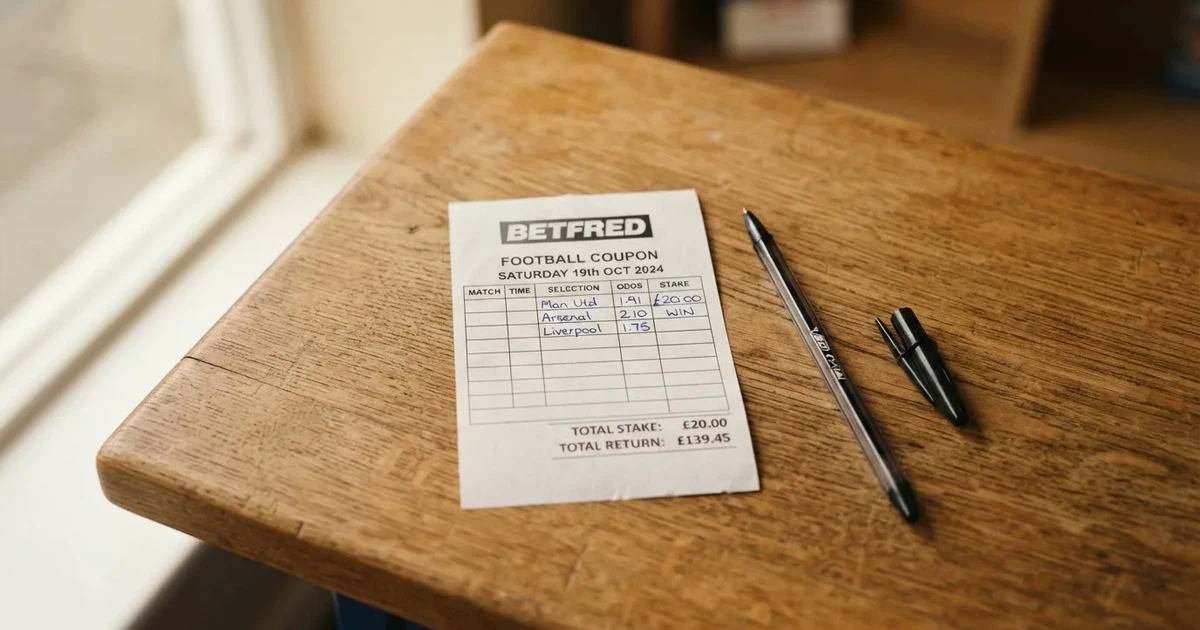
Both teams to score — BTTS in a betting shop, on a betting app and on the betting slips printed at Sky Bet — is a market built on a single question: will each side find the net before the referee blows for full time? It looks simpler than the 1X2 at the top of the coupon, which is precisely why it is worth a longer look. The mechanics of the bet, the rule that decides what counts as a goal and the margin baked into the price together decide whether a tip is worth following, and none of them are obvious from the price alone.
This page is for the British punter weighing where to place a BTTS wager, and for anyone who has heard the phrase and wants the rules behind it. The first section lays out the market itself: what both teams to score is, what it is not, and how a bookmaker settles it when a match runs long or short. The middle sections cover the licence check, the responsible-gambling tools a British bettor can rely on, and how a winning bet is actually paid back. The later sections work through the calculation every price carries, run through ten UK-licensed bookmakers that offer the market, and close with five questions the page answers in full.
The Market: What Both Teams to Score Actually Means
A BTTS wager has two outcomes, yes or no, and the bookmaker prices both. Yes wins if each side scores at least once during normal time. No wins if one side fails to score — whether the match ends 0-0, 1-0, 0-1, 3-0 or any other scoreline where one team is held off the scoresheet. The bet is settled on 90 minutes of play plus time added by the referee for stoppages. Extra time and penalty shootouts do not count, because extra time and penalty shootouts are not part of the 90 minutes the rule starts from.

The market looks like a coin flip, but the prices rarely meet at evens. A fixture between two free-scoring attacks prices Yes shorter than No, because the bookmaker expects goals at both ends; a meeting of the league’s tightest defence against the lowest-scoring forward line pushes No towards the favourite. A price of 4/5 on Yes and 11/10 on No is ordinary; 1/2 and 6/4 is not unusual for a one-sided tie; 6/5 and 8/13 is what a cagey, low-scoring contest tends to look like.
A BTTS wager has two pieces, and the second one matters more than it looks. The first is the question — both teams score or not. The second is the settlement window, and the rule book is explicit on it. Sky Bet’s published football rules state that football bets are settled on 90 minutes of play unless a market says otherwise, and that 90 minutes includes time added by the referee for stoppages. The phrasing is plain, and it is what other licensed bookmakers apply under their own rules of the same shape.
That settlement window is why a 1-1 match decided in the 89th minute settles Yes — the goal falls inside stoppage time. It is also why a cup tie decided in extra time settles as a draw for BTTS purposes if the score was level at 90 minutes plus stoppage time: the extra-time goal is real, but the rule reads 90 minutes plus stoppage time, and the rule is the rule. A punter who backs Yes and watches the winning goal fly in at the 119th minute has lost the bet, and the only legal result is the one the rule book describes.
Two related variants show up on the same coupon. Score in both halves asks whether a single team scores in each of the two halves of normal time, and a fixture that finishes 2-0 with both goals in the first half loses on that market. To score in both halves asks the same question of a single player: did the named forward find the net in each half? Both are settled on the same window — 90 minutes plus stoppage time — and both fall if the named player is substituted before the second half.
When the Match Stops
A football match abandoned after kick-off is treated under a separate rule, and the rule is harder than it sounds. Already-decided bets stand. Open bets are voided unless the restart is announced within three hours of the original kick-off and the match restarts within three days of the abandonment. A punter who took 5/1 on Yes at half-time with the score 1-1 sees that bet stand: both sides had scored before the abandonment, so the bet was already decided. A punter who took 8/13 on No at the same moment sees the bet voided: nothing had been decided, and the match was not completed under the rule.

The same logic applies to first-goalscorer bets settled on the result after 90 minutes including injury time. A goal in extra time does not move a first-goalscorer market unless extra-time betting is specifically offered on the same fixture. The principle — settled on 90 minutes plus stoppage time unless the market says otherwise — is the same principle applied to a different bet type.
What Both Teams to Score Is Not
BTTS is not a bet on the total number of goals. A 4-4 draw wins on Yes, and so does a 1-0 win for the away side followed by an 89th-minute equaliser — the question is whether each side scored at least once, not whether the match produced a particular total.
BTTS is not a bet on the match outcome. A 1-1 draw wins on Yes and pushes on Draw on the 1X2. A 2-1 win for the home side wins on Yes and pushes on Home Win. The two markets can be combined on a bet builder or a same-game multi, and a Yes on BTTS plus Home Win prices higher than either alone because both have to land, but the leg on BTTS settles on its own question and the leg on the match outcome settles on its own.
BTTS is not a bet on a player to score. The market is about the team, not the forward. A punter who wants a player angle picks first goalscorer, last goalscorer or to score in both halves, and settles on a different rule.
Why the Licence Check Matters
The gambling side of the page assumes a licensed market. In Great Britain the Gambling Commission licenses the whole commercial market under the Gambling Act 2005, which covers England, Scotland and Wales. Northern Ireland is outside the Act and has its own older law. A remote operator whose facilities are used in Great Britain needs a Commission licence wherever the operator is based, since the Gambling (Licensing and Advertising) Act 2014 amended sections 33 and 36 of the 2005 Act. A Curaçao, Maltese or Gibraltar licence is not a substitute. The Commission’s public register is the whole test of who holds a licence, and the register is searchable by business name, trading name, domain or account number. No GB-licensed operator is the only licensed operator; the register lists many more brands than any article can feature.
Every GB-licensed online operator takes part in GAMSTOP. That is a licence condition, not a marketing choice, and it has been mandatory since 31 March 2020. A punter who self-excludes through GAMSTOP is excluded across the whole licensed online market, not from one brand. The scheme covers online sites and apps; betting shops use a separate offline service. Exclusion periods are six months, one year, five years or five years with auto-renewal, and the minimum period is followed by a further seven years unless the customer asks GAMSTOP to remove the exclusion.
Identity verification before the first deposit has been a licence condition since 7 May 2019. A British punter cannot place a free bet, claim a bonus or stake a penny at a licensed site without name, address and date of birth verified. The rule covers bonuses as well as real-money play, which closes the old loophole of opening an account to claim free spins without an identity check. No anonymous play is offered at a licensed brand. That is the trade the licences bear — verification before the first bet, in return for the protection the licences bring.
Financial Vulnerability and Affordability
A financial vulnerability check (LCCP condition 3.4.4, in force since 30 August 2024) applies to licensed remote betting when a customer’s deposits minus withdrawals exceed £150 in a rolling 30 days. The £150 trigger has applied since 28 February 2025. The check is a public-record look-up — bankruptcy, county court judgments — not an income check and not a credit reference check. A punter who hits the threshold can expect to be asked to confirm a few details and may be asked for a payslip or a bank statement at the operator’s discretion.
Financial risk assessments — the affordability checks of the press — sit further along. The Commission has announced them in a staged plan (a Commission article of 7 July 2026), with no start date. They are not in force. Any number written today as the threshold for an affordability check is a guess.
A state-set deposit or loss ceiling does not exist. The cap is the punter’s own choice. Every licensed operator offers a gross deposit limit on a fixed time frame — daily, weekly or monthly — and the first phase of the rules has applied since 31 October 2025; a second phase was postponed to 30 September 2026, and whether that phase is live is not established. A punter who wants a hard ceiling sets one in the cashier before placing a bet, not after.
Payments
Credit cards have been banned for gambling in Great Britain since 14 April 2020, including credit-card-funded payments through an e-wallet (LCCP condition 6.1.2). Debit cards and bank-based payments are not covered. A punter who tries to fund an account with a credit card will be blocked at the cashier, and a punter who tops up an e-wallet with a credit card and then tries to deposit from the wallet will see the second leg blocked. The rule is operational, not advisory.
A British named-account rule, a state list of permitted payment methods and any rule for or against cryptocurrency deposits at licensed operators are not established. Payments are described qualitatively and only from each operator’s terms.
Tax
The punter pays no tax on betting winnings in Great Britain. General Betting Duty is the operator’s tax on gross profits, currently 15%; from 1 April 2027 a new remote betting rate of 25% applies within it, while remote bets on UK horse racing, bets on self-service betting terminals in licensed premises, pool betting and in-person betting stay at 15% (HM Government policy paper of 26 November 2025). Until 1 April 2027 the remote rate stays at 15%, and whether operators pass duty on through odds is not established. A punter is not charged duty at the cashier. That is general information, not tax advice; a professional gambler should ask HMRC or an adviser.
Offshore and the Loss of Protection
A GB licence is compulsory at the point of consumption. Providing gambling facilities in Great Britain without the licence the Act requires is an offence under section 33 of the Gambling Act 2005 (on summary conviction up to 51 weeks’ imprisonment, a fine up to level 5, or both; six months in Scotland) — aimed at the operator. A customer who bets on an unlicensed site does not commit the offence captured by the section, but the customer does lose the protection the licence brings. No GAMSTOP coverage, no Commission complaints route, no approved dispute-resolution body, no British consumer redress if funds are withheld, and the brand is not bound by the 10x bonus cap or the £150 vulnerability check. The licensed side is verification before the first bet; the unlicensed side is none of the protections and the possibility that funds are simply not paid out. Neither is the safe choice by default.
Enforcement against unlicensed operators is disruption, not blocking: cease-and-desist notices, search-engine referrals, work with registrars, hosts and payment providers. The Commission has been given, or is about to receive, court-order DNS blocking powers — never write that ISP blocking is in operation. The honest framing is the one above.
Responsible Gambling: What the Licence Buys
The licence buys a set of tools the punter can use without asking. GamCare runs the National Gambling Helpline. GambleAware funds treatment and education. The NHS runs gambling clinics across the regions. Gamblers Anonymous runs meetings in most British cities. The names are useful because the names are the first thing a punter is asked for at a treatment service.
The tools sit with the punter’s own account. A deposit limit can be set lower than the punter’s own budget, and the operator is required to honour it. A reality check pings the punter after a chosen period of play, and the punter can set it. Self-exclusion through GAMSTOP covers the whole licensed online market for the period chosen, and a punter who wants a faster exclusion can take a time-out from a single brand while keeping access to the rest of the licensed market.
The licence also buys the dispute route. Approved alternative dispute resolution (ADR) providers handle complaints a brand has not resolved, and the Commission takes complaints about the brand itself. A punter who is paid the wrong way at a licensed brand has somewhere to go; a punter who is paid the wrong way at an unlicensed brand has nowhere British to go.
What the Licence Does Not Buy
The licence does not buy a winning bet. The margin is the price the punter pays for the platform, and a sharp price is a sharp price whether the licence is in place or not. The licence does not buy anonymity. Identity verification before the first deposit is the rule, and a punter who wants to keep betting private online is not buying it at a licensed brand. The licence does not buy a recommendation — it buys the regulation, the tools and the dispute route. The pick is the punter’s own.
Strategy and the Limits of Tipsters
A tipster sells a forecast, and a forecast is a guess about what the bookmaker’s price has not already priced. The market sets the price, and the price is the tipster’s information. A tip that agrees with the price is no tip; a tip that disagrees with the price is a bet against the market, and the market has more information than the tipster.
The price carries a margin. A 5/6 and 5/6 book on Yes and No looks like a 50-50 shot, but the price implies a payout share of 92.3% and a margin of 7.7% — and that is the better end of the market, not the norm. A 4/6 and 11/10 line implies a payout share below 90% and a margin above 10%. The market has priced the goals. A tipster who picks BTTS Yes on a fixture the price has already priced for Yes has added nothing; a tipster who picks BTTS Yes against a price that has it priced for No has either seen something the market has missed, or has missed something the market has seen. The two are indistinguishable from the outside.
A bankroll is the punter’s stake plan. A flat unit of 1% to 2% of the bank on each bet is the conservative position; a unit of 5% on a tipster’s strongest pick is the aggressive one. The plan is independent of the tip. A tip at 2/1 on Yes is a tip at 2/1 on Yes regardless of the stake, and the stake is the punter’s only controlled variable.
The only edge a tipster can offer is information the market has not priced. A team selection surprise, a key defender ruled out an hour before kick-off, a pitch that has played slow all season — these move prices once the market learns, and a tipster who learned first has the edge. The edge closes fast, and the price moves. A punter who acts on a tip at the price the tipster saw has missed the edge.
Matched Betting and BTTS
Matched betting on BTTS is the same exercise as matched betting on any two-outcome market: back Yes at a bookmaker, lay Yes at an exchange, lock in a position that does not depend on the outcome. The qualifier at the bookmaker — minimum odds, payment-method exclusions, free-bet stake not returned — applies to BTTS as it applies to any other market. The platform is for a punter who already has an exchange account and a bookmaker account with a qualifying free bet; it is not a way to win at the bookmaker, because the bookmaker has priced the bet to keep its margin whatever the outcome.
Bet Types and Odds
The decimal odds are what a punter sees on most British apps, and the fractional odds are what shows up in a betting shop. A 6/5 shot in fractional odds is 2.20 in decimal; 11/4 is 3.75; evens is 2.00. A punter who is comfortable in one form stays in that form; a punter who reads both keeps the conversion in mind — divide the numerator by the denominator and add one. A 4/6 shot at decimal odds of 1.67 is odds-on; 6/5 at 2.20 is odds-against.
The return on a single bet is the stake multiplied by the decimal odds. A £10 stake at 2.20 returns £22, of which £12 is profit and £10 is the stake returned. The stake is not profit, and a punter who quotes the £22 return as winnings has miscounted. The arithmetic is the same for a combination bet — the legs multiply into one price — and the stake is paid out only if every leg lands.
A free bet is a stake the bookmaker gives, not a stake the punter puts down. The stake is usually not returned with a win: a £10 free bet at 2.20 returns £22 if it wins — £12 profit, no stake — because the £10 stake was the bookmaker’s, not the punter’s. A free bet with the stake returned is unusual and is described as such by the bookmaker. The cash value of a free bet is the stake multiplied by the implied margin; for a £10 free bet at 2.20 on a market priced at 5% margin, the expected value is £10 × (2.20 − 1) ÷ 2.20 × 0.95, or about £5.18. The figure is an estimate, not a guaranteed return, and it varies with the price and the margin.
A price boost raises the price on a single outcome. A 5/1 shot boosted to 6/1 still has the bookmaker’s margin baked in, and the boost is the difference between the original price and the new one. The boost is a marketing offer, not a free lunch, and the operator’s other rules — minimum odds elsewhere, payment-method exclusions — apply.
An accumulator insurance refunds the stake as a free bet if one leg of an accumulator loses. The refund is usually a free bet with the stake not returned, and the value of the refund is the calculation above with the qualifying odds in place. The insurance covers one losing leg; the other legs must win for the bet to be a loss return.
Cash out settles a bet before the event has finished. A punter who backed BTTS Yes at 4/5 with the score 0-0 at half-time can cash out at a loss, at a profit, or at the same money, depending on how the live price has moved. Cash out availability is not guaranteed, and a bet stands if cash out is unavailable. The bet is settled on the original stake and the original price when the event finishes; the cash-out figure is the bookmaker’s live offer, not the punter’s entitlement.
The Margin in the Price
The margin is the bookmaker’s edge. A two-outcome market priced 5/6 and 5/6 has an implied probability of 54.5% and 54.5%, and the sum of 109.1% is the overround. The payout share is 1 ÷ 1.091, or about 91.7%; the margin is 1 minus the payout share, or 8.3%. A market priced 4/6 and 11/10 has an implied probability of 60% and 47.6%, and the sum of 107.6% is the overround; the payout share is 1 ÷ 1.076, or about 92.9%; the margin is about 7.1%.
The margin is the price the punter pays for the platform, and it sits inside every price the punter sees. A 5% margin means 5p on the pound stays with the bookmaker across an infinite series of bets at that market; a 10% margin means 10p. The arithmetic is an estimate — it averages out across many bets, not one — and a single bet can win, lose or push, but the long-run cost is the margin.
The example that follows is the calculation the page works through.
The Calculation: Margin on an Illustrative BTTS Line
The arithmetic below uses an illustrative two-way BTTS line at decimal odds 1.90 and 1.90 — equivalent to fractional 9/10 each side. The price is an example for the arithmetic; it is not a quoted price from any operator.
Payout share for a two-way market with decimal odds o₁ and o₂ is 1 ÷ (1/o₁ + 1/o₂). With both prices at 1.90, the share is 1 ÷ (1/1.90 + 1/1.90), which is 1 ÷ 1.0526, or about 95%. The margin is 1 minus the payout share, which is 1 minus 0.95, or 5%. So an illustrative line at 1.90 / 1.90 carries a margin of roughly 5% — the better end of what a BTTS book looks like in practice.
Stated as a band: a market priced symmetrically in the region of 1.90 / 1.90 carries a margin in the region of 5%. The narrower the spread between the two prices — 1.85 / 1.95, say, instead of 1.90 / 1.90 — the closer the margin sits to the symmetric figure. A wider spread — 1.80 / 2.10, say — pushes the margin up by a couple of points. Real BTTS lines run from roughly 5% margin on a balanced fixture to 8% or more on a one-sided one, with the bigger-figure end of the band sitting on the side the bookmaker wants the punter to back. The arithmetic is the same in either direction.
The calculation is a statistical estimate: an average over many bets at the stated odds, not a guaranteed outcome for any single wager. The page uses the same calculation wherever the margin is named, and the same conclusion flows from the same inputs.
What the Margin Means in Practice
A punter staking £10 on Yes at 1.90 returns £19 if the bet wins, of which £9 is profit and £10 is the stake. The bookmaker keeps a margin of 5% across an infinite series of bets at the same market, and the £9 profit on a winning £10 stake is the punter’s share of the £1.90 return after the margin is taken out. On the No side, the math is the same. The margin is the bookmaker’s edge, and the price the punter sees is the price after the edge is taken out.
A punter who wants to compare two BTTS lines looks at the margin, not at the headline price. Two books at 1.90 / 1.90 carry the same margin; one book at 1.95 / 1.85 carries a lower margin than one at 1.85 / 1.95; and the lowest-margin book at the headline price is the one the punter backs. The calculation is the same across two-outcome markets, and a punter who is comfortable with the arithmetic can size stakes against the bookmaker’s edge on every selection.
The Licensed Shortlist: Ten UKGC Bookmakers for BTTS
| Brand | Licence | Licence Holder | Terms Summary |
|---|---|---|---|
| BetUK | 39198 | LeoVegas Gaming PLC | Debit card-funded free bets; excludes virtuals and esports |
| Betway | 39372 | Betway Limited | £40 in tokens; 7-day expiry; debit card deposits only |
| Midnite | 101839 | Midnite Limited | £25 in free bets and 50 spins; 14-day qualifying window |
| DAZN Bet | 48756 | DZBT Limited | Cash out, Bet Builder, and daily bet boosts |
| Betboro | 44181 | Webmedia Development N.V. | Boosted odds on singles from £10 stakes |
| DragonBet | 64908 | DragonBet Ltd | Welsh football and rugby markets |
| Bet600 | 44731 | Tyche Tech Limited | Best Odds Guaranteed on horse racing |
| Geoff Banks | 54095 | GB Sports Advisors Limited | Ante-post prices on future events |
| Sky Bet | 67370 | SBG Sports Limited | £30 in free bets; 5p minimum stake |
| Copybet | 53774 | Copybet UK Limited | All-day BOG and first-past-the-post racing |
The shortlist below is ten bookmakers that hold a Gambling Commission remote licence and offer football betting to customers in Great Britain. Each is named with the licence account number, the licence holder and a single line on what sets the brand apart on the comparison. The list is ordered by research, not by a personal ranking, and a place on the list is not a recommendation.
BetUK
Gambling Commission remote licence 039198-R-319450-029, account 39198; the licence holder is LeoVegas Gaming PLC. The brand runs as part of the wider LeoVegas group and offers a sportsbook alongside a casino. The welcome offer on the app is structured as free bet tokens with a debit card deposit requirement, and minimum odds apply. Free bets exclude virtual sports, esports and non-UK/IE horse racing. A punter who already keeps an account with the parent group will find the cashier and the bet slip familiar.
For a punter who wants the same wallet across products, BetUK is the easier of the LeoVegas entries. The brand sits inside a bigger group, and the casino side bleeds into the sportsbook in the welcome offer, which is worth checking before a stake is placed.
Betway
Gambling Commission remote licence 039372-R-319367-029, account 39372; the licence holder is Betway Limited. The brand has run since 2006 in the British market and offers a deep sportsbook across football, horse racing, tennis and the American sports. The welcome offer on the UK and Ireland app is £40 in free bet tokens credited as four £10 bets on settlement of a first bet of at least £10 at minimum odds of 2.0, with a seven-day expiry and debit card deposits only. The £40 headline is the gross figure; the net value depends on the qualifying bet and the markets the free bets are used on.
For a punter who wants a deep sportsbook with a familiar British front end, Betway is the standard pick. The seven-day expiry on the free bet tokens is the term to watch — four tokens, four weekends, four picks, and the punter who lets two expire has halved the headline number.
Midnite
Gambling Commission remote licence 101839-R-342850-001, account 101839; the licence holder is Midnite Limited. The brand’s site cites the licence and shows in-play events, an acca builder, popular accas and price boosts with maximum-stake limits. The sports welcome offer is £5 or more on pre-match odds of EVS (2.0) or greater within 14 days of sign-up, returning £25 in free bets and 50 free spins, valid for seven days. The 14-day qualifying window is generous against the seven-day expiry on the free bets.
For a punter who likes acca builders and price boosts, Midnite is the brand built around them. The maximum-stake limits on price boosts are the constraint to check, because the boost is a marketing offer with a stake ceiling that may sit below the punter’s usual unit.
DAZN Bet
Gambling Commission remote licence 048756-R-327274-019, account 48756; the licence holder is DZBT Limited. The brand runs as the sportsbook arm of the DAZN streaming subscription and offers Cash Out, Bet Builder, daily bet boosts and in-play betting. Cash out availability is not guaranteed, and bets stand if cash out is unavailable. The brand is a media-sportsbook hybrid, and the cross-promotion between the streaming product and the betting product is the angle that distinguishes it.
For a punter who already pays for DAZN, DAZN Bet is the easier entry. The cross-promo is the headline; the betting product underneath is a competent sportsbook with the standard bet builder and the standard cash out caveats.
Betboro
Gambling Commission remote licence 044181-R-324363-007, account 44181; the licence holder is Webmedia Development N.V. The brand offers in-play markets and cash out on football, racing and tennis, boosted odds on selected singles from £10 stakes, and responsible gambling tools (deposit limits, reality checks, self-exclusion). The boost floor at £10 is the qualifier to check — a punter staking £5 on a single cannot claim the boosted price.
For a punter who backs racing and tennis alongside football, Betboro is the broader book. The £10 stake floor on boosted odds is the term that distinguishes the offer from a flat boost.
DragonBet
Gambling Commission remote licence 064908-R-339041-003, account 64908; the licence holder is DragonBet Ltd. The brand’s app is published by dragonbet ltd and features Welsh football and rugby markets, racing, American football, in-play betting and bet builder markets. The Welsh angle is the differentiator — the brand carries Welsh Premier League and Welsh rugby that the bigger books carry less deeply.
For a punter who follows Welsh football or Welsh rugby, the brand is the natural home. These markets are covered here with a depth that larger international books often lack.
Bet600
Gambling Commission remote licence 044731-R-323941-016, account 44731; the licence holder is Tyche Tech Limited. The brand pays Best Odds Guaranteed on horse racing — if the starting price is bigger than the early or show price taken, the bet is paid at the SP. The BOG is the headline; the football side is a standard sportsbook without the same signature product.
For a racing-led punter, Bet600 is the BOG pick. A punter whose betting is mainly on football will find the racing BOG useful only as a hedge when a racing fixture falls on the same day as a football one.
Geoff Banks
Gambling Commission remote licence 054095-R-330366-010, account 54095; the licence holder is GB Sports Advisors Limited. The brand’s app offers live in-play prices and ante-post prices on future events. The ante-post book — the long-odds prices on tournaments and league winners taken weeks in advance — is the differentiator, and the in-play book is the supporting offer.
For a punter who bets on outright markets weeks ahead, Geoff Banks is the ante-post pick. It provides a niche service that differs significantly from the standard in-play coupon.
Sky Bet
Gambling Commission remote licence 067370-R-341330-005, account 67370; the licence holder is SBG Sports Limited. The brand’s welcome offer for new customers is £30 in free bets, credited as three £10 free bet tokens after a deposit of at least £5 and a first single or each-way bet of at least 5p at odds of 1/1 or greater. Sky Bet settles football bets on 90 minutes of play unless a market says otherwise, and 90 minutes includes time added by the referee for stoppages. The 5p minimum stake is the smallest in the British market and the qualifier most punters clear without thinking about it.
For a punter who wants a low-entry welcome offer and a deep football book, Sky Bet is the mainstream pick. The 5p minimum stake is the entry point that distinguishes the welcome offer; the 90-minute settlement rule is the rule most punters meet first.
Copybet
Gambling Commission remote licence 053774-R-330743-010, account 53774; the licence holder is Copybet UK Limited. The brand offers Best Odds Guaranteed all day, every day, on all UK and Irish racing, and pays first past the post on horse racing even if the winner is later disqualified. Copybet UK Limited is licensed and regulated in Great Britain by the Gambling Commission under account number 53774. The all-day BOG and the first-past-the-post payout are the two products that distinguish the racing book from the bigger names.
For a racing punter, Copybet is the all-day BOG pick and the first-past-the-post pick. A football-only punter will find the racing BOG useful only as a same-day hedge.
Where to Verify a Licence Yourself
A punter who wants to check a brand’s licence status opens the Gambling Commission’s public register and searches by business name, trading name, domain or account number. The register lists the licence categories the brand holds, the licence holder (which can be a parent company), the trading names that operate under the licence, and the licence status. A brand whose entry is “active” is licensed; a brand whose entry is “suspended” or “revoked” is not; a brand with no entry is unlicensed.
The register is the whole test of whether a brand holds a licence. A punter who sees a licence number quoted by a brand checks the number against the register, and a mismatch is a red flag. The mismatch is the operator’s, not the register’s, and the punter who finds one walks away.
The account number is the brand’s reference, and the licence number is the formal instrument under the Gambling Act. The two are linked: every account number carries a remote licence number, and the licence number is what the Commission’s enforcement actions are taken against. A punter who quotes the licence number in a complaint quotes the right instrument.
A punter who wants to check a brand’s payment terms, betting rules or settlement windows opens the brand’s own rules page. The brand is the source for its own terms, and the register is the source for the licence. The two together cover the questions a punter needs answered before placing a bet.
Responsible Gambling Tools at a Glance
GamCare runs the National Gambling Helpline on 0808 8020 133, free from any British phone. The line is open every day, and the advisers are the first point of contact for a punter who wants to talk. GambleAware funds treatment and education, and the website carries a self-assessment tool and a directory of local services. The NHS runs gambling clinics in London, Leeds, Manchester, Southampton, Bristol and the Midlands, and a referral from a GP is the usual route in. Gamblers Anonymous runs meetings in most British cities, and the website lists the local contacts.
GAMSTOP is the national self-exclusion scheme. A punter who self-excludes through GAMSTOP is excluded across the whole licensed online market for six months, one year, five years or five years with auto-renewal, and the exclusion stays in place for a further seven years after the minimum period unless the punter asks GAMSTOP to remove it. The scheme is free, the registration is online, and the punter is excluded at the point of sign-up rather than at the end of the registration.
The licensed brands offer their own tools. A deposit limit can be set on a daily, weekly or monthly basis, and the limit applies across the brand’s products. A reality check pings the punter after a chosen period of play, and the punter can set the period to whatever length suits the punter’s own plan. A time-out excludes the punter from the brand for a short period, and a self-exclusion excludes the punter for six months, one year or longer. The tools are the punter’s own; the brand is required to offer them.
A punter who needs help now opens GamCare, GambleAware or the NHS gambling clinic page. The three are the three front doors, and the punter who walks in through any one of them ends up at the right place.
Frequently Asked Questions
Where can I bet on both teams to score in Great Britain?
Any UK-licensed bookmaker offers both teams to score on a competitive football fixture. The shortlist on this page covers ten — BetUK, Betway, Midnite, DAZN Bet, Betboro, DragonBet, Bet600, Geoff Banks, Sky Bet and Copybet — and each holds a Gambling Commission remote licence for real-event betting. The Commission’s public register is the test of who is licensed, and the punter checks the register before placing a bet.
What does to score in both halves mean?
“First half” and “second half” are the two periods of normal time — 45 minutes plus added time each. To score in both halves asks whether the named team finds the net in each of the two periods. The bet loses if the team fails to score in either half, including the 1-0 win scored entirely in the first half, and it wins if the team scores in each. The bet is settled on 90 minutes plus stoppage time, and extra time and penalties do not count.
What is a both teams to score bet?
A both teams to score bet asks whether each side finds the net at least once during normal time. The bet wins if the match ends with both teams having scored, and loses if one side is held off the scoresheet. The bet is settled on 90 minutes plus stoppage time, and extra time and penalty shootouts do not count. The bet has two outcomes — Yes and No — and the bookmaker prices both.
How can I check that a bookmaker holds a Gambling Commission licence?
Open the Commission’s public register and search by business name, trading name, domain or account number. The register lists the licence categories the brand holds, the licence holder, and the licence status. A brand whose entry is “active” is licensed; a brand with no entry is not. The account number on the register is the brand’s reference, and the licence number is the formal instrument under the Gambling Act. A punter who sees a licence number quoted by a brand checks the number against the register before placing a bet.
How is the return on a bet worked out from the stake and the odds?
Return = stake × decimal odds. A £10 stake at 2.20 returns £22, of which £12 is profit and £10 is the stake returned. Profit = stake × (decimal odds − 1). For a combination bet the legs multiply into one price — three legs at 2.00, 3.00 and 4.00 multiply into 24.00 — and the stake is paid out only if every leg lands. The arithmetic is the same across single bets and combination bets, and the stake is not paid out on a free bet whose stake is not returned with a win.
What is the bookmaker’s margin and how can it be seen in the odds?
The margin is what the bookmaker keeps of every unit bet on a market. For a two-way market with decimal odds o₁ and o₂, the implied probabilities are 1/o₁ and 1/o₂; their sum is the overround. Payout share = 1 ÷ overround; margin = 1 − payout share. A line priced 1.90 / 1.90 implies a payout share of about 95% and a margin of about 5%. The margin is the bookmaker’s edge, and the price the punter sees is the price after the edge is taken out.
Bet types & in-play – Bookies Trust
Content created by the «Bookies Trust» team
