
Betting on field hockey in 2026: markets, odds and ten UK-licensed sportsbooks
 Available in US
Data current as of 27 October 2026 and verified against the Gambling Commission’s public register. Field hockey sits on the same fixture list as tennis and rugby at most British sportsbooks, but its market depth and its in-play coverage are thin compared with the Premier League or the County Championship. That thinness is the story: the margins are wider, the price boosts land on fewer events, and the operator that has actually bothered to list a Pro League tie or an FIH qualifier can be told apart from one that has not. The same ten brands hold the same Gambling Commission remote licences they held a season ago, and the same rules on verification, deposit limits and bonus wagering apply to every one of them. What follows walks through what the markets are, how the odds are built, what the law permits and what it does not, and where each of the ten reviewed operators sits on the spectrum from “covered” to “barely there”.

How field hockey betting odds are built and what they actually pay
Decimal odds are the standard in British sportsbook apps, even when a racecard still prints fractions. A price of 1.91 means a winning £10 returns £19.10 — the £10 stake plus £9.10 of profit. A price of 3.75 returns £37.50 on a £10 stake, of which £27.50 is profit. The arithmetic is the same on every bet, single or combined, before any free bet or bonus is added: return equals stake multiplied by odds, and net profit equals stake multiplied by odds minus one.
Fractional odds do the same job in a different costume. 5/1, read “five to one”, means a £1 stake returns £6 — the £1 stake plus £5 of profit. 11/4 means a £4 stake returns £15 — the £4 stake plus £11 of profit. 1/1, the price British bookmakers call “evens”, means the stake and the profit are the same: a £10 stake at evens returns £20. Conversion is one line: divide the numerator by the denominator, then add one. 5/1 becomes 6.00 in decimal form, 11/4 becomes 3.75, 1/1 becomes 2.00. The two notations answer the same question.
Two decimal prices, one on each side of a two-way market, are not the whole story. Take an illustrative two-way market priced at 1.90 against 1.90, a margin case rather than a quoted price. The implied probability of each outcome is 1 divided by 1.90, which is just over 52.6%. Added together, the two implied probabilities come to about 105.3%. The extra 5.3% above 100% is the bookmaker’s overround, the amount by which the probabilities exceed 100%. The bookmaker’s margin, which represents the house edge on the actual payout, is 5.0%. A bookmaker who priced the same two-way market at 1.95 against 1.95 would carry an overround of about 2.6% and a margin of 2.5%. The narrower the margin, the fairer the price to the punter on average, and the harder the bookmaker has to work to make a return on the line.
A combined bet multiplies the prices. Four legs at 1.91, 1.91, 1.91 and 1.91 combine to about 13.29. A £10 stake returns £132.90 if all four win, profit £122.90. The whole return rides on every leg landing. Cash out settles a combined bet before the last leg, at a price the bookmaker recalculates on the fly and is rarely generous.
Bet types available on a field hockey match
The match-result market is the floor: home win, draw, away win. With regulation draws possible — a tie after 60 minutes, plus extra time and, in some competitions since March 2013, a penalty shoot-out — most sportsbooks offer a 1X2 match-odds line and a separate “to lift the trophy” or “to qualify” line on a knockout tie. The 1X2 market usually has the widest margin in the book because it draws the most money and the bookmaker has the most information to defend against.

Over/under goals, normally a 2.5 line, is the next market to look for. A pitch that produces two, three or four goals in a typical club fixture is rare; 2.5 is a line that is sometimes posted and sometimes not, depending on the match. Handicap markets flatten the favourite by a goal and a half and the underdog gets the same gift the other way, a structure that suits matches where the favourite is short enough to be unbackable on the 1X2. Both teams to score is rare on a sport where clean sheets are the norm rather than the exception; if it is offered, the price is usually wide.
Player markets are thin. Top tournament scorer, first goalscorer in a named match and player of the match all appear on the bigger FIH events, less often on the Pro League and rarely on a routine club fixture. A bet builder, where the same sportsbook lets a punter combine markets from one event into a single price, is offered by a handful of British operators and almost never covers field hockey: a Premier League or Champions League match has the depth to support it, a Pro League regular-season game does not.
Fixtures and tournaments worth knowing
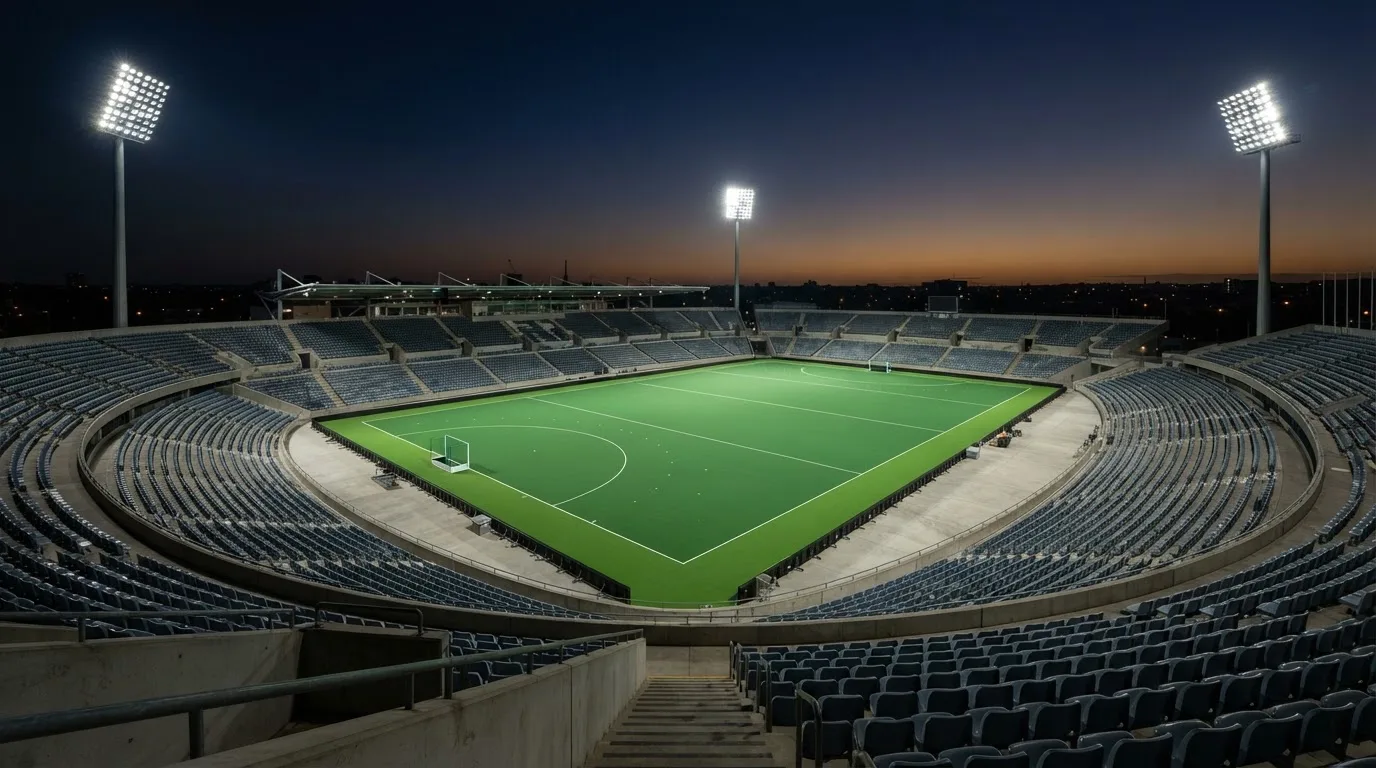
A field hockey side fields 10 outfield players and one goalkeeper, so eleven players on the pitch at any one time. The match is 60 minutes long, split since 2017 into four 15-minute periods with a 2-minute break between periods and a 15-minute break at half-time. A pitch measures 91.4 metres by 55 metres, and the goal is 2.14 metres high and 3.66 metres wide. Knowing those figures matters less than knowing what they imply: with 11 players on a 5,000 square metre surface, the play is constant, the pitch is wide, and the angles that produce a goal come off a long, fast pass more often than off a dribble. That is the geometry behind a price on a corner count, a shot count or a goalscorer at the back post.
The international calendar runs on the FIH. The Hockey World Cup — men’s and women’s, held every four years — is the headline event and the one most British sportsbooks price in advance. The FIH Pro League runs the rest of the cycle and is the most reliable source of weekly fixtures between World Cup years. Continental championships (the EuroHockey Championship for European nations, the Asia Cup, the Africa Cup of Nations, the Pan American Games) produce markets in the week they are played. Olympic hockey has been on the programme since 1908 for men (dropped in 1924, reinstated in 1928) and since 1980 for women: the next Olympic tournament is on a four-year cycle that puts it on the page in the same way as the World Cup.
In Great Britain, the domestic calendar is dominated by the Men’s England Hockey League and the Women’s England Hockey League, with the Cup competitions and a county structure underneath. A British sportsbook that lists field hockey at all usually lists the international weekends; the domestic club game is offered by the more thorough brands and ignored by most. India, the Netherlands, Australia, Germany, Belgium and Argentina are the men’s nations that produce the headline prices; for women, the Netherlands, Australia, Argentina and England are where the markets sit deepest. India won every game at the 1928 Olympic hockey tournament without conceding a goal, and won men’s gold in 1932, 1936, 1948, 1952, 1956, 1964 and 1980 — a record that explains why a bet on India in a major tournament is rarely priced long.
Tied matches vary by competition. Most league games and most round-robin tournament games can finish level, and a bookmaker will offer the draw. A knockout game usually goes to extra time, and a tied classification match goes straight to a penalty shoot-out under FIH rules in force since March 2013. A bettor looking at a knockout line should check whether the market is for the 60 minutes, the result after extra time, or the result after the shoot-out, because the price changes between the three.
The ten reviewed UK-licensed sportsbooks
The brands below hold a Gambling Commission remote licence for real-event betting. The Commission account number is the one to quote back to a customer service agent or to type into the Commission’s register. The licence holder is the company the operator runs under; the brand and the holder are not always the same name, and several of the names below share a holding group with brands that are not on this list. Where the licence holder is named, that is the legal entity the Commission holds to account.
| Brand | Gambling Commission licence | Licence holder | What the operator’s own terms state on field hockey |
|---|---|---|---|
| William Hill | 039225-R-319373-015 (account 39225) | WHG (International) Limited | Prices a deep football and horse racing book; field hockey markets appear on international weekends and on the bigger FIH events, with 1X2 match odds, a small over/under line and an outright on the major tournaments. |
| Fitzdares | 000400-R-103839-030 (account 400) | Fitzdares Limited | A premium-priced book with cash out, accumulators, Lucky 15s, specials and antepost markets across horse racing, football, tennis, rugby, cricket, golf and American football; field hockey is not a listed sport, and the sportsbook leans instead on what it knows. |
| Bet600 | 044731-R-323941-016 (account 44731) | Tyche Tech Limited | Pays Best Odds Guaranteed on horse racing: if the starting price is bigger than the early or show price taken, the bet settles at the SP. Field hockey coverage is light, with prices on the bigger FIH events only. |
| Dabble | 065677-R-340363-005 (account 65677) | Dabble Sports UK Ltd | Built around a social feed and a small welcome package; field hockey is a corner of the book rather than a focus, and the deeper value for a punter here is on football, racing and American sports. |
| Ladbrokes | 054743-R-330863-014 (account 54743) | LC International Limited | One of the deeper-priced books in Britain, with a 1X2 match-odds line, an over/under line, outright tournament prices and a long tail of smaller leagues and specials. |
| Sporting Index | 027343-R-308898-011 (account 27343) | Sporting Index Limited | A spread-betting and fixed-odds book with a Bet Builder for football, auto cash-out and Multi-Markets; field hockey is more likely to be priced as a spread than as a fixed-odds line, and a punt on goal totals is the more natural bet. |
| Swifty Sports | 058957-R-334734-006 (account 58957) | Swifty Global (UK) Ltd | Best Odds Guaranteed on horse racing, cash out on a wide market list, daily price boosts and live streaming; field hockey appears on the bigger international weekends with a basic 1X2 and an outright. |
| Unibet | 045322-R-324275-019 (account 45322) | Platinum Gaming Limited | Prices the FIH calendar more thoroughly than most, with 1X2, totals, a tournament outright and a player market on the World Cup; 1999 was the year the brand began operating, and the international book is where its reputation was built. |
| Betfred | 039544-R-319290-010 (account 39544) | Petfre (Gibraltar) Limited | A heavy football and racing book with a long tail of sports, including field hockey on international weekends; outright prices on the bigger FIH events are usually posted weeks in advance. |
| London Bet | 066162-R-340278-004 (account 66162) | Thistle Bet Limited | A combined sportsbook and casino with live in-play on the main sports; field hockey appears on the bigger internationals and is otherwise a sparse section of the app. |
The table is the shape of the market, not its ranking. Several of the ten brands do not list field hockey in any depth at all, and a punter who has a specific FIH tie in mind will find the better price and the deeper market on a different book. The point of having ten on the same page is to make that choice easy: a bookmaker with a good football book and a poor field hockey book is a worse place to put a Pro League stake than a bookmaker with a smaller football book and a deeper FIH section.
What the regulator expects and what the law allows
The Gambling Commission is a non-departmental public body sponsored by the Department for Culture, Media and Sport. It licenses the whole commercial market in Great Britain under the Gambling Act 2005. The Act covers England, Scotland and Wales. Northern Ireland sits under its own older law and is outside the Commission’s reach, so a Commission licence is a Great Britain licence and not a UK-wide one. Since the Gambling (Licensing and Advertising) Act 2014, an operator whose remote facilities are used by customers in Great Britain needs a Commission licence wherever it is based. A Curaçao, Maltese or Gibraltar licence does not work as a substitute.
The licence is not a list of permitted sports. There is no statutory list of markets the Act allows and no cap on the number of operators. The Commission registers the operator, attaches conditions, and audits against them; the operator decides what to price. That means a field hockey market, or a politics market, or a novelty market on a TV show, can be priced by any Commission-licensed operator that has decided to price it. The check is whether the operator’s terms allow it and whether the bet is offered in the way the Commission expects.
The Commission’s public register is the test of who holds a licence. It can be searched by business name, trading name, domain or account number. The ten brands on this page were all checked on the register. No count of licensed operators is quoted on the page because that count changes and the register should be checked at the time of the check. A licensed operator may use a .com as well as a .co.uk, so the domain does not prove anything. The name of the legal entity on the register is the licence holder; the brand on the app is the trading name. A consumer who wants to confirm that a brand is licensed finds the licence holder on the register, then checks the brand against that holder’s account.
In-play betting is offered by GB bookmakers under their own licence conditions. There is no statutory rule that says in-play is “unrestricted”, and a bookmaker’s house rules — minimum stake, maximum stake, suspension of markets, voiding of bets on a clear error — apply on the same terms as pre-match. Spread betting that is not a financial instrument is inside the general betting framework and is licensed by the Commission; financial spread betting is licensed by the Financial Conduct Authority, and a bookmaker offering both runs two licences. Spreadex, for example, is regulated by the FCA for spread betting and by the Gambling Commission for fixed-odds betting, and the firm’s own page notes that spread betting losses can exceed the deposit.
Verification, deposit limits and safer gambling
Every GB-licensed operator checks the customer’s name, address and date of birth before the first deposit. The check is mandatory under licence conditions and has been since 7 May 2019. A free bet, a bonus, a price boost — anything that needs a funded account or a placed bet — sits on the same verification path as a cash wager. There is no anonymous play at a licensed site, and a punter who is asked for proof of address or a source-of-funds document at higher spend is being asked under money-laundering rules, not as a marketing ploy.
A financial vulnerability check, under LCCP condition 3.4.4, has been in force since 30 August 2024 and applies to remote betting when a customer’s deposits minus withdrawals exceed £150 in a rolling 30 days. The check went live in that form on 28 February 2025. It is a public-record check — for example a bankruptcy register or a county court judgment — not an income check and not a credit reference check. A financial risk assessment, the more thorough affordability check that has been in the press under the heading of “affordability checks”, is on a staged plan the Commission published on 7 July 2026; the start date has not been set, so the line to write is “announced, staged, no start date” and not “in force”. A punter who has not been asked for one yet is not exempt; the operator decides when to ask, and a deeper book may ask sooner.
Deposit limits are the customer’s choice. There is no state-set deposit ceiling or loss ceiling for sports betting. The Commission requires licensed operators to offer a gross deposit limit on a fixed time frame under RTS 12, and the first changes have applied since 31 October 2025, with a second phase postponed to 30 September 2026 — the live status of which has not been confirmed. The deposit limit is the punter’s own setting, and a daily, weekly or monthly cap is something a punter can set, lower it, or raise it under the operator’s own cooling-off process. A punter who wants to stop entirely uses GAMSTOP, the national multi-operator self-exclusion scheme, which has been a mandatory licence condition for online operators since 31 March 2020. The minimum exclusion period is six months; longer options are one year, five years, or five years with auto-renewal; after the minimum, the exclusion stays in place for a further seven years unless the punter asks GAMSTOP to remove it. GAMSTOP covers online sites and apps; betting shops use a separate service.
The credit-card ban, in force since 14 April 2020 under LCCP condition 6.1.2, covers credit cards and any credit-card-funded payment through an e-wallet. Debit cards and bank-based payments are not covered. A punter who tries to fund a betting account with a credit card is refused at the deposit screen, and a refund to a credit card from a winning bet is also not permitted. Source-of-funds questions at higher spend are normal, and a punter who plans to deposit more than the £150 rolling-30-day threshold above should expect the operator to ask.
The help lines are the National Gambling Helpline, run by GamCare, the GambleAware site, the NHS gambling clinics and Gamblers Anonymous. Fitzwilliam Sports, for example, links to GambleAware, GamStop and Gamblers Anonymous on its own home page — a small, useful cue to the layout of a typical responsible-gambling footer.
Bonuses, free bets and the 10x cap
A welcome offer at a UK sportsbook is a free bet, a price boost, an acca insurance or a deposit-gated package, each with a different mechanic and a different cost. The cheapest to clear is a free bet with no wagering condition: place the bet, take the winnings, walk away. The most expensive is a deposit-gated cash bonus with a 50x wagering requirement, which is now banned in any case. The 10x cap on bonus wagering, in force under promotion rules since 19 January 2026, puts a ceiling on the multiplier: a £10 bonus can be cleared with at most £100 of qualifying bets. A book that quoted 50x before the cap is now non-compliant on the same bonus.
A “Bet £10, Get £10 in Free Bets” offer at a new book is a simple example. The punter deposits at least £10, places a sports bet of at least £10 at a minimum price — usually 1.50 or 2.00 — and receives £10 of free bets once the qualifying bet settles. The free bets expire, usually within 7 days. The stake is not paid back with a winning free bet, so a £10 free bet at 3.00 returns £30 of which £20 is profit, not £30. A punter who places the free bet at a price below 1.50, or on a market the book excludes, will see the bet voided. A punter who places the qualifying bet on a market the book has restricted — a same-game-multi leg, an each-way horse race with non-runners, an in-play market suspended at the moment of placement — will see the free bet lost.
The headline number is not the cost. A £10 free bet at 1.50 on a 5% market has a real value of about £4.76, which is what the punter is being paid in expectation. A £10 free bet at 5.00 on the same market is worth about £8, because the higher odds give the book less of a margin to keep. The punter who wants the most value from a free bet picks the highest price the book will allow, not the first one they see. The expected value of a free bet is the stake multiplied by the odds minus one, divided by the odds, scaled by the payout share of the market the bet is placed on; for a 1.91 / 1.91 market, that works out at about 47.6% of the free-bet stake. A £10 free bet at 1.91 is therefore worth about £4.76 on average. The arithmetic is the same on a price-boost token, where the boosted portion is paid as a free bet rather than as cash.
Mixed-product promotions — an offer that requires gambling on two or more product types, like “bet on football to get free spins” — have been banned since 19 January 2026. The book that used to bundle a sportsbook bonus with a casino offer is now offering them as two separate promotions, or not at all. A punter who sees a “bet and spin” package on a UK site is looking at a non-compliant offer, and the right move is to check the terms.
The 10x cap does not apply to every bonus. The Commission’s promotion rules cap the multiplier; they do not, on the evidence published so far, cap the cash value of a bonus or specify the minimum odds a qualifying bet must carry. A punter who is offered a £100 free bet with a 5x wagering requirement should still read the terms on minimum price, expiry, eligible markets and whether the stake is returned.
Live betting and cash out on field hockey
Live betting on field hockey is offered by most of the bigger British sportsbooks when the FIH is on, and by a handful of the mid-sized ones on a club fixture. The market depth is thin: a 1X2 line and a next-goal market are the floor, with totals and a handicap in the larger events. A bet builder, where the same sportsbook lets a punter combine markets from one event, is offered by a handful of British operators on football but rarely on field hockey; Midnite and bet365 both run a bet builder, and Midnite’s site also shows in-play events, an acca builder, popular accas and price boosts with maximum-stake limits. bet365’s Bet Builder+ combines markets from one event into a single bet, available pre-match and in-play, and the same book runs Super Boosts, daily Bet Boosts and Winnings Boosts on Bet Builders and selected singles.
Cash out is the bookmaker’s tool for settling a bet before the event ends. Auto cash-out, where the book closes the bet at a price the punter has pre-set, is offered on some books. Sporting Index’s app lists auto cash-out alongside its Multi-Markets and a Bet Builder for football. A punter who uses cash out on a 1X2 football bet is settling at a price the bookmaker has calculated to be worse than the back-and-lay spread on an exchange, and the same arithmetic applies on field hockey. The cash-out value is the back price on the same selection, minus the bookmaker’s margin, plus a small premium for the certainty; the premium is the cost the punter pays for closing the bet early.
Live streaming is offered by Swifty Sports and a few of the other mid-sized books, and the bigger books have a FIH feed for the larger events. A live-stream punter on a Pro League game is the same person as the live-bet punter: the stream is the data the bettor needs to place a bet during a penalty corner, and the same bookmaker’s live price on the next goal will be the second-fastest line on the market. The fastest line sits with the bookmaker that has the best live data feed, and on field hockey that is usually the operator that has bothered to subscribe to the FIH data rather than to scrape a lower-quality feed.
Predictions, tips and what they are worth
Tipping sites, social tipsters and paid services are not a substitute for looking at the book. A “best bet” on a Pro League game is, at the very best, the same view the bookmaker has priced into the line, with the mark-up on the wrong side. A tipster who claims a strike rate above the break-even point for the markets they tip is either running a small sample or a marketing angle; the break-even point on a 5% market is 52.4% of bets, on a 10% market it is 52.6% (because the implied probabilities add up to 110%, and the tipster must beat the line by more than the margin), and on a tight 2.5% market it is 51.3%. A tipster who is hitting 60% on a 5% market is, in expectation, making money; a tipster who is hitting 60% on a 10% market is making a much larger return; a tipster who is hitting 55% on a 5% market is making a small return that does not cover the subscription fee. The arithmetic is unforgiving, and the honest framing is that a punter who has the time can build the same model from the public data and the bookmaker’s own prices.
A bankroll framework is the punter’s own lever. The standard rule is a flat stake of 1-2% of the bank on any single bet, with a stop-loss on a losing run and a stake reduction after a downswing. A punter who bets 5% of the bank on a single leg will be wiped out by a 20-bet losing run, which happens in field hockey as often as in any other sport. A punter who bets 1% of the bank on the same edge is still betting after the 20-bet run, with 82% of the bank still in place. The difference is the number of bets the punter gets to place, and that is the long-run determinant of whether the edge pays out.
The bookmaker’s margin sits inside every price on the page. A bettor who bets only on the day of the match, on a market where the bookmaker has had the time to price accurately, is taking the worst end of the price; a bettor who bets in advance, on a market where the bookmaker has priced the line and the price has drifted, is taking the better end. The professional side of the market is built on line shopping, on the difference between 1.91 and 1.95 on the same selection across the ten books on this page, and on the willingness to leave a selection unbacked if no book has priced it. A bookmaker’s margin of 5% on a Pro League game is roughly twice as wide as the margin on a Premier League game, and a bettor who knows that is a bettor who prices the field hockey book the same way the Premier League book is priced — by line shopping, not by loyalty.
Offshore and the loss of consumer protection
A bookmaker licensed outside Great Britain is not licensed for the GB market. The Commission’s enforcement is the only route: cease-and-desist notices, search-engine referrals, registrar and host work, payment-provider work, and the court-order DNS blocking powers that the regulator has been given or is about to receive. There is no ISP-level blocking in operation. The customer who uses an offshore book is not committing an offence on the evidence the Commission has published; the operator is. The customer is, however, walking away from the protections the GB licence commands: no GAMSTOP coverage, no Commission complaints route, no approved dispute-resolution body, no British consumer redress if funds are withheld, no 10x bonus cap, no £150 vulnerability check, no credit-card ban. The framing the Commission itself uses is that a licensed book carries the checks, the limits, the GAMSTOP membership and the bonus cap, and an unlicensed book carries none of those.
The verification check at first deposit is the most visible cost. A licensed book checks name, address and date of birth before a free bet or a deposit, and a punter who is excluded under GAMSTOP is refused at the front door. An unlicensed book does not check, and an excluded punter can deposit and bet. The same feature is sold as a benefit by the offshore book and as a loss of harm-protection by the regulator, and both framings are correct from their own vantage point. The point for a punter comparing the two is that the licensed book is the more protective setting and the offshore book is the less protective setting, and the difference is what the GB licence actually buys.
Operator reviews
The reviews below are written from the public record: the Commission’s register, the operator’s own terms and the App Store listing where the operator’s app is published. Where an operator’s terms are explicit on a feature, the review is explicit; where they are silent, the review is silent. The verdict at the end of each review is the page’s own judgement of how the brand sits on a field hockey bettor’s shortlist, and not a recommendation to sign up.
William Hill
William Hill is the longest-established high-street name in the British book, and the remote licence it runs is held by WHG (International) Limited under account 39225. The remote book is deep on football and horse racing — Best Odds Guaranteed on UK and Irish racing from 8 AM on the day of the race, on both single and multiple bets, but not on ante-post, tote or pari-mutuel bets — and field hockey is one of the long-tail sports the app carries. The 1X2 match-odds line and an outright on the bigger FIH events are the most a bettor will usually find, with a small over/under line on the headline fixtures. The bettor who wants the breadth of a deep racing book and the depth of an FIH outright, with a brand whose terms have been tested in the British courts for decades, has a place to start. The bettor who wants a live field hockey market with totals and a handicap will find the section sparse.
Verdict: A reliable base for the casual field hockey punter, not the place to look for in-play depth.
Fitzdares
Fitzdares runs a remote licence under Fitzdares Limited, account 400, and the brand is positioned at the premium end of the British book. The app offers cash out, accumulators, Lucky 15s, specials and antepost markets on horse racing, football, tennis, rugby, cricket, golf and American football, with in-play live odds. Field hockey is not on that list. The bookmaker has chosen not to list it, and the bettor who wants a field hockey market will not find one. The terms are well-written, the operator is well-capitalised and the brand is well-respected, and none of that is the answer to a field hockey question. The bettor with a small acca across a Premier League weekend and a rugby international is the target customer; the bettor with a Pro League slip is not.
Verdict: A premium book for the sports it lists; field hockey punters are not on its list.
Bet600
Bet600 runs under Tyche Tech Limited, account 44731, and is built around Best Odds Guaranteed on horse racing: if the starting price is bigger than the early or show price taken, the bet settles at the SP. The BOG structure is a fair and transparent offer on racing, and the bookmaker’s price on a racing market is, on average, the SP rather than the early price. Field hockey coverage is light. The 1X2 line and an outright on a World Cup or an Olympic qualifier are the most a bettor will find, and the section does not grow in the way the racing section does. The bettor with a racing habit and a side interest in the bigger FIH events is the target; the bettor with a weekly Pro League slip will look elsewhere.
Verdict: A BOG bookmaker for racing with a field hockey section, not a field hockey bookmaker.
Dabble
Dabble runs under Dabble Sports UK Ltd, account 65677, and the brand is built around a social feed and a simple welcome offer: Bet £10, Get £10 in Free Bets on a first deposit for new customers, with minimum odds, a 7-day free bet expiry and the stake not returned with a win. The free bet is a fair offer against the 10x cap and is cleared on a single qualifying bet. Field hockey is a corner of the book rather than a focus, and the deeper value for a punter here is on football, racing and American sports where the social feed is most active. The bettor who wants a community-led book with a small welcome package has a place to start, but those seeking deep field hockey coverage should compare other sites.
Verdict: A social book for football and American sports; field hockey is not the use case.
Ladbrokes
Ladbrokes is published by Entain Operations Limited and runs under LC International Limited, account 54743, which also holds the licence for Coral and a handful of other Entain brands in the British market. The Ladbrokes app is rated 4.66 from 101,255 ratings in the GB App Store, which is the strongest of any book on this page. The sportsbook is one of the deeper-priced in Britain, with a 1X2 match-odds line, an over/under line, outright tournament prices and a long tail of smaller leagues and specials. Field hockey appears on international weekends with a 1X2 and an outright, and the brand is one of the few on the page that has priced the women’s FIH Pro League in addition to the men’s. The bettor with a preference for a deep-priced British book for major events will find excellent coverage here.
Verdict: A strong all-rounder, and one of the few on this list to price the women’s Pro League.
Sporting Index
Sporting Index runs under Sporting Index Limited, account 27343, and the brand is a spread-betting and fixed-odds book. A punter can switch between fixed odds and spread betting, with in-play betting, a Bet Builder for football, auto cash-out and Multi-Markets. Field hockey is more likely to be priced as a spread — goal totals, shots on target, corners — than as a fixed-odds line, and the spread book is the more natural fit for a sport with high variance and few outright markets. A bettor who is comfortable with the spread format and wants to bet on goal totals over a Pro League weekend has a place to look. Those who prefer a traditional fixed-odds 1X2 line will find more robust options elsewhere.
Verdict: A spread book first; the fixed-odds field hockey book is sparse, and the spread book is where the brand is honest about what it prices.
Swifty Sports
Swifty Sports runs under Swifty Global (UK) Ltd, account 58957, and the brand’s terms list Best Odds Guaranteed, cash out on markets including horse racing and football, daily price boosts, live streaming and in-play betting, with a Bet Builder listed as coming soon. The book is mid-sized and growing, and the feature set is competitive. Field hockey appears on the bigger international weekends with a basic 1X2 and an outright, and the section does not yet carry the depth of the racing or football book. The bettor with a small acca across the Premier League and a side interest in a Pro League weekend has a place to look, but frequent FIH punters will find more market depth on the specialist books.
Verdict: A growing mid-sized book with a fair feature set; field hockey is a future rather than a current strength.
Unibet
Unibet runs under Platinum Gaming Limited, Gibraltar, account 45322, and the brand has operated since 1999, which is a long operating history even by British standards. The sports welcome offer is Get £40 in Free Bets when you bet £20: a deposit and a sports bet of £20 or more at minimum odds of 2.0 (1/1), with free bets expiring within 7 days, for new GB customers using a debit card or instant bank transfer. The welcome package is generous against the 10x cap and the minimum price is on the high side, which means the qualifying bet has to be on a market with a price of 2.0 or higher. Unibet prices the FIH calendar more thoroughly than most, with 1X2, totals, a tournament outright and a player market on the World Cup, and the international book is where the brand’s reputation was built. This operator remains a primary choice for punters seeking thorough international coverage.
Verdict: The strongest FIH book on this list, and the welcome offer is the most generous against the cap.
Betfred
Betfred runs under Petfre (Gibraltar) Limited, account 39544, and the Betfred app covers 21 sports plus over 2,000 casino-style games. The book is heavy on football and racing with a long tail of sports, including field hockey on international weekends. Outright prices on the bigger FIH events are usually posted weeks in advance, and the brand has a long history of pricing antepost markets on the major tournaments. Punters focused on early outright markets will find this a useful resource, though active in-play betting on Pro League games is less central to their offering.
Verdict: A heavy football and racing book with a respectable FIH outright market; the in-play section is not its strength.
London Bet
London Bet runs under Thistle Bet Limited, account 66162, and the brand is a combined sportsbook and casino with Pragmatic Play slots and live in-play betting. The sports list covers football, tennis, horse racing, greyhounds, darts, golf, cricket, NFL, NBA, MLB and snooker, and field hockey appears on the bigger internationals. The combined book is the brand’s selling point: a punter who wants a sportsbook and a casino on the same app has a place to look. The bettor with a specific FIH tie in mind will find the section sparse, and the bettor with a casino habit and a side interest in football is the target customer.
Verdict: A combined sportsbook and casino; field hockey is not the use case.
How the prescribed margin works on a field hockey line
A two-way market priced at 1.90 against 1.90 carries an overround of 5.3% and a margin of 5.0%. A two-way market at 1.95 against 1.95 would carry an overround of 2.6% and a margin of 2.5%, and a two-way market at 1.80 against 1.80 would carry an overround of 11.1% and a margin of 10.0%. The narrower the margin, the more the punter keeps of every winning bet on average. Field hockey lines are typically wider than football or tennis lines because the betting volume is lower and the bookmaker has less information to defend against. A punter who lines up a 1X2 selection across the ten books on this page will find a band of prices rather than a single number, and the band is the margin in disguise. The bookmaker with the narrowest band is the one with the tightest line, and the punter with the time to line up is the one who takes the best of the ten. The arithmetic belongs to the punter, not to the page: a band of 1.85 to 1.95 on a single selection is a band of 5% to 8% in margin, and a band of 1.91 to 1.91 is a band of 5.0%. The same selection can sit on different margins on the same bookmaker across the season as the betting volume moves the line, and a punter who takes the early price and is paid at the SP, on a horse race under a BOG offer, sees the line close at the wider end.
Tax, currency and the small print
The player pays no tax on betting winnings in Great Britain. The operator pays General Betting Duty, a tax on gross profits, currently 15%. From 1 April 2027 a new remote betting rate of 25% applies within General Betting Duty, while remote bets on UK horse racing, bets on self-service betting terminals in licensed premises, pool betting and in-person betting stay at 15%; until 1 April 2027 the remote rate stays at 15%, and whether operators pass duty on through the odds is not established. The 25% rate from April 2027 is a real cost that may show up in the price, and a punter who reads the same line in 2026 and again in 2027 may see a wider margin. Spread betting has its own rates — 3% on financial spread bets and 10% on other spread bets. Currency is pounds sterling, written £ before the number with no space, and a punter who deposits in another currency will be converted at the operator’s own rate. A punter who is a professional gambler in the HMRC sense is in a different position, and a professional gambler is not the subject of this page. The Commission’s levy is a separate charge paid by the operator, not a tax on the player.
Frequently asked questions
How is it checked that a bookmaker holds a Gambling Commission licence?
The Commission’s public register can be searched by business name, trading name, domain or account number. The licence holder on the register is the legal entity the Commission holds to account; the brand on the app is the trading name. A punter who wants to confirm a brand is licensed finds the licence holder first, then checks the brand against that holder’s account on the register. A licensed operator may use a .com as well as a .co.uk, so the domain alone does not prove anything.
How is the return on a bet worked out from the stake and the odds?
Return equals stake multiplied by decimal odds, and net profit equals stake multiplied by odds minus one. A £10 stake at 1.91 returns £19.10, of which £9.10 is profit. A £10 stake at 5.00 returns £50, of which £40 is profit. The arithmetic is the same on a combined bet, where the prices of the legs multiply into a single price and the stake is multiplied by the combined price.
What is the bookmaker’s margin and how is it seen in the odds?
The margin shows up as the percentage by which the implied probabilities of all outcomes exceed 100% (the overround). A two-way market priced at 1.90 against 1.90 carries an overround of 5.3% and a margin of 5.0%. A two-way market at 1.95 against 1.95 carries an overround of 2.6% and a margin of 2.5%. The narrower the margin, the tighter the book and the more the punter keeps of every winning bet on average.
How do fractional odds such as 5/1 convert to decimal odds such as 6.00?
Divide the numerator by the denominator and add one. 5/1 becomes 5.00 plus 1.00, which is 6.00. 11/4 becomes 2.75 plus 1.00, which is 3.75. 1/1, the British “evens” price, becomes 1.00 plus 1.00, which is 2.00. The two notations answer the same question: a £1 stake at 6.00 returns £6, of which £5 is profit, and a £1 stake at 5/1 returns £6, of which £5 is profit.
Which tools for controlling play does a licensed bookmaker have to offer?
A licensed bookmaker must offer GAMSTOP, the national multi-operator self-exclusion scheme, and must offer deposit limits on a fixed time frame. The credit-card ban is in force, and a financial vulnerability check applies to a customer’s deposits minus withdrawals above £150 in a rolling 30 days. The deeper affordability check is on a staged plan with no start date. The help lines are the National Gambling Helpline, GambleAware, the NHS gambling clinics and Gamblers Anonymous.
Are betting winnings taxed in Great Britain, and who pays General Betting Duty?
The player pays no tax on betting winnings in Great Britain; this is general information and not tax advice, and a professional gambler is in a different position. The operator pays General Betting Duty, currently 15%, and from 1 April 2027 a new remote betting rate of 25% applies while remote bets on UK horse racing, bets on self-service betting terminals in licensed premises, pool betting and in-person betting stay at 15%. The Commission’s levy is a separate charge paid by the operator.
US & other team sports – Bookies Trust
Content created by the «Bookies Trust» team
