
Horse Racing Betting Odds in 2026: How the Price Is Built and Which Bookmakers Stand Behind It
 Available in US
A £10 bet at odds of 5/1 pays £60 in profit plus the £10 back. Every bettor can work that out. What they can’t, not from a betting slip, is how much of every pound wagered the bookmaker keeps, where Best Odds Guaranteed actually starts and stops, and why a horse quoted at 9/2 today will be quoted at 4/1 an hour before the off. This page walks through how UK bookmakers build horse racing odds, what an each-way bet really costs, which ten Gambling Commission-licensed brands offer what on racing in 2026, and where the marketing language around “free bets” and “best odds” earns its prose — or doesn’t.

Current as of 27 October 2026, verified against the Gambling Commission’s public register.
The First Question to Settle: Who Holds a UK Remote Betting Licence
Every commercial bookmaker taking bets from customers in Great Britain needs a Gambling Commission licence — that is the whole test, and the Commission’s public register is the only place it is published. Since the Gambling (Licensing and Advertising) Act 2014 the requirement applies wherever the operator is based, so a Curaçao, Maltese or Gibraltar licence is not a substitute for a UK one. Under section 33 of the Gambling Act 2005, providing gambling facilities in Great Britain without the licence the Act requires is an offence aimed at the operator. The customer placing a bet on an unlicensed site is not committing an offence under that section, but neither is the customer protected by anything a British licence triggers — no GAMSTOP cover, no Commission complaints route, no approved dispute-resolution service, no guaranteed return of funds if the operator withholds them.
The licence categories that matter for racing are remote general betting standard (real events) and remote pool betting; betting exchanges run under a betting intermediary licence. The register can be searched by business name, trading name, domain or account number, and licensed operators commonly use both .co.uk and .com domains, so the address proves nothing. Operators in this guide have been checked against the register for their listed licence. The Commission publishes no count of licence holders without an access date, and a “thousands of licensed bookmakers” line should not be trusted unaccompanied.

Identity verification runs before the first deposit on every licensed site in Great Britain, since 7 May 2019 — a free bet and a bonus are bets, and they sit behind the same check. There is no anonymous play at a UK-licensed operator, and the same identity trail applies to withdrawing anything won.
Safer Gambling in a Racing Market
GAMSTOP is the national multi-operator online self-exclusion scheme. Registration is free, the minimum period is six months, and the choices are six months, one year, five years or five years with automatic renewal. After the minimum period the exclusion stays in place for a further seven years unless the customer asks GAMSTOP to remove it. Every online bookmaker licensed in Great Britain takes part; betting shops operate a separate in-shop self-exclusion scheme and GAMSTOP does not cover them. Since 31 March 2020 GAMSTOP membership has been a mandatory licence condition.
A licensed operator must offer a deposit limit on a fixed time frame under the Commission’s Remote Technical Standards (RTS 12). The first phase of changes has applied since 31 October 2025; a second phase has been postponed to 30 September 2026 and whether it is now live is not established. There is no state-set ceiling on deposits or losses — the operator must offer limits, but the customer chooses them. A financial vulnerability check applies once net deposits (deposits minus withdrawals) cross £150 in a rolling 30-day window; in force since 28 February 2025, it is a public-record check — bankruptcy or county court judgments — not an income check. Wider financial risk assessments — the affordability checks debated in the press — were announced in a staged plan on 7 July 2026 with no start date.
For someone worried about their own play, GamCare runs the National Gambling Helpline; NHS gambling clinics, GambleAware and Gamblers Anonymous are listed in every licensed operator’s safer-gambling section. Self-exclusion via GAMSTOP is enforceable across every GB-licensed site at once; voluntary timeouts and deposit limits apply at the operator that set them.
Crypto and Other Payment Methods at UK-Licensed Racing Bookmakers
UK-licensed bookmakers take debit cards and bank-based payments. Credit cards have been banned for any form of gambling in Great Britain since 14 April 2020, and that ban covers credit-card-funded payments through an e-wallet too. Identity verification runs before the first deposit, on a free bet and on a bonus, so the licensed market is not anonymous to begin with. A British named-account rule, an official list of approved payment methods and a rule for or against cryptocurrency deposits at UK-licensed operators were not found in the published framework; what matters is what each operator’s own terms say about a specific method.
Operators routinely layer their own restrictions on top — minimum and maximum deposits, methods that earn a free bet but cannot withdraw one, banks that decline gambling transactions outright. The honest position is: check the cashier’s terms before depositing, and assume any deposit method has a rule you have not read yet.
The offshore picture is the opposite. Brands without a GB licence set their own house rules, accept whatever payments their bankers will clear, and run no GAMSTOP membership, no Commission complaints route and no British consumer redress if funds are withheld. The crypto pitch — pseudonymous, fast, no card ban to dodge — describes the gap a GB licence leaves, but a bettor who values those things has already stepped outside the protections a licence triggers.
Free Bets, Bonuses and What the Promotion Rules Actually Cost
A “free bet” is a token the operator credits to a customer’s account, almost always without the stake returned when it wins: a £10 free bet at odds of 5/1 pays £50 of profit, not £60. A “cash bonus” is bonus money credited with conditions attached; the headline “100% bonus” stops making sense the moment the wagering requirement is read. Both fall under the Commission’s promotion rules, in force since 19 January 2026, which cap wagering requirements on bonuses at 10x — a £10 bonus at 50x wagering would have required £500 of qualifying bets before withdrawal, and under the cap no more than £100 of qualifying stakes is needed. Mixed-product promotions — those that require gambling on two or more product types, such as a sports bet to unlock casino free spins — are banned outright. Whether the cap extends to free bets with no wagering condition, and any ceiling on the money value of a bonus, are not established.
Best Odds Guaranteed is the better-known racing-specific promotion and a different beast: it pays the starting price if the starting price is bigger than the price taken. William Hill extends it to UK and Irish horse racing from 8 AM on the day of the race, applies it to single and multiple bets and excludes ante-post, tote and pari-mutuel bets. Most major UK brands run the same deal under the same exclusions. The mechanism is real, not a slogan, but the start time matters and not every race or bet type is covered.
The marketing around these offers tends to oversell. “Risk-free” is a refund as a free bet — the stake is not returned when the qualifying bet loses, so the second bet is the refund, not a stake returned; “free bets no deposit” is a small credit attached to one or two races underwritten by the operator; “enhanced odds” is a price boost on a named selection, usually with a stake cap. The arithmetic behind each is in the worked examples below.
The Racing App Market in Britain
A betting app for horse racing does three things well: it presents the day’s racecards in a form that loads quickly on a phone, lets a customer place a bet, settle or cash out in a few taps, and pushes notifications when a price moves or a non-runner is declared. The British App Store lists racing-capable apps from long-established high-street brands (Betfred, for example, a sports, casino and games app published by Done Brothers (Cash Betting) Ltd covering twenty-one sports) and from newer racing-focused operators (Geoff Banks, published by GB Sports Advisors Ltd, showing live in-play and ante-post prices). The majors — bet365, Betfair, Paddy Power, William Hill, Ladbrokes, Coral — each describe themselves as the “most downloaded” or “leading” racing app on their own listings, which is marketing, not measurement.
The honest comparison is by what the app actually does. Live streaming is a differentiator when the operator holds the rights to a feed. Cash out needs a settled bookmaker infrastructure to back it. Bet builders belong to football more than racing. The page below looks at each operator’s own statements, not the marketing summary, and treats what’s missing from an App Store listing as a reason to check the operator’s site rather than a verdict.
In-Play, Live Shows and Cash Out on Racing
In-play betting on horse racing is a margin product, not a substitute for pre-off punting. The price moves with the leader, and any bookmaker offering in-play carries a margin on the in-play market that is typically wider than its pre-off margin. Midnite shows in-play events on its sports home page; Sporting Index lets a customer switch between fixed odds and in-play; LiveScore Bet builds its bet builder for football not racing. Live shows — broadcast feeds in the app — vary by operator and depend on which racing rights they hold.
Cash out is the operator’s offer to settle a bet before the race finishes, at a price the operator is willing to take back the bet at. The number is below the true win probability by enough that, over a sample of races, the punter who always cashes out trails the punter who lets bets run. It is a useful instrument when circumstances change mid-race — a jockey stopped riding, a leader eased — and is wasteful when used as a habit. Each operator sets its own minimum stake and minimum return for cash out; those figures are on the operator’s terms page, not on the App Store listing.
Tips, Predictions and Betting Systems
Every tipster service in British racing works off the same basic inputs: form, going, draw, jockey and trainer strike-rates, market moves. None of them knows the outcome. A “system” is a staking plan — a set of rules about which races to bet in, which horses to back, what fraction of the bank to stake. The maths of staking plans is well known: a level-stake approach cannot turn a negative-expected-value bet into a positive one, only vary the variance; each staking plan produces a different loss profile for the same losing sequence. A daily tipster sheet, a “today’s horse racing betting odds” page and a forecast column are forms of marketing for a tip service, not independent analysis. The Commission’s customer-protection framework requires safer-gambling messaging to be present in racing content; nothing about a tip makes it any more likely to come in.
What genuinely helps in punting is the reading of odds movements. A horse backed from 10/1 into 7/2 has attracted money for some reason; a horse drifting from 3/1 to 9/2 has lost it. The reasons are sometimes public (going change, jockey change), sometimes known only to the market. The bettor who treats early prices and SP as two distinct bets, with two distinct margins, is the one giving themselves the smallest informational edge they can measure.
Bet Types on Horse Racing: Every-Way, Forecast and Accumulator
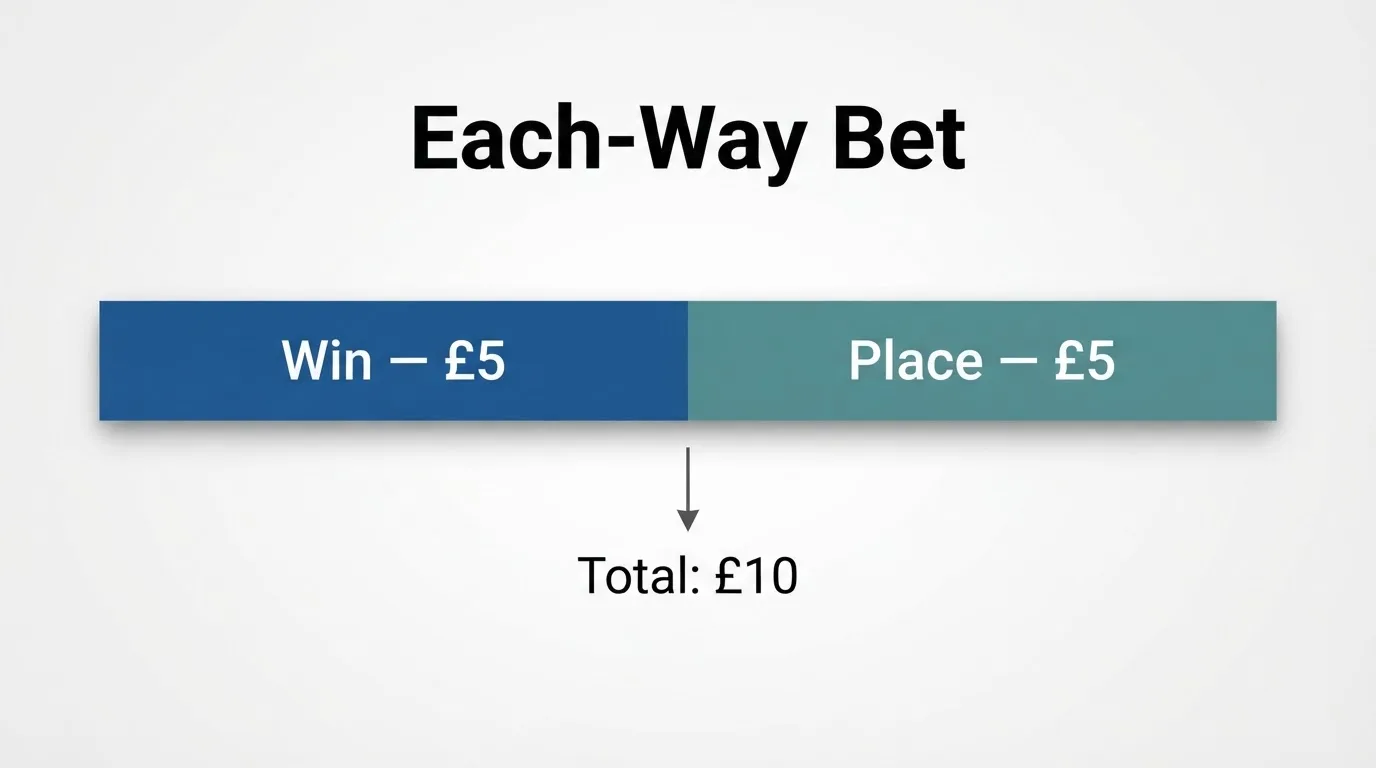
An each-way bet is two bets of equal stake — a win bet and a place bet — so a £5 each-way bet costs £10. The win pays the full odds; the place pays a fraction of the odds depending on the number of runners and the race type. UK each-way place terms, set by the betting industry rather than by statute, run like this:
- Handicaps with more than fifteen runners: 1/4 odds for 4 places.
- Handicaps with twelve to fifteen runners: 1/4 odds for 3 places.
- Other races with more than seven runners: 1/5 odds for 3 places.
- Races with five to seven runners: 1/4 odds for 2 places.
- Fewer than five runners: win only, no place dividend.
A worked example, with the maths in plain terms: a £10 each-way bet on a 10/1 horse at 1/4 place terms (3 places) costs £20. The win part returns £100 in profit plus £10 back when the horse wins; the place part returns the stake on the place odds, which is 10/1 × 1/4 = 5/2, so £25 in profit plus £10 back. Total back if the horse wins: £145 (the £20 stake plus £100 plus £25 of profit, returning the £20 of win and place stake). Total back if the horse is placed: £20 stake plus £25 profit plus £10 stake = £45 (the £10 place stake is returned at place-odds profit of £25 plus stake, a total of £35, plus the win stake of £10 is lost). The point of an each-way bet is the place dividend when the horse does not win — the bettor is paying for two outcomes instead of one.
Forecast and tricast bets name the first and second (and third, in a tricast) horses in the correct order, and the payouts multiply quickly because the permutations rise fast — a six-runner race has thirty ordered combinations in a forecast. Accumulator bets (or “accas”) combine four or more selections into one bet; the odds of each leg multiply into one price, so a four-fold acca at evens (2.00) prices is 16.00, and an eight-fold acca of the same selections is 256.00. The catch is the same one any combination bet carries: every leg has to win, and the bookmaker’s margin is multiplied across every leg. A bet builder on a single football match (up to ten selections in LiveScore Bet’s case) is the same mechanism inside one fixture; the margin compounds in the same way.
Spread betting, run as a financial product by Spreadex and Sporting Index, is a different beast again. The customer buys or sells “points” — for example a horse’s finishing position relative to a line set by the firm — and the loss or profit is the points difference multiplied by the stake. Losses can exceed the deposit, and the Financial Conduct Authority regulates the financial-spread-betting side of these firms rather than the Gambling Commission. The section on operators below covers fixed-odds racing only.
What Goes on the Card: Races, Distances and the Major Fixtures
Flat racing in Great Britain and Ireland runs directly between two points around a straight or oval track. Flat distances range from around 440 yards (400 m) up to more than four miles (6.4 km), with five to twelve furlongs (around 1.0 to 2.4 km) the most common race lengths. Jump racing — steeplechases and hurdles — is called National Hunt racing on this side of the Irish Sea. Handicap races assign each horse a different weight to carry based on its official rating, so a higher-rated horse carries more weight than a lower-rated one; conditions races give horses the same weight with allowances for younger horses and fillies and mares.
The British Triple Crown runs through three races: the 2,000 Guineas, the Derby and the St Leger. Each pays out to win and place punters under each-way terms; ante-post betting on these classics opens months in advance and runs without Best Odds Guaranteed, since BOG is a day-of-race mechanism. The Grand National and the Cheltenham Festival headline the jump-racing calendar; both attract ante-post money and volume on the day. The Classics, the National and the Festival are the fields on which every UK bookmaker opens the deepest market — more runners, more place terms, more each-way action.
The Ten Operators Reviewed
These ten brands each hold a Gambling Commission remote general betting standard (real events) licence and were verified against the public register. A licence is not a ranking — every GB-licensed operator offers racing — and placing them in a comparison table is no judgment on the prices each charges. The table below is a starting point; the write-up that follows it is the page’s own assessment.
| Brand | Gambling Commission remote licence and holder | Racing-specific terms and product |
|---|---|---|
| Tote | 054779-R-331321-008, held by TDCO Limited (account 54779) | Pool-betting racing product with tote odds settled by dividend, separate from fixed-odds bookmakers |
| BetGoodwin | 002927-R-327985-008, held by Goodwin Racing Limited (account 2927) | Welcome offer of three free bet tokens on a £10 qualifying sports bet, racing-focused app |
| Geoff Banks | 054095-R-330366-010, held by GB Sports Advisors Limited (account 54095) | Live in-play and ante-post prices on future events, racing-focused app |
| VBet | 044662-R-324273-022, held by SCGO Limited (account 44662) | £10 free bet if a new verified customer’s first £10+ bet loses |
| Sporting Index | 027343-R-308898-011, held by Sporting Index Limited (account 27343) | Spread betting alongside fixed odds, in-play, Bet Builder for football |
| Kalooki Sportsbook | 057730-R-333396-005, held by Kalooki Sportsbook Limited (account 57730) | Fixed-odds racing bookmaker, GAMSTOP member, identity verified before the first deposit |
| LiveScore Bet | 056859-R-332720-005, held by LiveScore Betting and Gaming (Gibraltar) Limited (account 56859) | Bet Builder for football (up to ten selections), racing markets on each fixture |
| Dabble | 065677-R-340363-005, held by Dabble Sports UK Ltd (account 65677) | £10 in free bets on a £10 first-deposit qualifying bet, 7-day free bet expiry, stake not returned |
| 10bet | 043173-R-322899-023, held by Blue Star Planet Limited (account 43173) | Racing coverage alongside football and tennis, Cash out, Bet Builder, Live Streaming |
| Betfred | 039544-R-319290-010, held by Petfre (Gibraltar) Limited (account 39544) | Twenty-one-sport coverage in app, in-shop and online, longer-running British high-street bookmaker |
Two licences share a holding company elsewhere in the market — Ladbrokes and Coral under Entain, Paddy Power and Betfair under Flutter — and the same point could in principle apply to one of the ten above. The reviews below treat each brand on its own terms but note any shared infrastructure where it changes the picture.
1. Tote — TDCO Limited
Tote’s product is pool betting on horse racing, settled by dividend rather than by a bookmaker’s margin-loaded price. The licence category on the Commission’s register is the same general-betting-real-events one used by the fixed-odds bookmakers, but the customer is betting into a pool with other customers, not against the firm. A nationalised heritage — the Tote was in public ownership until 2011 — sits behind an offering that looks more like a sweep than a sportsbook. The licence check came back clean (account 54779 against TDCO Limited), and the brand is one of the few GB-licensed operators whose product on racing is fundamentally different from a margin book. Verdict: for a punter who likes pool betting’s settlement model and accepts that a pool’s payout is variable by definition, the Tote is the structurally different option on this list; the customer looking for fixed-odds BOG should look elsewhere.
2. BetGoodwin — Goodwin Racing Limited
BetGoodwin’s welcome offer splits the headline £30 of free bet value into three tokens — £5 for a single sports bet, £5 for an acca and £5 for a Sub-Cover bet, against a £10 qualifying stake. The Sub-Cover is the racing-specific element: it refunds a losing single-leg bet on a named race as a free bet, rather than as cash, so the stake is still not returned on a winning free bet. The site is set up by Goodwin Racing, the late John McCririck’s former bookmaking business, and the racing focus shows in the markets offered and the ante-post lists. Verdict: the racing focus and the three-token welcome suit a customer who already bets on racing regularly; the small size of each individual token means the headline number reads better than it spends.
3. Geoff Banks — GB Sports Advisors Limited
Geoff Banks runs as a racing-focused bookmaker, with an app that surfaces live in-play and ante-post prices on future events. The account on the Commission’s register (54095) is held by GB Sports Advisors Limited; the offer is narrow — racing is the centrepiece, with other sports more thinly covered. For a punter who cares about ante-post prices months ahead of the big festivals, the depth of the racing list is the differentiator. Verdict: the racing depth is the point and the reason to come; a customer whose betting diet is mostly Premier League football will find it thin.
4. VBet — SCGO Limited
VBet’s sports welcome offer is a £10 free bet if a new verified customer stakes £10 or more on a first-ever bet that loses — so the first bet is refunded as a free bet (stake not returned) if it loses, no refund if it wins. The licence check came back clean against SCGO Limited (account 44662). The brand is positioned as a multi-product sportsbook rather than as a racing specialist, but the racing markets are present and priced. Verdict: the welcome is a strict “losing first bet, refunded as a free bet” structure, common to several brands on this list, and the customer who wins their first bet gets nothing — a wagering edge favours the user who already plans to bet anyway.
5. Sporting Index — Sporting Index Limited
Sporting Index, like Spreadex, runs two products under the same roof: fixed odds on racing from the Gambling Commission side and financial spread betting from the FCA side. The app is set up so that a customer can switch between fixed odds and spread betting, with in-play betting on a long list of sports and a Bet Builder that is football-only. Loss on a spread bet can exceed the stake and can exceed the original deposit. Racing is present in the fixed-odds book, but the differentiation is the spread side — point-based products on horses’ finishing position, jockey performance and so on. Verdict: for a customer already running a spread-betting book this is the multi-product option; a racing-only customer will pay for features they don’t use.
6. Kalooki Sportsbook — Kalooki Sportsbook Limited
Kalooki Sportsbook is operated by Kalooki Sports Book Ltd (company number 12938274) and holds a Gambling Commission licence under account 57730, with GAMSTOP membership and identity verification before the first deposit. The product is a fixed-odds racing bookmaker with a smaller market share than the majors on the list. Smaller racing books sometimes price a narrow market less aggressively than the majors and a niche market with sharper lines — the difference matters depending on which races a customer bets in. Verdict: the basic checks (licence, GAMSTOP, identity verification before betting) are present; the proposition for the punter is the racing pricing and the welcome offer, both to be checked against the current terms.
7. LiveScore Bet — LiveScore Betting and Gaming (Gibraltar) Limited
LiveScore Bet rides on the LiveScore brand and the Bet Builder product (up to ten selections, match result, both teams to score, corners, total goals, player scoring and card markets). Racing is offered on each fixture with the usual win and each-way markets, ante-post on the major festivals and a cash-out function. The licence is held by LiveScore Betting and Gaming (Gibraltar) Limited (account 56859), and the bet builder is football-only — a punter whose betting menu is racing should not be sold on this feature. Verdict: the LiveScore live-results brand pulls in traffic, and the in-play depth on football is the differentiator; racing punters will find the markets they need but not the depth a racing specialist offers.
8. Dabble — Dabble Sports UK Ltd
Dabble’s welcome offer is “Bet £10, Get £10 in Free Bets” on a first deposit for new customers, with minimum odds applying, a seven-day free bet expiry and the stake not returned. The licence check came back clean against Dabble Sports UK Ltd (account 65677). The app is set up around social features — tip sharing and copy-following are part of the offering — which distinguishes it from a more traditional sportsbook. Verdict: the headline offer is straightforward and reads exactly as written — one free bet token, 7 days to use it, stake not returned when the free bet wins; the social layer is the differentiator for a punter who likes picking alongside others.
9. 10bet — Blue Star Planet Limited
10bet’s sportsbook covers football, tennis and horse racing, with Cash out, Bet Builder and Live Streaming described in its app listing. The licence check came back clean (account 43173, Blue Star Planet Limited). The product is a broad multi-sport bookmaker rather than a racing specialist, with the typical welcome offer against a £10 or £20 qualifying bet, racing coverage on the day’s meetings and a Bet Builder that doubles up on football. Verdict: a general multi-sport product with all three of cash out, Bet Builder and live streaming attached, suited to a punter whose betting diet is varied and not racing-only.
10. Betfred — Petfre (Gibraltar) Limited
Betfred is the longest-running name on the list, with a digital operation under Petfre (Gibraltar) Limited (account 39544) and a high-street bookmaking brand behind it. The app covers twenty-one sports plus over 2,000 casino-style games. Racing is in the product mix and BOG is on the major races; like the other brands in this list, the racing depth is real but not the differentiator. Verdict: a general multi-sport product with British high-street heritage and a comprehensive sportsbook; a punter who values brand familiarity and a long track record will land here by default.
How a Bookmaker’s Margin Is Built Into the Odds
The bookmaker’s margin is the slice of every pound wagered the firm keeps, on average, across all outcomes of a market. It is not a charge deducted from a winning bet; it is built into the prices on offer. A market with two equally likely outcomes at decimal odds of 1.91 / 1.91 gives a payout share of 1 ÷ (1/1.91 + 1/1.91) = 0.955 — that is 95.5% of stakes returned across all outcomes, which means the margin is 4.5%. If the same market is priced at 1.80 / 1.80, the payout share is 1 ÷ (1/1.80 + 1/1.80) = 0.900, the margin 10%. Higher margin, worse price for the punter; lower margin, better price.
The band depends on the market. The headline racings markets — win and place on the major meetings — typically run at margins in the high single digits; smaller meetings and exotic markets (forecast, tricast) carry fatter margins in the teens and twenties, because volume is lower and the firm is less exposed to sharp money. As an illustrative band on a standard two-way market at decimal odds of 1.90 / 1.90 (9/10 fractional), the math gives a payout share of about 95% and a margin in the 5% region — an order of magnitude, not a quote.
The same mathematics that locks the margin into a market also caps what a tipping or handicapping edge can recover. A punter with a genuine 3% advantage on a market with a 6% margin still loses money in the long run, because the margin eats the edge before the edge eats the variance. The bookmaker’s margin is the constant tax on punting; the only way around it is to back only when the edge exceeds it, and that rule reduces a punter’s volume more than it improves their strike rate.
Bet Settlement and Taxation in Great Britain
A punter in Great Britain pays no tax on betting winnings; the operator pays General Betting Duty (currently 15% on gross profits) instead. From 1 April 2027 a new remote betting rate of 25% applies within General Betting Duty, while remote bets on UK horse racing, bets on self-machine terminals in licensed premises, pool betting and in-person betting stay at 15%. Spread betting carries separate rates — 3% on financial spread bets, 10% on others. Whether operators pass duty on through their odds is not established in the published framework. Where the brand is the operator, currency is the pound sterling throughout this guide.
Reading the Betting Markets Without Losing the Thread
The day’s racecards are published the evening before; form, going, draw and a market are already attached. The early prices are a betting firm’s margin-loaded view at the moment the card was published; the morning prices may move with overnight money; the SP — the starting price, recorded at the off — is the last published market. Best Odds Guaranteed pays the bigger of (early or morning price taken) and (SP), so a bettor who takes an early price and the horse drifts is paid the early price; a bettor who takes an early price and the horse shortens is paid the bigger SP. The mechanism is real and documented; it is not a slogan. Each book’s cut-off time — typically around ten to fifteen minutes before the race — and the markets excluded (ante-post, tote, pari-mutuel) matter to the size of the protection.
Cash out, lay betting on a betting exchange and a Rule 4 deduction on a non-runner are all operator- or exchange-side mechanisms that change a settled bet’s economics after the bet was placed. The Commission’s customer-protection framework — identity verification, GAMSTOP, deposit limits, the financial vulnerability check at £150 — does not extend to the cash-out or pricing decisions themselves; those run on each operator’s own licence conditions and codes of practice.
The Bet Types and How the Return Is Worked Out
A winning single: return = stake × (decimal odds − 1) in profit plus stake. A winning double on legs at 2.00 and 3.00: return = stake × 6.00, with the £1 unit stake returning £6 (profit £5). Accumulator mathematics multiply each leg’s odds into one price; an each-way accumulator is two accumulators (win and place) of the same legs, so the stake is doubled for an each-way acca just as it is for an each-way single. The free bet, when the stake is not returned, returns stake × (decimal odds − 1) per unit stake credited — which is to say, profit only, not stake-plus-profit.
A tricast picks the first, second and third in order; in a six-runner race there are 6 × 5 × 4 = 120 ordered permutations. A £1 tricast on all six in order costs £120 to cover every combination, and the payout of the winning permutation is shared across the unit stakes that covered it — divided by the number of winning tickets at the firm, multiplied by the relevant stake. The unit stake that wins is the only one with a winning ticket, so the whole pool of bets that named the correct order is in the winning combination. Forecast and tricast payouts are calculated per permutation; the same maths applies to a £0.50 stake on a tricast covering part of the permutations on a twenty-runner field.
Three Snap Decisions a UK Racing Punter Makes Every Day
Take the price, or wait? Taking the early price locks in a bigger number if the horse shortens and a smaller number if it drifts; BOG pays the bigger of the two. Waiting costs the early-only specials and changes the margin on the bet taken.
Win or each-way? An each-way bet doubles the stake for a partial return on a place, not on a win; the bettor pays for two outcomes. In a five-runner race each-way is not offered (fewer than five runners means win only); in a twenty-runner handicap each-way returns a quarter of the win odds for four places.
Cash out or let it ride? Cash out pays the operator’s take-back price at that moment, which is below the true win probability; letting the bet ride accepts the risk of losing it all on the run-in for the chance of the full payout. The two strategies are not equivalent in expectation.
Working the Numbers on an Offer
The headline “100% bonus” with a 6x wagering requirement on the bonus amount means the customer must place bets totalling six times the bonus before the bonus balance and any winnings become withdrawable. A £20 bonus needs £120 of qualifying bets at minimum odds (commonly evens or 1.50 decimal) before the bonus money is unlocked. A £20 free bet with stake not returned at decimal odds of 4.00 returns £60 of profit (stake × (4.00 − 1) = £60), not £80 — the marketing says “free £20 to win”, the arithmetic says “free £20 to win a profit of £60 on a 4/1 shot”.
The promotion rules cap wagering requirements on bonuses at 10x in Great Britain; a £10 bonus at 50x needed £500 of qualifying bets under the old rules and needs no more than £100 under the current cap. Mixed-product promotions — sports-and-casino combined offers — are banned outright. The cap is the law, the operator’s terms set the rest, and the difference between a bonus and a free bet is the stake not returned on a free bet win.
The British Terms to Know
GAMSTOP is the national self-exclusion scheme; GamCare runs the National Gambling Helpline; the Gambling Commission (UKGC) is the regulator; the LCCP is the Licence Conditions and Codes of Practice. ASA / CAP / BCAP codes govern marketing. A punter is a bettor; a bookie is a bookmaker; BOG is Best Odds Guaranteed; SP is starting price; an “acca” is an accumulator; an each-way bet is two bets of equal stake. Decimal odds (3.00, 5.50) and fractional odds (2/1, 9/2) convert by a/b → (a ÷ b) + 1; £5 is “a fiver”, £10 is “a tenner”. Dates are written “9 April 2025”. Spell “licence” as a noun, “license” as a verb, “organisation” not “organization”, “whilst” not “while”.
What a Punter Should and Should Not Take From the Page
The bookmaker’s margin is the constant tax on punting — small on major meetings, larger on smaller ones and bigger still on exotics. Identity verification at the front door, GAMSTOP membership and the £150 financial vulnerability check are the cost of betting with a UK-licensed firm; they are also the protection that the offshore route foregoes. Bonuses and free bets come with terms: a stake usually not returned on a free bet win, a wagering cap of 10x on a bonus, a seven-day expiry at some firms. The market’s own tax — General Betting Duty — is the operator’s bill, not the punter’s; whether it is passed on is not established in the published framework. The British player pays no tax on winnings, the operator’s licence is the test of who is regulated, and the only consistent edge is reading prices more carefully than the next punter does.
Frequently Asked Questions
How is a return on a horse racing bet worked out from the stake and the odds?
A single returns stake × decimal odds if the horse wins, which equals the profit (stake × (decimal odds − 1)) plus the stake. A £10 bet at 5/1 (decimal 6.00) returns £60 in profit plus the £10 back. An each-way bet is two bets of equal stake, so the total cost is doubled, and the win part pays the full odds, the place part pays a fraction of the odds set by the race’s place terms.
What is the bookmaker’s margin and how does it show in the odds?
The margin is the slice of every pound wagered the bookmaker keeps across all outcomes of one market. On a two-way market at decimal odds of 1.91 / 1.91, the payout share is 1 ÷ (1/1.91 + 1/1.91), which is 95.5%, so the margin is 4.5%. Bigger prices (1.80 / 1.80) widen the margin; smaller prices (1.95 / 1.95) tighten it. The margin is not a charge; it is already inside the prices on offer.
How are horse racing each-way place terms decided?
UK each-way place terms are set by the betting industry rather than by statute. Handicaps with more than fifteen runners pay 1/4 odds for 4 places; 12–15 runners 1/4 for 3 places; other races with more than seven runners 1/5 for 3 places; five to seven runners 1/4 for 2 places; fewer than five runners are win only. Ante-post bets do not get each-way settlement on most firms.
How is a bookmaker’s UK licence verified?
Search the Gambling Commission’s public register at the Commission’s website by business name, trading name, domain or account number. Every operator that legally takes bets from customers in Great Britain is on the register, including offshore firms that hold a remote licence. A licence on the register is not a recommendation; a licence off it means the operator is not regulated for British customers at all.
How is the margin compounded across an accumulator bet?
The margin of each leg’s market is carried into the combined odds by multiplication. A four-fold acca at evens on each leg (2.00 × 2.00 × 2.00 × 2.00 = 16.00) carries the margin of all four legs. The longer the accumulator, the larger the total margin; a tipping edge on any one leg has to be bigger than the compounded margin of all the legs to be profitable in expectation.
How does Best Odds Guaranteed work?
BOG pays the bigger of the price taken (before the off) and the starting price (SP, recorded at the off) on a winning bet. A horse taken at 6/1 that drifts to 10/1 and wins is paid at 10/1; a horse taken at 6/1 that shortens to 4/1 is paid at 6/1. The offer usually starts around 8 AM on the day of the race, runs on UK and Irish racing, applies to single and multiple bets and excludes ante-post, tote and pari-mutuel bets — each operator’s own terms set the exact exclusions and start time.
Horse racing & greyhounds – Bookies Trust
Content created by the «Bookies Trust» team
