
Darts Betting Tips 2026 — Value, Form and the Hidden Cost of Every Price
 Available in US
The image of a tipster who knows something nobody else does is, in darts as in every other sport, a fantasy. There is no signal that crosses the bookmaker’s trading desk without the desk already holding it; there is no projection of three-dart averages that the market has not already priced in. That leaves the genuine question — how does a tip become a bet, and what does it cost the bettor who places one — and that question is what this page is here to answer. The material that follows works through how the market is built (the score formats, the throw line, the average, the finishing range), how odds are formed and what sits inside them, and how a stated price becomes the difference between a sensible punt and an expensive one. The angle is consequence: not which player wins, but what follows when a bet is settled, when a bonus is cleared, or when the bookmaker’s margin is allowed to do the work it is already doing.

Current as of 27 October 2026 against the Gambling Commission’s public register and operator terms pages.
Darts odds and what the bookmaker’s margin takes out of them
Every darts price carries a margin. It is built into both sides of the market so the bookmaker wins whether the favourite or the underdog takes the leg, and the only way to see it is to do the arithmetic: take the two prices on a two-way market, invert each one, add the two reciprocals and subtract the result from one. What is left is the share of every pound wagered that the bookmaker keeps on that market.
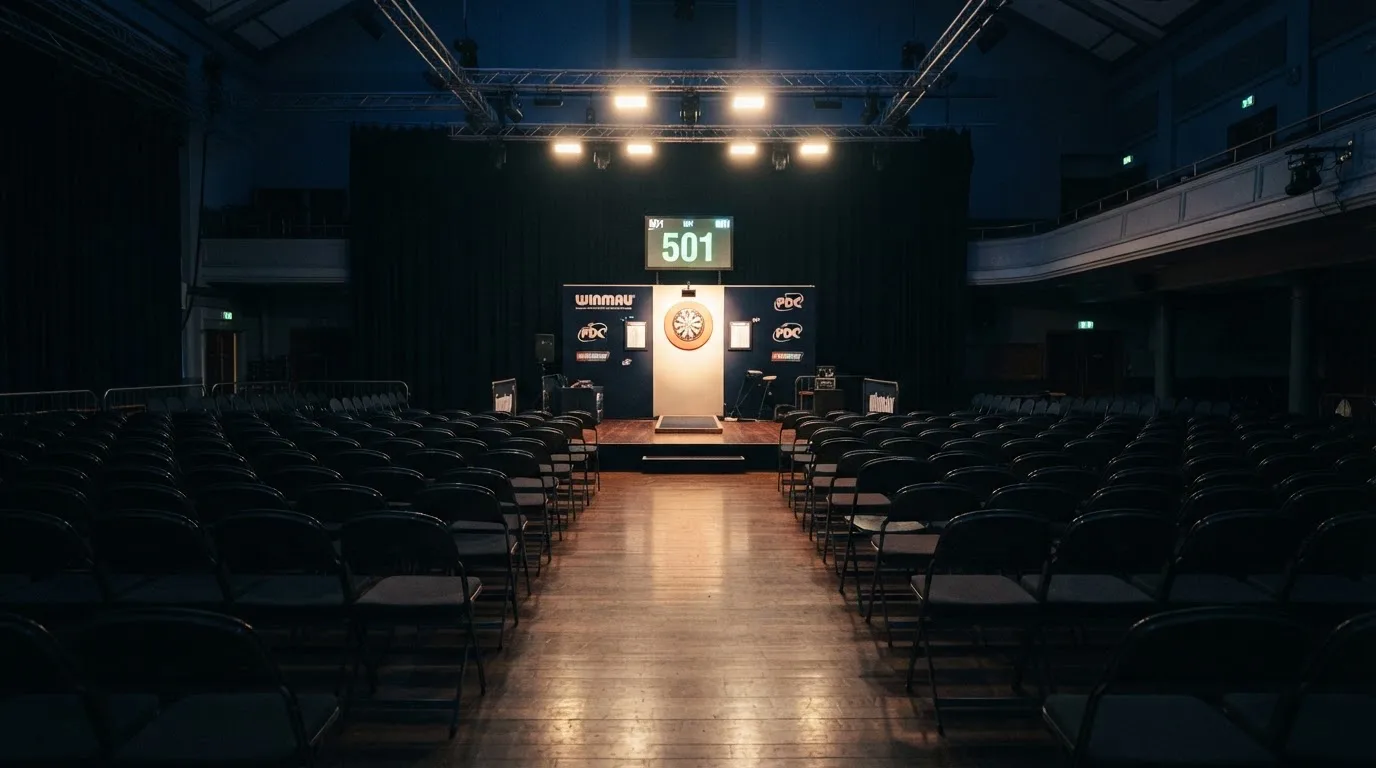
Take the simplest possible two-way price, the match winner at 1.90 against 1.90 — even money in fractional form, 9/10. The reciprocal of 1.90 is 0.5263, and two of them sum to 1.0526. The margin on that market is 1 minus 1.0526 of the unit staked, which is 4.76%. On a real darts match the two prices are rarely level — a heavy favourite will sit at 1.30 with the outsider at 3.50, and the margin hidden across them is wider. Where the two prices look generous, the proportion taken off the unit stays the same shape: tighter margins on mainstream match outright markets, heavier margins on smaller props, on handicaps, and on combination bets that string several legs together. As a rule of thumb on darts, an outright match winner with both prices between 1.40 and 2.50 is a market carrying somewhere between 4% and 8% margin; props, same-game multiples and 180s specials push that figure upward, sometimes well upward.
A worked example at 1.90/1.90 (fractional 9/10) returns roughly 95.2% of every unit staked across both outcomes of a settled market, with the remaining 4.8% kept by the bookmaker in the long run. A punter picks one side, and on average that side wins what the market says it wins, minus the margin. The mechanic explains why the same stake, on a market with a 7% margin, returns less across a season than the same stake on a market with a 4% margin — and why a frequent bettor loses to the spread of prices more reliably than they lose to individual outcomes. Where the page below talks about a price as “expensive” or “tight”, it is the margin that drives that judgement, not the visible odds on one side of the bet.
The second mechanic worth knowing is the difference between margin and payout share. The two are the same market described from opposite ends: 1 minus payout share gives margin, and 1 minus margin gives payout share. They are not interchangeable in any sentence; the bookmaker “keeps” a margin, the punter “receives” a payout share, and writing 5% margin is a different claim from writing 95% payout share, because the first is what the bookmaker earns and the second is what the punter takes back.
The sport inside the bet: 501, the throw line, the finishing numbers
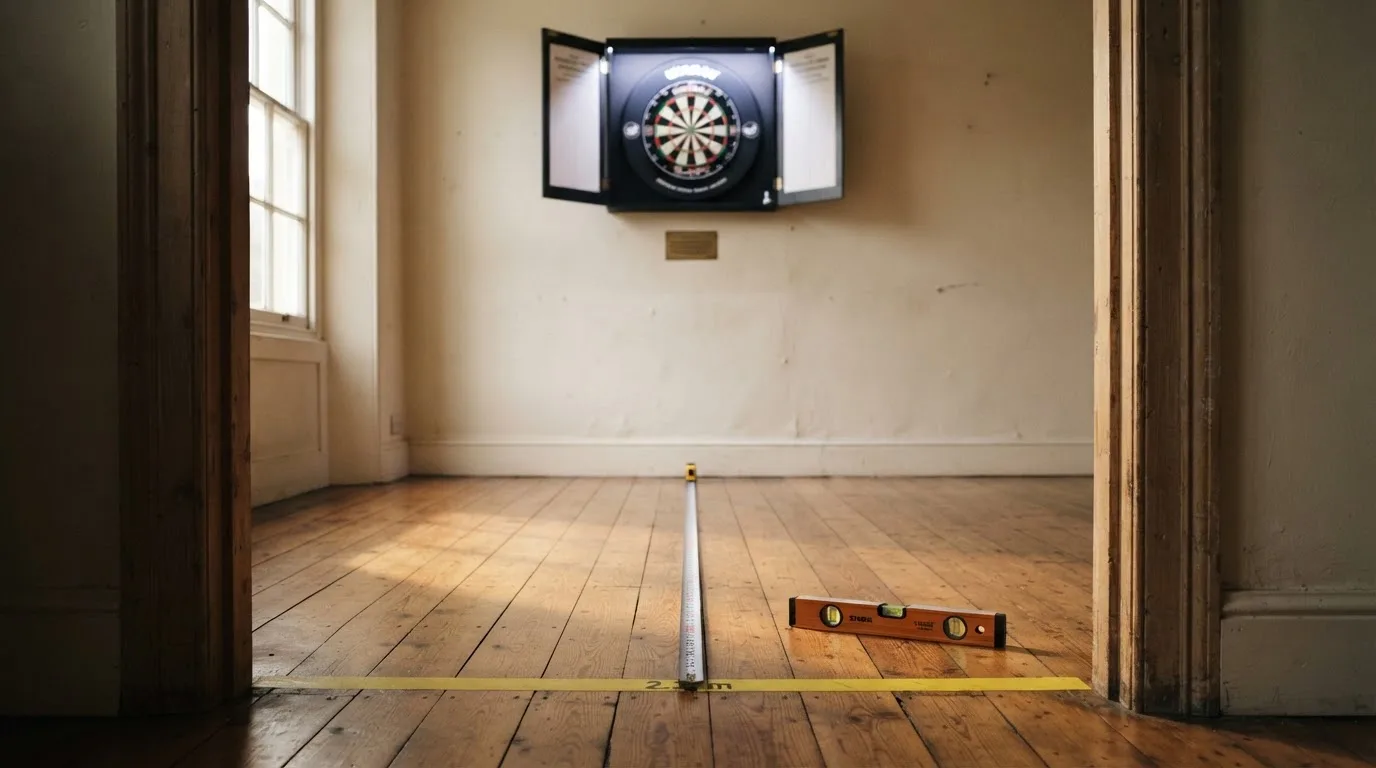
Darts looks like a sport without structure, because the highest televised averages sit above 110 and a single treble-20 visit moves the score by sixty. The structure is there, and it is the structure a serious market sets prices off. A standard dartboard carries twenty numbered segments, each split into single, double and treble bands, with a bull worth 25 on the outer ring and 50 in the centre [the image in the section above shows the board and the band arrangement]. Two numbers govern every leg: the throw distance — 2.37 metres from the oche to the face of the board — and the bull height, at 1.73 metres off the floor. Neither is a betting number, but both are why the form table looks the way it does.
Almost every televised match is played at 501, with the player required to finish on a double or the bullseye. The rule has an immediate consequence: the score a player needs to leave themselves for a finish is always even. A score of 50, 40 or 32 down to 2 is a setup; a score of 49, 41 or any odd number is a missed visit. That is why top players throw for doubles with a confidence that looks disproportionate to the score itself — the practical finishing range is finite, on a standard dartboard it runs from double-1 to double-20 plus the bullseye, and the highest possible three-dart finish, the famous 170, is treble-20, treble-20, bullseye. The minimum leg — nine darts — is itself a market angle: a leg that goes to a finish in nine darts matters because the opponent was never in it, and the way bookmakers price finishes and checkout markets reflects that. Players who hit high doubles under pressure are paid for it, and players who keep missing the same double are paid against.
The PDC World Darts Championship is the headline event of the calendar and remains the highest-profile market on most sportsbooks. It is played over the Christmas and New Year period, and the 2025/26 edition ran from 11 December 2025 to 3 January 2026 at Alexandra Palace, with a field of 128 players — an expansion from the previous 96-player cut. Luke Littler beat Gian van Veen 7–1 in the final, on a prize fund of £5,000,000 with £1,000,000 to the winner. Round structure is a guide to how a market scales: rounds one and two were first to three sets, rounds three and four first to four, the quarter-finals first to five, the semi-finals first to six and the final first to seven. Outright markets on the Championship tend to price through the whole field, with the top six or eight names sitting short and the rest of the draw rated at large prices; each-way terms typically allow a paying place at one quarter or one third of the outright field.
What a tip actually is — form, statistics, the market’s own odds
A “tip” in the betting sense is the public name for a private calculation: a forecast of which player is more likely to win a leg, a match, or a tournament, expressed as a probability, then translated into a price. The forecast itself is built from three inputs, and the three are not equally available to the bettor and the bookmaker.
The first input is form. Recent match results, recent legs won, recent averages. Form tells a bettor where a player’s game has been and lets them answer the simplest question — has this player been winning, and by how much. Form on its own is the weakest of the three inputs, because form is a backward-looking description of a player who is still getting better, or worse, or struggling with an injury. A player who has won three matches in a row at an average of 108 is in better form than one who has won three matches at 95; the same is true that a player who is ranked first and has just lost three in a row is still ranked first.
The second input is statistics. Three-dart average, first-nine average, 100+ throws per leg, 140+ visits, checkout percentages by band, doubles hit, doubles missed. Statistics are what the betting public quote when they quote a number, because statistics move slowly and the bookmaker’s market has not priced every one of them. The catch is that bookmakers do not lag. A punter using public statistics is, by definition, using the same information the trading desk is using; the price they see at 1.85 may already be 1.85 because the bookmaker has adjusted for the same statistics the punter has adjusted for.
The third input, and the only one a serious tip truly rests on, is the market’s own odds. The starting price on a darts match is set by the bookmaker and refined as money comes in. Where the market is efficiently priced — the Premier League, the World Championship, the late stages of major TV events — the implied probabilities across the field add up to a margin over 100%, and the only way a bettor can expect a positive return on a particular selection is to find a price that is genuinely larger than the probability that selection deserves. That price is the “value bet”, and finding one is the only way the arithmetic works in favour of the bettor over a long run.
The mechanics of finding one are straightforward in principle: estimate the true probability of each outcome, add the bookmaker’s margin back in, and compare. If the bettor’s estimate of a player’s win chance is 50% — the bettor is pricing the match as a coin-toss — and the bookmaker is offering 2.20 on the same selection, the bet is value. The same match at 1.90, the even-money price the section above used as a margin example, is not value. The reason: 1.90 implies a probability of 52.63% once the 4.76% margin is included, and the bettor’s estimate of the same outcome is 50%, leaving the bettor paying 2.63 percentage points of margin on an outcome they themselves do not believe is that likely.
The reason no tip is ever certain is the reason no forecast is ever certain: the three inputs above do not generate a probability, they generate a probability conditional on past data, against a field of players who are themselves adjusting, on stages that change, with weather in any outdoor tournament, with travel, with form cycles, with the dart that lands in treble-5 instead of double-16. A price is the bettor’s best estimate of the chance. A punter picks one player because the price is, on the bettor’s calculation, greater than the chance. That decision is right sometimes and wrong sometimes. The arithmetic of value says the bettor wins on average — not in any particular bet, and not in any particular tournament, but on average across many bets. A bettor who picks the favourite at 1.30 once a week for a season pays a margin of roughly 4–6% on every selection and loses in the long run; the same bettor picking the favourite only when the price is, on their own calculation, better than 1.35 has a chance of breaking even after the margin. That is what a tip really buys — a way to filter the betting menu into a smaller set of bets the bettor can defend on the figures.
The bet types you actually meet at a UK sportsbook
A match outright — Littler to beat van Veen, or to win the tournament outright — is the simplest darts market and the easiest one to read. Most televised matches offer a match winner with three prices when best-of-three is in play (win 2-0 is priced separately, and so is the deciding-leg option). Outright tournament markets price the field from 4/1 or 5/1 on the favourite out to 500/1 and beyond on the long shots.
Handicap markets — where one player is given a leg start to flatten the price — run at the same bookmaker and are settled on the official match score. A favourite priced at 1.20 to win may be priced at 1.85 with a -2.5 leg handicap, which means the favourite must win by three or more legs. The number does the work the outright price did before: a heavy favourite covers a small handicap easily, a form player covers a bigger one and a tail-ender does not. Handicap markets carry more margin than a simple outright because the line the bookmaker is offering invites the punter to behave like a tipster, and bookmakers price for that.
Set and leg totals sit under the totals heading. Each match carries a quoted number of sets for the match (3.5, 4.5, 5.5) and legs within a single set, both heavily in the totals menu. The same 4–8% margin applies, and the same principle: the price is the punter’s only test of whether the bet is value.
Player props — most 180s in the match, highest checkout, total number of 180s in the match, total number of legs in the match — are the smaller markets and tend to carry a wider margin. So do the specials on the dart itself: the highest checkout in a given session, the method of the winning checkout, a player to hit a 170 in a named leg. These markets are tempting, because they promise a specific outcome, but a punter who is price-sensitive will skip them and put the stake in a market that pays closer to its face value.
Combination bets — accas and same-game multiples — multiply the legs into one price and one stake. A treble at 1.60/1.80/2.00 prices up at 5.76, which reads large but pays out only on three simultaneous wins. The catch is that the margin is multiplied across each leg, and a treble on three short-priced legs is often an unprofitable accumulator sold as a “safer” alternative to a single; the deeper the combination, the wider the effective margin built into the cumulative price. Two-leg combinations across a match outright and a player prop are widely offered and are the standard fare for British bookmakers’ bet builders.
Each-way betting — each-way bets split the stake into two equal halves, one on the win and one on the place. The place terms are set by the bookmaker and vary by field size and event: for a typical tournament the place terms pay one quarter of the outright odds for placing in the top two or three, and one fifth for placing in the top four. Each-way betting does not change the margin; it doubles the stake and adds a layer of price on the place element. It is a feature of horse racing that has carried into other sports because the format fits outright markets well.
Live darts betting — betting after a match has started, with the prices moving as the legs are won — is offered at every UK sportsbook and is dealt with in the live betting section below.
Where the dart lands: the licensed UK market and its mechanics
The British online betting market is governed by the Gambling Commission, an independent regulator that licenses commercial gambling in Great Britain under the Gambling Act 2005. The Commission’s public register is the test of who holds a licence: any brand offering remote betting to customers in Great Britain must appear on that register, and a search by trading name or domain gives the answer in seconds. A bookmaker whose facilities are used in Great Britain needs a Commission licence, no matter where the operator itself is based; this has been the position under the Gambling (Licensing and Advertising) Act 2014 since the point-of-consumption change took effect.
A Gambling Commission licence is the prerequisite for anything that follows in this article — the protection from verification before the first bet, the credit-card ban, the GAMSTOP membership, the bonus cap on wagering requirements. The licences themselves come in five types. General betting standard (real events) is the headline licence: it covers sports betting on real-world events, including darts. General betting standard (virtual events) covers computer-simulated markets; pool betting is its own licence, used for horse and greyhound pools; the betting intermediary licence is the one that lets exchanges match back and lay bets; and there is a general betting limited licence for smaller operators. A brand appears on the register as the trading name, but multiple brands often run under a single licensee — Ladbrokes and Coral are the same licensee, as are Paddy Power and Betfair — and that materially affects how a punter reads a comparison table.
There is no statutory cap on stakes, no statutory cap on winnings, no state monopoly on a category, and no state list of permitted markets. Operators set their own stake limits and may restrict individual customers; markets are offered at the operator’s discretion under the Commission’s Licence Conditions and Codes of Practice. A licence does not, on its own, make any specific market legal or illegal — it permits an operator to offer markets under its own rules. Markets such as betting on politics, on TV shows and on novelty events are widely offered by GB-licensed bookmakers, and the question of what may be bet on is settled at the operator’s discretion rather than by a statutory list.
Betting exchanges sit under their own licence type — the betting intermediary licence — and operate on a back-and-lay model that is genuinely different from a bookmaker’s offer. The exchange is not setting a margin in the same way; the prices are set by the customers backing and laying, and the exchange earns a commission on net winnings. Rates and conditions are specific to each exchange and are stated only from that exchange’s own terms. Spread betting is separate: financial spread betting is regulated by the Financial Conduct Authority, while non-financial spread betting is treated as general betting and covered by the Commission’s framework. Spread betting losses can exceed deposits — the same mechanics make gains uncapped on the upside.
Identity verification is the practical entry point. Since 7 May 2019, GB-licensed remote operators must verify a customer’s name, address and date of birth before the first deposit or wager, including with a free bet or bonus — the verification is not optional even where the deposit amount is small. Credit cards are banned for gambling in Great Britain, including credit-card-funded payments through e-wallets; debit cards and bank-based payments are not covered by the ban. Cryptocurrency is not on the list of accepted payment methods at GB-licensed operators as a class — operators state their own payment terms, and whether any given operator accepts a specific coin is a question for that operator’s terms page.
Bonuses are capped at a wagering requirement of 10x the bonus value, in force since 19 January 2026. The rule means a £10 bonus at 50x wagering (where it would have needed £500 of qualifying bets) is no longer allowed — the maximum turnover requirement under the cap is £100. Mixed-product promotions, where a bet on one product unlocks a bonus on another (the classic “bet on football to get free spins” model), are banned as part of the same package of changes. Free bets without a wagering condition are not within the same scope as a capped bonus, and the cap may not apply to them in every case. Operators’ own terms pages still govern the practical claim.
The player’s winnings are tax-free in Great Britain. General Betting Duty is the operator’s tax on gross profits, currently 15%, with a new remote betting rate of 25% set to apply within that framework from 1 April 2027; pool betting, in-person betting and spread betting carry their own rates. The duty sits on the operator, not the punter, and operators’ pricing reflects it in the margin the book builds into every market. Whether a given operator passes the duty through into the prices is not established as a matter of fact — the prices carry the duty either way, and an analysis of the margin does not separate them out.
Offshore operators serving GB customers without a Commission licence are operating outside the Act. Section 33 of the Gambling Act 2005 makes it an offence to provide gambling facilities in Great Britain without the licence the Act requires; on summary conviction the maximum sentence is up to 51 weeks’ imprisonment and a level-5 fine, six months in Scotland, aimed at the operator. The Act does not aim an offence at the customer who merely bets on an unlicensed site — the loss in that case is the loss of consumer protections. No GAMSTOP coverage, no Commission complaints route, no approved dispute-resolution body, no British consumer redress if funds are withheld, and the operator is not bound by the bonus cap, the deposit rules or the verification regime. Enforcement is disruption: cease-and-desist notices, search-engine referrals, registrar and payment-provider work, and court-order DNS blocking powers that have been or are about to be made available. The licence is the test of who operates inside the British system, and there is no shortcut to it.
Responsible gambling and the limits operators must offer
Every operator that holds a remote general betting licence in Great Britain takes part in GAMSTOP, the national multi-operator online self-exclusion scheme. Self-exclusion periods run for six months, one year, or five years, with an option to extend for a further five; once the minimum period ends the exclusion remains in force for a further seven years unless the customer takes positive steps to lift it. GAMSTOP covers the online site and app; betting shops carry their own self-exclusion scheme. Joining GAMSTOP is one of the most decisive ways a customer can cut off access to multiple operators in a single step, and the test of whether a brand is genuinely “self-excludable” is whether the brand appears on GAMSTOP at all.
A financial vulnerability check — under Licence Conditions and Codes of Practice condition 3.4.4, in force since 30 August 2024 — applies to licensed remote betting when a customer’s deposits minus withdrawals exceed £150 in a rolling 30 days, with the second phase taking effect in February 2025. The check is a public-record review (bankruptcy and county-court judgment checks are typical inputs), not an income check and not a credit-reference check. A financial risk assessment, the stronger “affordability check” that has been discussed in the British press, is set out in a Commission announcement of 7 July 2026 with a staged plan; no start date has been published.
Deposit limits are mandatory as a matter of operator licence (under the Remote Technical Standards, RTS 12): a GB-licensed operator must offer the customer a way to set a gross deposit limit on a fixed time frame. The first changes to deposit rules took effect on 31 October 2025; a second phase has been postponed to 30 September 2026. There is no state-set cap on deposits or losses — the limit is the customer’s choice, and operators are required to make that choice possible. Stake limits are set by the operator; in-play limits and per-market caps are common, particularly in combination bets and on player props, and the operator may also tighten a customer’s stake for a specific event at any time.
Help is available at every licensed operator and at the national level. GamCare runs the National Gambling Helpline. GambleAware funds treatment and education. The NHS runs gambling clinics. Gamblers Anonymous runs peer-led meetings. The Customer Protection part of the Commission’s licence conditions is the legal structure: safer-gambling tools, self-exclusion, deposits limits, and links to support organisations must be present on the operator’s site in the way the customer needs them.
Staking discipline on the punters’ side is what the rest of the structure exists to support. A bank is the pool of money a punter commits to betting for a defined period — a season, a quarter, a month — and stake size is a fixed percentage of the bank rather than a reflection of how confident today’s tip feels. A flat 1% or 2% stake is the discipline most professional bettors adopt; growth in the bank follows from winning, and a single losing streak does not blow the bank. Staking plans like the Martingale — doubling the stake after every loss to recover the previous stake with one win — are mathematically seductive and bank-bust a punter in the wrong sequence; that is not betting advice, it is the central case study in the lesson that staking plans do not alter the underlying probability.
Bonuses, free bets and what they actually cost the punter
Bonuses in darts betting come in three shapes — a free bet, a deposit bonus, and an odds boost — and each carries its own cost profile. The headline is rarely the cost.
A free bet is a stake credit the punter places on a market; if the bet wins, the free bet stake is usually not paid back with the winnings. A £10 free bet on a winner at 3.00 returns £20 in profit — the £10 stake comes out of the calculation, and the punter pockets £20, not £30. The implied value of a free bet, at a market with a 5% margin and a price of 3.00, is roughly £10 × (3.00 − 1) ÷ 3.00 × 0.95, which is £6.33. At 5.00 the value is £7.60; at 2.00 it is £4.75; at 1.50 it falls to £3.17. The free bet is not what it looks like in the marketing.
A deposit bonus typically offers a matched percentage on the punter’s first deposit; the matched amount is bonus money that needs to be wagered a set number of times at a minimum price before the winnings — and often the bonus — are withdrawable. Under the 2026 cap on wagering requirements, the maximum turnover requirement is 10x the bonus value, which limits the worst offenders, but the average offer still demands that a £100 bonus be turned into £1,000 of qualifying bets before withdrawal. The arithmetic on the cost of clearing is this: if the punter wagers a £100 bonus 10 times against a market with a 5% margin, they stake £1,000 of bets and lose roughly £50 on average to the margin, with no return on the original stake. Where the minimum price for a qualifying bet is 1.50 or higher, the punter cannot place the smallest possible bet and grind out the rollover; the bet has to be a market the punter would not have bet on otherwise, and the bonus is paid for in the marginal cost of bets the punter was not going to make.
An odds boost (a price boost, or enhanced odds on a single market) is the most honest of the three on a per-bet basis: the punter takes the higher price on a single bet, no rollover required, no minimum price on a chain of subsequent bets. A boost from 4.00 to 5.00 on a Premier League night is a real increase in value, and a punter who already planned to bet on that market benefits without conditions. Where the boost comes with the same stake cap as a free bet, the punter should treat it as a stake-limited free bet; where it comes at full stake, the boost is straightforward.
The specific shapes bettors actually see at UK sportsbooks at the moment sit in this list. Paddy Power’s app runs a Bet Builder+ feature and Super Sub, which lets a bet carry over to a substitute player if the selected player is pulled mid-event; the brand also offers expanded Win More markets and player stats within an accumulator. William Hill runs Best Odds Guaranteed on UK and Irish horse racing — not darts, but the mechanics translate. BetGoodwin runs a BOG product on the same racing markets. Midnite’s app shows in-play events, an acca builder, popular accas and price boosts with stated maximum-stake limits. Unibet’s app shows the player-profile test, deposit limits, product restrictions and self-exclusion, with links to support organisations visible from the homepage. These are the mechanics the punter meets; the offer conditions tell the story each operator’s terms page tells.
The single rule to take from the section is this: read the offer’s qualifying conditions and wagering requirements before claiming, look up the minimum price for any rollover bet, and remember that a £10 free bet is not £10 of expected value. Where a bonus is required to be turned over a number of times on bets at a minimum price, the cost of turning it over is a function of the market’s margin and the bettor’s stake — and at a 5% margin, a bonus that requires 10x turnover costs roughly half its face value on average to clear.
Live darts betting and cash out
Live betting is the practice of placing bets on a darts match that has already started. UK sportsbooks offer in-play pricing on televised events from the Premier League nights down, with prices that move leg by leg as the match progresses. The structure of a darts match makes it well-suited to in-play pricing: each leg is short, the legs are bounded by a checkout, the score sets up a more or less obvious finishing position, and a player winning three legs in a row is enough to swing the match outright price into a fundamentally different shape. A 1.80 favourite at the start of a match can be 2.20 within two legs without either player playing out of form.
The mechanics are also the risk: in-play prices move fast, the bettor is committing to a price that will update before the bettor has placed the bet, and the bookmaker’s trading desk will not hold a stale price for the bettor’s benefit. A bettor who wants to bet a specific leg on the in-play market is, in most cases, betting a market with the widest margin — the in-play 180s market is a particular favourite, with margins often above 10%, and the in-play highest-checkout market is the same.
Cash out is a feature offered by every operator on this page. It lets the bettor settle a bet before the event on which it was placed has run its full course, at a price the bookmaker is offering in real time. The mechanics carry their own consideration: the cash-out price is the bookmaker’s own valuation of the bet at that moment, derived from the live market, and the bookmaker’s own margin sits inside that valuation just as it sat inside the original price. A bettor who cashes out a winning position early at a price that is generous by the in-play standard is still receiving the in-play price, with the margin still on top. Where cash out is unavailable on a market, the bettor is locked in to the original event outcome.
A discipline across live betting and cash out: stake size. In-play markets are wide enough that a punter who bets at the same size as on a pre-match menu is overpaying on the margin and giving back the edge a value tip provides. Smaller stakes, with the option of partial cash out on the larger bets, are the structure most professional bettors adopt, and the option to set a deposit limit across the calendar is part of the structure operators provide.
Predictions, strategy and the difference between a forecast and a tip
A prediction is a forecast. A tip is a prediction with a stake attached. The only difference is the consequence of getting it wrong, but the difference is large: a forecast that turns out wrong costs nothing, a tip that turns out wrong costs the stake.
The strategy for both rests on the same building blocks. First, look at form across the last three to six months; do not bet recent losers and recent winners on the same match. Second, look at statistics on the same window — averages, checkout percentages, the 180s count per leg — and price the favourite and the underdog accordingly. Third, look at the market’s own odds and decide whether the price offered is, on the punter’s estimate, a value price. Fourth, place the stake at the same fraction of the bank on every bet, regardless of confidence. The first three rules are the forecast; the fourth is the only way the forecast turns into a sustainable betting practice.
A specific example walks through. Suppose a Premier League night has two players with similar recent form, similar averages and a near-50/50 match outright. The market opens at 1.90/1.90, the price the margin example earlier used — bookmaker’s margin of 4.76%. The punter’s calculation says the favourite is more like 53/47 than 50/50 on the night, on form and averages, but the price being offered is 1.90 — implied probability 52.63% on the favourite side. The punter’s calculation is 53%, the price says 52.63%, and the punter places the bet at 1.90 because the punter believes the punter’s number is more accurate. The bet is a value bet — narrowly, but the difference of 0.37 percentage points is the entire edge.
Translate that into stake size. A bank of £500, a discipline of 2% per bet, gives a £10 stake. The bet wins at 1.90 and returns £19, of which £10 is stake and £9 is profit. The punter’s edge is 0.37 percentage points; on £10 stake across many such bets, that edge recovers roughly 37p of margin per bet on average, a fraction over the 47p of margin taken out by the bookmaker. Over fifty such bets the bank is roughly £500 × (1.0017 × 0.9524)^50, which works out to about £485 — the bank is moving in the right direction. The same bank with fifty random outright bets on 1.90/1.90 would, by the same arithmetic, end at about £476. The edge is small in absolute terms but it compounds, and the discipline is what compounds it.
That is what a betting tip is, in practice: a forecast of probability, expressed as a price, filtered through a market’s own margin, priced into a stake relative to the bank. The forecast can come from form, from statistics, from the betting public’s pricing, or from a tipster — the source does not change the arithmetic. A tipster who can identify winners at a higher rate than the market does is a tipster who has an edge, and a tipster who offers tips at the right price is rare; a tipster who charges for access without an edge is selling the fantasy described at the top of this article.
The bookmakers at a glance
This section runs through ten UK-licensed sportsbooks that offer darts markets, in the order set by research. The full comparison table follows the individual reviews.
Paddy Power
Paddy Power’s app carries Bet Builder+ alongside the original Bet Builder, with Popular Bet Builders shown on the home screen and Super Sub — a bet that converts to the substitute if the selected player is pulled mid-event — added on top. Player stats and accumulator stats surface within the bet-building flow, and the Win More markets list price boosts the operator wants the punter to see on the front page. Underneath: a Gambling Commission remote general betting licence operating under Commission account 39439, with Paddy Power’s trading name held by PPB Counterparty Services Limited. The operator’s own terms on this subject show Bet Builder+ across multiple product lines, expanded specials and a stake cap on boosted prices that varies by market.
The verdict: Paddy Power suits a punter who places combination bets across several legs of a darts match and wants a substitute mechanic for player props. The Win More markup is the largest single feature other operators in the table do not run.
Betmaster
Betmaster is operated by BM Solutions GB Ltd, registered in Malta, with a Gambling Commission account of 65699 and a remote general betting standard (real events) licence. The operator’s own terms show a sportsbook across mainstream UK and European sports with darts priced throughout the televised calendar, and the welcome offer is a matched percentage of the first deposit subject to a stated wagering requirement. Specific mechanics on bet builders, accumulators and price boosts are stated on the operator’s own terms, not on the marketing pages.
The verdict: Betmaster is the standard small-stake alternative, with the same licensed framework as the larger operators and a smaller brand footprint behind it.
BetGoodwin
BetGoodwin runs Best Odds Guaranteed on all UK and Irish horse and greyhound racing, up to £1,000 per day. Darts markets sit alongside the racing product on the same site. The licence is under Goodwin Racing Limited, with a Gambling Commission account of 2927 and a remote general betting standard (real events) licence. The BOG mechanic is the headline — it pays out at the starting price if the starting price is greater than the price taken at bet placement — and on a racing-heavy book the cost is a per-day cap, with darts markets carrying the operator’s standard terms.
The verdict: a racing-first operator whose darts market is solid, useful for a punter who already uses BetGoodwin for horse racing and wants the same wallet for the darts calendar.
Sporting Index
Sporting Index sits alongside Spreadex at the small number of UK brands that offer spread betting. The new-customer offer is: a £10 fixed-odds bet at minimum odds of 1/2 unlocks three £10 fixed-odds free bets, three £5 Total Goals spread bets, three £5 Winning Favourites spread bets and a £1 Race Index spread bet, with the qualifying bet not placeable in-play or cashable early. The licence sits under Sporting Index Limited, with a Gambling Commission account of 27343 and a remote general betting standard (real events) licence. Spread betting is a separate mechanic, governed by the FCA where financial and by the Commission where not — the losses on a spread bet can exceed the stake, on both products, and on financial spread bets the loss can be unlimited.
The verdict: Sporting Index makes sense for a punter who already understands spread betting and wants fixed-odds darts in the same wallet. Spread betting markets need their own careful reading: the mechanics are not the same as a fixed-odds book.
LiveScore Bet
LiveScore Bet is the betting product of the LiveScore group, with a Gambling Commission account of 56859, holding the same general betting licence as the other operators. The brand’s payment offering is broader than most: debit cards (Visa and Mastercard), Apple Pay, PayPal, Pay by Bank (Open Banking) and Revolut Pay, all listed by the operator’s own help pages. That mix lets the punter move money in and out without falling back on a single channel, and the wider number of methods is part of the operator’s positioning as a mainstream app-based sportsbook with a strong darts menu.
The verdict: a clean mainstream darts book with a payment menu wider than most. The combination is what the punter gets for being there over a smaller brand.
Midnite
Midnite’s site carries Gambling Commission account 101839 and shows in-play events, an acca builder, popular accas and price boosts with maximum-stake limits. The welcome offer is: bet £5 or more on pre-match odds of EVS (2.00) or greater within 14 days of sign-up and receive £25 in free bets and 50 free spins, valid for 7 days. The licence sits under Midnite Limited.
The verdict: Midnite is a small-stake welcome bonus with a wide in-play menu, and the maximum-stake limits on price boosts are a real cost the punter should check before adopting the operator’s main boost as a featured strategy.
DAZN Bet
DAZN Bet is the betting product of the DAZN group, with a Gambling Commission account of 48756, holding the same general betting licence under DZBT Limited. Deposits start at £5 by debit card, Apple Pay, Paysafecard, Trustly and Skrill, and at £20 by PayPal, with no processing fees. The wider deposit menu is the operator’s positioning — the lower PayPal minimum is a meaningful difference on a small-stake bettor, where the £5 baseline matches a £20 PayPal deposit.
The verdict: a payment-first sportsbook. The £5 deposit floor across most methods keeps the operator accessible, and the licensed framework is the same as the rest of the table.
Lottoland
Lottoland’s UK app combines casino, lottery betting, sports betting and scratchcards on a single Gambling Commission account of 38991, under EU Lotto Limited. The lottery-betting product is the dominant offering; the sportsbook is a smaller part of the product. The licence covers the sportsbook as part of a wider offering, and a punter who finds the sportsbook alongside a lottery habit will use the same wallet. Specific offers and mechanics on the sports betting side are governed by the operator’s own terms page, with no specific welcome-offer mechanics for darts markets.
The verdict: a lottery-first brand where the sportsbook is a smaller offering; suits a punter whose main UK gambling is on lottery lines and whose darts betting is a side product.
Fitzwilliam Sports
Fitzwilliam Sports is the small bookmaker of the table. The brand offers phone and live chat with the office open from 09:00 to 21:00 every day, with messenger replies generally within 90 seconds. The licence sits under SBKI Limited, with a Gambling Commission account of 48760, and it operates under the same general betting licence as the others. The personal-service model is the bettor’s main reason to use Fitzwilliam over a larger brand, and the same model is the limit on the operator’s product line.
The verdict: phone-led service for a punter who values the personal contact. The market coverage is narrower than the larger operators, and the same bookmaker’s hospitality does not extend to a 24/7 live chat.
William Hill
William Hill is the longest-running brand of the table. Best Odds Guaranteed applies to UK and Irish horse racing from 8 AM on the day of the race, on single and multiple bets — not on ante-post, tote or pari-mutuel bets, where the BOG mechanic does not apply. The darts market sits under a Gambling Commission account of 39225, with WHG (International) Limited as the licence holder, operating under the same general betting licence. William Hill’s app and site carry a wide darts menu priced across the televised calendar, with the operator’s own terms on accumulators and bet builders setting out the features.
The verdict: a broad, mainstream darts book with the longest brand track record on the list. A punter whose primary use is horse racing will find the BOG product as good as the table offers; a punter whose primary use is darts will find the market coverage is wide without the operator-specific gimmicks other brands layer on top.
The licensed UK bookmakers on darts in comparison
A side-by-side comparison of the ten licensed bookmakers above, on the two matters that matter for a darts punter: who holds the licence, and what the operator’s own terms say on the subject that defines the page — here, the in-play product, the welcome offer or the closest equivalent. The table reads as a quick reference for the licence register and the brand’s own positioning, not as a recommendation, because every operator on the list holds the same Commission licence for the same purpose.
| Operator | Gambling Commission licence holder (account number) | What the operator’s own terms state on the page’s subject |
|---|---|---|
| Paddy Power | PPB Counterparty Services Limited (39439) | Bet Builder+, Super Sub and Win More markets on the same app |
| Betmaster | BM Solutions GB Ltd (65699) | Standard sportsbook across UK and European sports, with a matched-deposit welcome offer |
| BetGoodwin | Goodwin Racing Limited (2927) | Best Odds Guaranteed on UK and Irish horse and greyhound racing up to £1,000 |
| Sporting Index | Sporting Index Limited (27343) | Spread betting products alongside fixed-odds, with a sportsbook welcome offer tied to fixed-odds qualifying bets |
| LiveScore Bet | LiveScore Betting and Gaming (Gibraltar) Limited (56859) | A wide payment menu covering debit cards, Apple Pay, PayPal, Pay by Bank and Revolut Pay |
| Midnite | Midnite Limited (101839) | In-play menu, acca builder and price boosts with maximum-stake limits |
| DAZN Bet | DZBT Limited (48756) | Deposits from £5 by debit card, Apple Pay, Paysafecard, Trustly and Skrill, £20 by PayPal, no processing fees |
| Lottoland | EU Lotto Limited (38991) | Sportsbook alongside lottery betting, casino and scratchcards |
| Fitzwilliam Sports | SBKI Limited (48760) | Phone and live chat with the office open 09:00 to 21:00 Monday to Sunday |
| William Hill | WHG (International) Limited (39225) | Best Odds Guaranteed on UK and Irish horse racing from 8 AM on race day, single and multiple bets |
The comparison table is intentionally short on a per-operator product detail. Most operators carry the same baseline — a darts outright market, a match handicaps market, a totals market, a 180s market, an in-play offering — and the differences above the baseline show up in the welcome mechanics (Midnite’s small-stake free-bet welcome, Sporting Index’s split fixed-odds-plus-spread welcome), in the live-betting mechanics (Paddy Power’s Bet Builder+ on a darts night, Midnite’s acca-builder with maximum-stake price boosts), in the payment mechanics (LiveScore Bet’s Pay-by-Bank and Revolut, DAZN Bet’s £5 deposit floor across most methods), in the racing-only mechanics (William Hill’s BOG, BetGoodwin’s BOG), and in the service model (Fitzwilliam’s phone-led contact centre).
The licensed UK sportsbook market is competitive on welcome offers and price boosts in particular, and a punter who reads the welcome terms carefully and watches the boosted prices on televised darts will be ahead of one who picks the brand with the largest headline. The arithmetic on a 5% market margin is unchanged across operators on the same market, and the welcome offer — a £25 set of free bets at Midnite on a £5 qualifying bet, a £30 set at Sporting Index on a £10 qualifying bet — is a known cost to the operator and a known value to the punter once the wagering condition has been read. Two specific mechanical checks, before claiming any welcome offer: the qualifying bet’s minimum price, and the time window during which the qualifying bet must be placed. Each of these is a bettor’s condition, not a regulator’s, and each is published in the offer’s own terms page.
Settled: where this leaves a bettor in 2026
The single thread the page has held from the margin example at the top to the comparison table at the bottom is that darts betting in the UK is a market with a regulator, a license, and a margin — and the bettor’s job is to find prices that match their forecast once the margin is taken out. The market is built around the score formats and finishing numbers this page sets out; the prices sit inside a margin that runs at roughly 4% to 8% on outright markets and wider on props; the operators holding a Commission licence are the only ones offering the protections GAMSTOP and the wagering cap deliver; and the welcome offer is a cost to clear, not a windfall.
A punters’ checklist in 2026:
- check the licence. The Commission’s public register is the only test;
- read the welcome offer carefully. Minimum price, time window, qualifying market, wagering multiple;
- skip the spread of small prop markets where the margin is wider;
- price the bettor’s own forecast and compare it with the market’s odds, with the margin worked out;
- stake at a flat percentage of a banked roll, whatever that stake size works out to;
- use the safer-gambling tools the operator provides — deposit limits, time-out, GAMSTOP if the bank’s edge is gone;
- and remember that no tip is ever certain, no tip is ever guaranteed to win, and a tip without a stake is a forecast.
Frequently asked questions about darts betting in 2026
How do I bet on darts?
Betting on darts in Great Britain takes place through a sportsbook licensed by the Gambling Commission, on televised events from the Premier League and World Championship down to lower-tier tournaments. The simplest market is the match outright — pick which player wins — and the menu expands into set and leg totals, handicap lines, 180s and highest-checkout props, same-game multiples and outright tournament markets. The bettor opens an account, verifies their identity before the first deposit or wager, and places the bet from a menu the bookmaker has priced.
What is darts betting?
Darts betting is the practice of staking on the outcome of a darts match or tournament through a licensed sportsbook. Almost every televised match is played at 501, where players start at 501 and finish on a double or the bullseye, and the highest possible three-dart finish is 170. The bettor picks an outcome, the bookmaker offers a price, and the stake is at risk if the picked outcome does not come in.
How does darts handicap betting work?
A handicap bet gives one player a head start in legs or sets; the favourite has to win by more than the handicap for the bet to pay out, and the underdog can lose by less than the handicap and still win the bet. A favourite priced at 1.20 to win may be priced at 1.85 with a minus-2.5 leg handicap — meaning the favourite must win by three legs or more for the bet to pay.
What is a value bet and why is no tip ever certain?
A value bet is a bet at a price greater than the punter’s own estimate of the probability once the bookmaker’s margin is taken out. The punter’s estimate of a player’s win chance is the forecast, the price offered is the market’s estimate, and the bet is value where the punter’s estimate is higher. No tip is ever certain because no forecast accounts for everything that happens in a match; form, statistics and the market’s odds all carry information, and the best a tip can do is give the punter a price that beats the punter’s estimate of the probability.
What is the bookmaker’s margin and how can it be seen in the odds?
The bookmaker’s margin is the share of every unit staked that the bookmaker keeps across both sides of a market. It is calculated as 1 minus the sum of the reciprocals of both prices: at 1.90/1.90 the margin is roughly 4.8%, at 1.50/2.50 the margin is wider, and the wider the gap between the two prices the wider the margin tends to be. The margin is the reason a winning bet returns less than the implied “fair” odds, and it is the cost the punter pays for the bet on every selection they make.
How is the return on a bet worked out from the stake and the odds?
For a single bet, the return is stake multiplied by the decimal odds, and the net profit is stake multiplied by (odds minus 1). A £10 stake at 3.00 returns £30 in total, of which £20 is net profit and £10 is the returned stake. For a combination bet (a treble, for example), the odds of the legs multiply into one price: a treble on three legs at 1.60, 1.80 and 2.00 prices up at 5.76, and the £10 stake returns £57.60 if all three legs win.
Tennis, darts & cue sports – Bookies Trust
Content created by the «Bookies Trust» team
