
Chess betting tips: how the odds are built and where to take them in 2026
 Available in US
A search for chess betting tips arrives at the same place every time: pages promising picks for fixtures no one has fixed, predictions for tournaments that have not started, and forecasts dressed as insight. The page in your hands is built around a different idea — that a tip is not a tip until you can see how it was reached, and that the betting slip is the smaller half of the job. What follows is the working machinery: how a chess match becomes three outcomes, how a bookmaker sets a price, why the favourite has shrunk before you clicked on it, and what a value bet looks like once the operator’s margin is taken out. The licensed operators in Great Britain that currently take bets on chess sit at the foot of the page, each with its licence number and a verdict, then five questions readers keep asking sit together at the end.

27 October 2026 · Gambling Commission public register, name, domain and account number cross-checked for each operator named below.
How Chess Becomes a Betting Market
Chess is a closed system of 64 squares, 32 pieces and three results. White wins, Black wins, or the game ends level — a result recorded as 1–0, 0–1 or ½–½ — and that triplet is the spine of every market a bookmaker opens on the game. Anything else a punter wagers on (total moves, the first piece to fall, the opening played) is a derivative of one of those three, or a derivative of a derivative. Understanding what sits beneath the price you see is the first step to reading any tip.
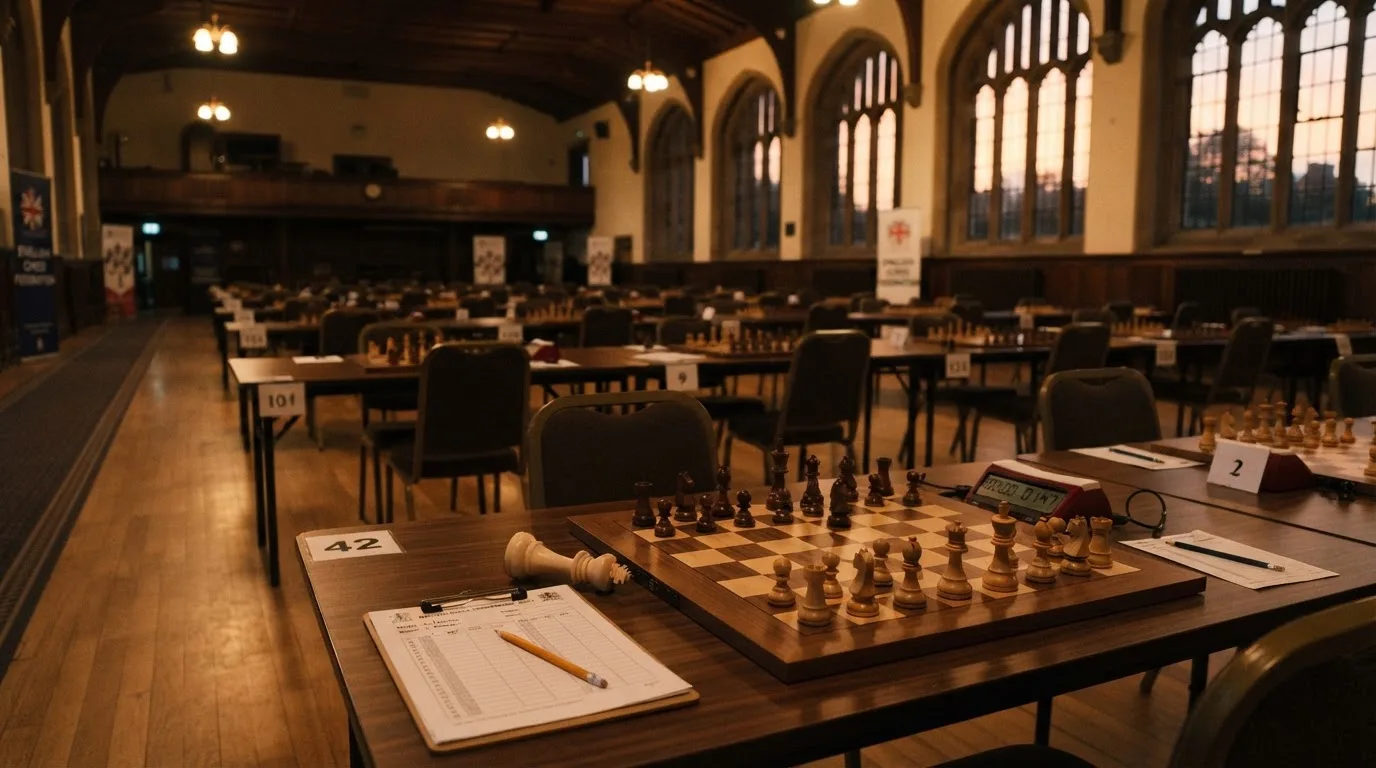
FIDE — the International Chess Federation, the world governing body — publishes the rules in its Handbook, and it sets the conditions under which a game is drawn: by stalemate, by agreement between the players, by a claim of threefold repetition (the same position reached three times) or under the fifty-move rule. Since 2014, fivefold repetition and a 75-move rule end the game automatically, removing the manual claim. A draw is not an unfortunate accident in elite chess — it is a designed feature of a competitive landscape in which neither side can be compelled to overreach. Pre-match odds that look like 1.60 / 4.50 / 5.00 (favourite / outsider / draw) tell you the operator expects a draw roughly half as often as an outsider win, and a chess tip is rarely a one-line piece of advice: it is a position on that triangle, sized against your bankroll and the operator’s margin.
A second layer is the format. Classical chess, with controls running past an hour per player, behaves differently from rapid (15 to 60 minutes total) and blitz (under 15). Draw rates climb in classical between closely rated players and fall in shorter formats where blunders compound. A tip that fits World Championship play may not fit an online blitz tournament the operator is also taking bets on, and the markets are not always labelled to make that obvious. Checking the format before sizing the bet costs nothing; treating it as decorative costs the bettor.
The Three Markets a Chess Punter Actually Bets On
A bookmaker offers several markets on a chess event, but three carry most of the money.

The match result, the 1X2 equivalent for chess, is the simplest. One player to win, the other to win, or a draw. The outsider’s price sits higher than the favourite’s precisely because the draw column will claim a third or more of the volume in elite games, and the operator has had to price it accordingly. Tips built around a long-priced outsider winning outright are usually built around the format and the colour sequence — White moving first in game one of a match is a documented but small edge, smaller than it looks when the operator has priced it.
Outright tournament winner is a futures market. Pick the champion of a Candidates cycle, a Grand Chess Tour event, a Titled Tuesday; the field runs from a handful of elite players to several dozen, and each way down the list the price stretches. The trick of this market is that the favourite often wins outright, but at a price that returns less than a single deposit’s worth of edge after the operator’s cut. Tips built around the field — pick anyone in the top three to back each-way at one operator’s place terms versus another’s — are the ones that actually move money.
Handicap and totals markets sit further down the menu. A bookmaker posts a total-moves line (over/under 60.5 for a rapid game, for example), a handicap on the move count (-5.5 for White), or settled-on-first-blood markets on the first piece to be lost. These markets are thinly priced and heavily margined; the tip to read carefully here is the rule for what counts as a “move”, and how the operator handles a forfeit or disconnection.
How a Chess Tip Becomes a Value Bet
The word on most pages promising “chess betting tips” is not a tip at all. It is a single-decorated forecast — player X to win game Y, odds Z, place the bet — and the reader is left to take it on trust. A tip with anything to say about it walks through three steps.
The first is a probability assessment. Before price, before stake, the tipster forms a view: White wins this game roughly 38 per cent of the time, Black 22 per cent, draw 40 per cent. The view can come from form, head-to-head history, white/black sequence, tournament context, or all of these together. It is always an estimate; nobody has the future.
The second is the operator’s price. The same tip, passed through two bookmakers, will return two different prices, because each operator prices the margin differently. The tip becomes a value bet when the probability the tipster assigned is higher than the probability implied by the operator’s price — once that operator’s margin has been removed.
The third is the stake. A value bet sized at ten per cent of a bankroll can ruin a bettor on a single bad week; the same value bet at one per cent is a profession the bankroll survives. A bankroll rule — same unit stake on every selection, never more than a small per cent of the bank at risk — is the discipline a tip cannot give the reader by itself. It is also the discipline most tip pages do not bother to mention, because naming the size is more candid than the forecast was.
No tip survives all three steps untouched. The tipster who publishes the probability and the price, and lets the reader decide on the stake, is the tipster whose numbers will still be readable a year later.
Reading the Margin Inside a Chess Price
A bookmaker does not charge a fee. It widens the book — each outcome’s price is slightly shorter than the true probability would support, and the gap between what the prices should return and what they do return is the operator’s margin. The margin is the same thing as overround, named from the side of the betting exchange, and it is the same number written the other way up: a market at a five per cent margin pays back 95 per cent of every pound bet on it over the long run.
Consider an illustrative two-way market quoted at 1.90 / 1.90 in decimal odds (fractional 9/10), as an example only — no live price is being asserted. The implied probability of each outcome is one divided by 1.90, which is roughly 52.63 per cent. Two outcomes, both at the same implied probability, sum to 105.26 per cent. That 5.26 per cent is the margin: it sits inside the prices, and every pound wagered on the market returns 94.74p back to bettors on average. Where research gives a margin for one operator’s chess market under one snapshot, it is stated as that snapshot. Where the price is a worked example, it is a worked example and nothing else.
The trade-off is mechanical and unavoidable. Drop the margin to roughly 2.5 per cent and the payout share on the same two-way market climbs to 97.5 per cent — closer to a betting exchange, where backers and layers set prices against each other. Hold the same price and the margin widens with the number of outcomes: a three-way chess market with a draw column carries more margin than a two-way match-up, and totals markets carry more again. The advice for the reader is not to chase the lowest margin on every bet; it is to understand that the price on the slip already includes a built-in retention, and that a tip promising 2.00 on a player whose true probability is 35 per cent is a tip that loses money over a sample.
What a Winning Bet Pays Back
A single is the cleanest calculation. Stake times the decimal odds is the return — the original stake plus the winnings. Stake times (odds minus one) is the profit, the part the punter keeps. A £10 single at 3.50 returns £35 and profits £25. A losing single returns nothing and the stake is gone.
A combination bet — a double, a treble, an accumulator (“acca”) — multiplies the legs into one price. Three selections at 2.00, 1.80 and 2.50 combine into a single price of 9.00; the £10 stake returns £90 and profits £80 if all three win. The legs are independent in the eyes of the operator: each must win on its own market, on its own day, under its own rules, and a voided leg shortens the accumulator to the remaining price. The catch is the size of the price, which tempts the punter toward a small stake and the bettor toward a disciplined one. The bigger the price looks, the more the operator’s margin compounds — leg over leg, the overround multiplies — and a 9.00 “acca” is rarely the value play its headline suggests.
Each-way betting doubles the stake on horse racing and on a handful of chess outright markets, splitting the unit stake between a win position and a place position. The place fraction varies by event and by operator: a quarter of the win odds for the first two places is common, a fifth of the odds for the first three places on a fuller field is also common. An each-way bet at £10 is two bets of £10, not one — a point worth knowing when the operator’s minimum stake is set at £5 and the bettor lays £10.
Live Betting and Cash Out on a Chess Match
Live chess is a slow watch. A classical game runs past five hours; a rapid event settles in under one. The markets run accordingly. Pre-match prices remain on the board through the opening, the middlegame and into long endings, and a small live market opens on the next decisive moment — next capture, first piece lost, total moves past a line. Live prices update move by move in long games, which means the punter’s “live” experience is closer to a checking-in window than a football score ticker.
Cash out sits awkwardly with chess. Most chess events settle on game end, and a cash-out price is the operator’s offer to buy the bet back before settlement, derived from the live price and a margin of its own. On a game that ends in stalemate or threefold repetition the result is a draw regardless of who has the advantage at move 40, and a cash out taken before that resolution is the punter selling the operator certainty for less than it is worth. Where a live chess market exists, the cash-out price is a real number, not a guaranteed one — and on chess the value of waiting is often the higher number.
In-play betting is offered by the licensed operators in the comparison that follows, but the in-play margin is wider than the pre-match margin in chess, as it is on most thinly-traded markets. A tip that was value pre-match is often not value at the in-play price, and the half-time shop-window is a different market with a different margin and a different clock.
The Landscape of UK-Licensed Operators Taking Chess Bets
Great Britain requires a Gambling Commission licence for any operator taking remote bets from customers in England, Scotland and Wales. The Commission’s public register, searchable by trading name, licence number or domain, is the only place the licence is properly verified — never the marketing line on the operator’s own site. The brands below are drawn from that register and each holds a standard general betting licence, the category under which chess sits. Several of them run as part of a larger group; Ladbrokes and Coral, for example, sit under one licence holder, and Paddy Power and Betfair under another, which is why the page carries them as sister brands and not independent operators. Every GB-licensed online bookmaker takes part in GAMSTOP, the national multi-operator online self-exclusion scheme, and the marketing at each is bound by the CAP Code and the LCCP social-responsibility code. The cross-check for every licence on this page is the Commission’s public register as of the date at the top of the page.
The comparison that follows lists each licensed operator with its account number, its licence holder and a one-line statement of what its own terms say about the chess-betting questions the page keeps meeting. The data is current as of the date above and against the Commission’s register. The same operators appear later with longer verdicts.
| Operator | Licence (account number) | Licence holder | What the operator’s own terms state |
|---|---|---|---|
| Betboro | 44181 | Webmedia Development N.V. | Offers in-play markets and cash out on selected sports, with boosted odds on singles from a £10 stake and a deposit-limit toolset. |
| Hollywoodbets | 53028 | Hollywoodbets International UK Limited | Welcome offer pays a stake-matched free bet of up to £30 on a first losing accumulator of three or more legs, settled within seven days. |
| 888sport | 39028 | 888 UK Limited | Pre-match and in-play markets, Cash Out, Bet Builder, racing streams, BetFinder form tools and daily boosted odds on the platform. |
| Sky Bet | 67370 | SBG Sports Limited | Welcome offer is £30 in free bets after a £5 deposit and a first settled bet of at least 5p at odds of 1/1 or greater. |
| Swifty Sports | 58957 | Swifty Global (UK) Ltd | Best Odds Guaranteed, Cash Out on horse racing and football, daily boosts, live streaming and in-play markets, with Bet Builder listed as coming soon. |
| Ladbrokes | 54743 | LC International Limited | Odds boosts on horse and greyhound racing, Best Odds Guaranteed on UK and Irish racing, in-play betting and Acca Boosts. |
| DAZN Bet | 48756 | DZBT Limited | Deposits start at £5 by debit card, Apple Pay, Paysafecard, Trustly and Skrill, and at £20 by PayPal, with no processing fees. |
| Betfair | 39439 | PPB Counterparty Services Limited | In-play betting, Bet Builder, free live streaming inside the app and a 90 Minute Payout market on selected events. |
| QuinnBet | 61011 | QuinnBet (Gibraltar) Limited | Free bets valid for seven days, used on any market at minimum odds of 1/2 (1.50) and capped at maximum odds of 50/1. |
| William Hill | 39225 | WHG (International) Limited | Best Odds Guaranteed on UK and Irish horse racing from 8 AM on race day, on single and multiple bets. |
The comparison is a starting point, not a finish. Each operator carries a verdict below, written for the reader who wants to know which one is worth their account.
The Legality and Regulation Behind the Licence
A bookmaker serving customers in Great Britain needs a Gambling Commission licence. The point is not pedantry: since the Gambling (Licensing and Advertising) Act 2014 the test applies at the point of consumption, and a Curaçao, Maltese or Gibraltar licence does not substitute. A site taking bets from a customer in Manchester without a Commission licence is breaking section 33 of the Gambling Act 2005 (as amended), which is the legal point the offshore marketing copy tends to skip.
The framework is the Gambling Act 2005, sponsored by the Department for Culture, Media and Sport through the Commission as a non-departmental public body. The Commission publishes a public register, which can be searched by business name, trading name, licence number or domain, and which is the whole test of whether a brand is licensed. The categories on the licence are the categories the operator can offer: remote general betting standard (real events), remote general betting standard (virtual events), remote general betting limited, remote pool betting, and remote betting intermediary for exchanges. Chess sits under “real events”. A licence is not a marketing endorsement; it is permission to operate within a defined set of rules.
The minimum age is 18 across all GB-licensed sites. Name, address and date of birth are verified before the first deposit or wager — the requirement has been in force since 7 May 2019 and covers free bets and bonuses, not only paid bets. Credit cards are banned for gambling in Great Britain since 14 April 2020 (LCCP condition 6.1.2), including credit-card-funded payments through an e-wallet; debit cards and bank-based payments are not covered by that ban. There is no state monopoly and no statutory cap on stakes; operators set their own maximum stakes, and may restrict customers on a risk basis.
What may be bet on is not a closed list. Each operator offers markets under its own rules and the Licence Conditions and Codes of Practice. In-play betting on chess is offered by GB bookmakers, governed by the operator’s licence conditions and customer-protection duties — never written as an unrestricted right, because it is governed rather than free. Esports, virtual events, politics and novelty markets are also offered; virtual events are a separate licence category.
Financial spread betting is regulated by the Financial Conduct Authority, not the Commission — a dividing line worth knowing because a brand that offers spread betting on chess indices (Spreadex is the example most cited in the trade press, regulated by the FCA on the spread side and the Commission on the fixed-odds side) carries two regulators and two sets of rules on what is and is not allowed.
Player Protection, Limits and Where to Get Help
GAMSTOP is the national multi-operator online self-exclusion scheme in Great Britain and a mandatory licence condition for every GB-licensed online bookmaker since 31 March 2020. Exclusion periods are six months, one year, five years, or five years with auto-renewal; after the chosen period the exclusion stays in place for a further seven years unless the customer asks GAMSTOP to remove it. GAMSTOP covers online sites and apps; the high-street betting shop exclusion scheme is a separate system.
A financial vulnerability check has been in force for licensed remote betting since 30 August 2024: when a customer’s deposits minus withdrawals exceed £150 across a rolling 30 days (since 28 February 2025), the operator runs a public-record check — bankruptcy, county court judgments — to confirm the customer’s position. The check is not an income check, and not a credit reference check. The “affordability checks” the press describes are announced under a staged plan by the Commission (article of 7 July 2026), with no start date set — write “announced, staged, no start date”, not “in force”. Deposit limits under RTS 12 are the customer’s choice: the gross deposit limit, which the operator must offer on a fixed time frame, and the first changes have applied since 31 October 2025; a second phase was postponed to 30 September 2026. Whether the second phase is live is not established.
There is no state-set deposit or loss ceiling. The player pays no tax on betting winnings in Great Britain (general information, not tax advice; a professional gambler should ask HMRC or an adviser). General Betting Duty is the operator’s tax on gross profits at 15 per cent, with a new remote betting rate of 25 per cent applying from 1 April 2027, while remote bets on UK horse racing, pool betting, in-person betting and self-service betting terminals stay at 15 per cent (HM Government policy paper of 26 November 2025). Until 1 April 2027 the remote rate is 15 per cent; whether operators pass duty on through odds is not established.
Help is available through GamCare, which runs the National Gambling Helpline; through GambleAware; through the NHS gambling clinics network; and through Gamblers Anonymous. BeGambleAware is the body that points readers to most of these. A serious financial signal — a chase, an unpaid bill on a betting account, a secret gambling balance — is a reason to talk to one of these services before it becomes a reason to talk to a debt adviser.
Advertising, Bonuses and the Wagering Cap
Betting advertising in Great Britain is not licensed by the Commission. It runs through the CAP Code (non-broadcast) and BCAP Code (broadcast), enforced by the ASA, alongside the Commission’s LCCP marketing conditions. The CAP Code’s section 16 covers the social-responsibility rules: marketing must not be of strong appeal to under-18s, and no one who is or seems to be under 25 may be featured gambling or playing a significant role in an advertisement, with an exception for marketing placed where a bet can be made directly. The rule concerns who can appear in the ad, not who can bet.
Promotion rules in force since 19 January 2026 cap wagering requirements on bonuses at 10x: a £10 bonus at 50x requires £500 of bets to clear it; under the cap no more than £100. Mixed-product promotions (an offer that requires gambling on two or more product types such as betting, casino, bingo and lottery) are banned. Whether the cap applies to free bets with no wagering condition, and any cap on the money value of a bonus, are not established. “Whistle-to-whistle” is an industry code rather than a law: since 1 August 2019, betting advertisements are not shown on TV from five minutes before a live sporting event to five minutes after it, before the 9pm watershed, with horse and greyhound racing excluded. The Premier League clubs’ voluntary withdrawal of front-of-shirt gambling sponsorship from 2026/27 is voluntary, not law.
The honest framing on bonuses, after that brief: a free bet whose stake is not returned is not a free bet in the lay sense — it is a credit the bettor wagers with, and the price the bettor takes at the credit already includes the operator’s margin. A welcome offer of three £10 free bet tokens after a £5 deposit and a first settled bet at odds of 1/1 (Skate Bet’s terms read this way) is a real claim, but the value of each token on a chess market at 2.50 with a five per cent margin is £10 times (2.50 − 1) times 0.95, which is around £14.25 of expected return — a third of the token’s headline value. That is how the offer works at average, and the typical chess bet will need several selections to find its footing. The promised boost on enhanced odds is the same arithmetic, with the smaller the margin the worse the boost has to look to clear.
Offshore, Blocked and What the GB Licence Does Not Cover
A GB licence is required at the point of consumption, regardless of where the operator is incorporated. A Curaçao-licensed brand taking bets from a customer in Birmingham is breaking the law in the United Kingdom, not in Curaçao. The Commission takes a point-of-consumption line because the previous offshore model saw British customers routed through shell licences with no British oversight — and the post-2014 framework is the legislative response.
The penalty for the operator, not the customer, runs up to 51 weeks’ imprisonment, a level-5 fine, or both on summary conviction (six months in Scotland) under section 33 of the Gambling Act 2005 as amended. The Commission has not been found to pursue the customer who merely bets on an unlicensed site, and a customer using an offshore brand faces the much heavier penalty of being unprotected: no GAMSTOP coverage, no Commission complaints route, no British dispute-resolution body, no British consumer redress if funds are withheld, and not bound by the 10x bonus cap or the £150 financial vulnerability check. Honest framing: a licensed site brings checks, limits, GAMSTOP coverage and a bonus cap, but also verification before the first bet; an unlicensed site brings none of those protections. Neither is “the safe choice” by default.
Enforcement is disruption rather than blocking. The Commission issues cease-and-desist notices, refers domains to search engines, and works with registrars, hosts and payment providers. Court-order DNS blocking powers have been granted or are about to be granted — never written as an ISP-blocking regime that already operates. A reader does not need to know the operational detail; the reader needs to know that the brand they fund is on the Commission’s register, or that the brand they fund is not, and what the second case costs them in concrete protections.
Mobile, App and Browser — Where the Slip Lives in 2026
A chess bet placed from a phone is the typical chess bet in 2026, and the operator’s mobile offering is now the operator’s main offering. The verification requirement that lands before the first deposit — name, address and date of birth — happens inside the app in most cases, often through a document scan and a selfie, often completed in under a minute. A payment method follows, and the bettor is in. Browser-only operators still exist, but the experience is second-best to the app for live chess betting, where the move-by-move update matters and the tab-the-app pattern matters.
Most of the comparison operators publish an iOS app through the App Store and an Android app through the Play Store; a smaller number publish a progressive web app for the browser. The performance differences are real: live scores reach the app faster than the browser, bet placement is two taps versus a form’s worth of fields, and the push notification on the next decisive move is more useful than an email five minutes later. On a chess game that ends in 90 moves, a tab kept current with a move-by-move feed is worth more than a single bet in price.
The risk on the app side is also worth taking seriously. Push notifications are the operator’s most direct route to the reader’s attention; safer-gambling tools (deposit limits, reality checks, time-out) sit inside the same settings page as the bet-slip preferences. A reader who wants to read a chess tip and walk away should set a reality check before opening the betting app. The reader who wants to bet one accumulator and stop should set a deposit cap at the same number as the day’s planned betting budget, and let the operator enforce the discipline the bankroll rule cannot.
Predictions, Strategy and the Verdict That No Tip Can Carry
A tip that names a winner is not a tip. It is a forecast dressed as insight, and a reader who acts on it without the working steps above is paying the bookmaker to confirm a guess. The honest version of a “chess betting tip” in 2026 looks like the argument above, beginning with what the tipster thinks the probability is, walking through what the operator is offering, and ending with what stake the bankroll allows. The strategy is the same on every bet: probability above price, after margin; unit stake sized as a small percentage of the bank; a log of every selection so the bankroll’s actual edge, not its hoped edge, can be read each month.
A prediction market on chess is a quiet niche. Prediction-platform markets on World Chess Championship cycles surface when news breaks and the operators price them, and a tipster who follows them well is one who knows the operator’s market-making pattern. The strategy sits close to the same arithmetic: take the predicted probability from the published odds, subtract the operator’s margin, and decide whether the bet is at value. Where the prediction-market price matches the bookmaker’s price, the bettor has no edge. Where the two diverge by enough to clear the margin and the bettor’s commission, the bettor has a trade.
No tip on this page, or anywhere, can guarantee the outcome of a chess game. Magnus Carlsen has lost tens of elite classical games to players ranked below him; Gukesh Dommaraju won the World Chess Championship in 2024 as the youngest undisputed champion in history. The events that decide a chess match — a missed tactic on move 27, a pawn exchange on move 60, a clock flagging under time pressure — are not predictable to the resolution the betting market requires, and the bettor who treats them as predictable pays the margin for the privilege. That is also why tipsters who promise certainty are tipsters whose names a year later no one remembers: the certainty they sold was never for sale. The discipline is the investment; the bet is the trade.
Reviewed Bookmakers for Chess Betting in Great Britain
The ten operators below are the licensed operators from the comparison above, each with the licence number, the licence holder, the chess-facing facts carried over and a verdict at the end. The verdict is the page’s own judgement, written from the terms above and from what each licence number signals about the operator’s standing on the register.
Betboro
Betboro carries Gambling Commission account 44181, held by Webmedia Development N.V., and trades under a standard general betting licence. Its own terms describe in-play markets and cash out on selected sports, with boosted odds on singles from a £10 stake and a deposit-limit toolset. The licence categories include the type of licence chess sits under, which means the brand is permitted to offer the game without a category change.
The chess calendar at Betboro is not the headline calendar of a UK-facing sportsbook — football, horse racing and tennis dominate — but chess is listed and priced when an event matters. The boosted-odds promotion on singles from £10 is a worthwhile hook on a singles betting strategy rather than an accumulator strategy, and a deposit-limit toolset is the safer-gambling ground floor a bettor should set before the first bet. The page would want to see, on a fresh visit, the chess outright tournament winner market and the match-result market both priced at non-trivial events before sizing a stake; a reader with a smaller set of planned events may find the brand a quiet second account rather than a primary one.
Hollywoodbets
Hollywoodbets is licensed under Gambling Commission account 53028, held by Hollywoodbets International UK Limited, on a standard general betting licence. The brand’s welcome offer pays a stake-matched free bet of up to £30 on a first losing accumulator of three or more legs at combined odds of 4/1 (5.00) or greater, settled within seven days; one free bet per customer. The operator’s app published terms also describe the operator’s role on South African racing and other sports, with chess listed when an event matters.
The welcome offer is a stake-not-returned free bet on a losing accumulator, not a stake-returned one on a single. The expected value of a £30 free bet at average bookmaker margin on a 5.00 chess market is £30 times (5.00 minus 1) times 0.95, which is around £114 of expected return against the operator’s edge — but only if the legs win. The accumulator constraint (3+ legs, 4/1 minimum) is the math the reader runs on the slip, and a singles-only strategy will not trigger the offer. The honest position is that the offer is real and the expected value is real, and the bettor who takes it should plan for a seven-day tickler before it expires.
888sport
888sport holds Gambling Commission account 39028, operated by 888 UK Limited under a general betting licence. Its platform describes pre-match and in-play markets, Cash Out, Bet Builder, racing streams, BetFinder form tools, a live bet feed and daily boosted odds. The range is the broad sportsbook that 888sport trades under across Europe, and chess sits inside the menu rather than on the headline banners.
The BetFinder form tool is worth knowing about on a chess outright: it can be turned against historical odds tables rather than form tables, and a reader who uses it as a price-history tool rather than a tip-tool is using it for what it does. Cash Out on a chess bet that runs past game end is a useful safety valve on a market that may go sideways; the Bet Builder is less useful on chess than on football or American sports. The verdict is that 888sport is a fit second account for chess outrights and a fit primary account for a reader whose betting slips run across multiple sports.
Sky Bet
Sky Bet is licensed under Gambling Commission account 67370, held by SBG Sports Limited, on a standard general betting licence. The brand’s welcome offer is £30 in free bets, credited as three £10 tokens after a £5 deposit and a first settled single or each-way bet of at least 5p at fractional odds of 1/1 (decimal 2.00) or greater. Sky Bet’s app and site describe the operator’s broader UK-facing sportsbook, with chess listed when an event matters.
The welcome offer is structured to land three tokens of £10 each, all of them stake-not-returned, with a one-day expiry on the tokens. The expected value of three £10 tokens at typical bookmaker margin on chess markets priced between 2.00 and 5.00 is roughly £70 to £140 over the life of the tokens, against the £5 qualifying deposit the reader has already made. The minimum first-bet stake of 5p at 1/1 (2.00) is a low bar and is the standard pattern for “qualifying bet” construction. Verdict: a primary-account candidate for a chess outright punter who already bets on Sky Bet’s other sports, and a fit secondary on the chess-only bettor’s shortlist.
Swifty Sports
Swifty Sports is licensed under Gambling Commission account 58957, held by Swifty Global (UK) Ltd, on a standard general betting licence. Its app terms describe Best Odds Guaranteed, Cash Out on horse racing and football, daily price boosts, live streaming and in-play markets, with Bet Builder listed as coming soon. Chess is part of the menu but not the headline.
Swifty Sports’ Best Odds Guaranteed is the same horse-racing promotion other major operators offer; it does not transfer to chess. Cash Out on horse racing and football is useful on those sports; on chess the bettor may find that a settled-bet slip on a chess outright is more useful than a cashed-out one. The Bet Builder being listed as coming soon is a flag for the reader who trades in combination bets on football but does not affect a chess singles strategy directly. Verdict: a fit secondary account on a reader’s shortlist, but not the chess-first choice — the operator is a more natural primary on racing and football than on chess specifically.
Ladbrokes
Ladbrokes is licensed under Gambling Commission account 54743, held by LC International Limited, on a standard general betting licence and an intermediary licence. The operator’s terms describe odds boosts on horse and greyhound racing, Best Odds Guaranteed on UK and Irish horse races, in-play betting and Acca Boosts. The licence holder is the same body that operates Coral — the brands sit under one licence, which is the architectural reason both names appear at the same sportsbook.
Ladbrokes’ price-boost and acca-boost economics are similar to Sky Bet’s and Betfair’s; the difference is the depth of the markets on offer and the cumulative scale of a long-running brand. A reader who uses Ladbrokes for chess is using a deep sportsbook where chess sits inside a much larger menu, and the price advantage on a one-off chess event versus the field is rarely dramatic. Verdict: a fit primary account on a multi-sports reader’s shortlist; for a chess-only punter, the brand is a useful second rather than a first.
DAZN Bet
DAZN Bet, licensed under Gambling Commission account 48756 and held by DZBT Limited, carries a general betting licence. Its published deposit terms start at £5 by debit card, Apple Pay, Paysafecard, Trustly and Skrill, and at £20 by PayPal, with no processing fees stated. The brand sits inside a sports-media group whose headline product is the streaming service, with the sportsbook bolted on.
The deposit minimum of £5 on most methods is the friendliest on the page for a bettor whose staking unit is small; the £20 PayPal minimum is the standard ceiling PayPal itself imposes on gaming transactions, not a DAZN Bet choice. The lack of stated processing fees is a useful operating point on a market where some operators charge a percentage on withdrawals under a threshold. The chess offering is not the headline offering of the sportsbook. Verdict: a reasonable second account for a chess betting reader whose staking unit is small, particularly on the deposit-method side.
Betfair
Betfair is licensed under Gambling Commission account 39439, held by PPB Counterparty Services Limited, on a standard general betting licence. The operator’s app terms describe in-play betting, Bet Builder, free live streaming inside the app and a 90 Minute Payout market. Paddy Power is the sister brand under the same licence holder, which is why both names appear at the same sportsbook-as-platform group.
The 90 Minute Payout market is the football cashback offer of the brand, not the chess one. The Bet Builder is similar to the football-side offering and not native to chess singles. The in-play offering on chess is thinly margined and tracked by most sportsbook comparison tables; the Betfair exchange’s published-margin advantage on close two-way markets is the most useful operating point on the brand. Verdict: a fit chess account for a reader who already trades the exchange; a fit secondary account for the sportsbook-only reader, particularly on markets where the Betfair price leads the field.
QuinnBet
QuinnBet is licensed under Gambling Commission account 61011, held by QuinnBet (Gibraltar) Limited, on a standard general betting licence. The operator’s free bet terms run for seven days from credit, usable on any market at fractional odds of 1/2 (decimal 1.50) or greater, with a maximum odds cap of 50/1. Straight accumulators are allowed; Trixies, Patents and Yankees — the patent system’s combination bets on 3, 4 and 4 selections respectively — are not.
The seven-day expiry is shorter than the typical 30-day expiry on larger operators, and the 1.50 minimum is a low bar; the maximum odds cap is a tighter ceiling than most operators apply. The exclusion of Trixies, Patents and Yankees is a tax on the patent-style punter and a reason to read the bonus terms. The bettor who takes the bonus and clears it in chess singles is at the more permissive end of the conditions; the bettor who plans to clear it on racing combination bets should expect to find the patent system off the menu. Verdict: a fit secondary account on a shortlist whose bets run in singles and accumulators, and a careful first one for a reader whose strategy leans on the patent system.
William Hill
William Hill is licensed under Gambling Commission account 39225, held by WHG (International) Limited, on a standard general betting licence. The operator’s Best Odds Guaranteed runs on UK and Irish horse racing from 8 AM on race day, on both single and multiple bets; ante-post, tote and pari-mutuel bets are excluded. The brand’s broader sportsbook carries chess when the events matter.
William Hill’s brand recognition is the brand’s lasting operating point: the high-street chain remains visible in many British towns and the online brand sits underneath it. On chess specifically the brand’s offering is similar to Ladbrokes’ and Coral’s — a deep sportsbook where chess sits inside the menu rather than on the front page. The Best Odds Guaranteed is a horse-racing promotion, not a chess one. Verdict: a fit primary account for a multi-sports reader whose tipping touches football and racing as much as chess; a fit secondary for a chess-only punter.
How to Use This Page
The page is built around a single argument: a chess betting tip has three working parts — probability, price and stake — and a tip that hands the reader only the first part is leaving the second and the third as the reader’s problem. The operators named above are the licensed operators in Great Britain; the licence numbers are the verifiable ground; the verdict at the foot of each operator is the page’s own judgement on what the operator is good for.
The most useful thing a reader does with this page is set a bankroll rule — same unit stake on every selection, never more than one or two per cent of the bank at risk — and verify the licence on each operator’s homepage against the Commission’s register. The least useful thing the same reader can do is chase a tip that does not walk the reader through the price and the stake.
Chess is a game of three results and a margin inside every price. The rest is the discipline to walk away when the math no longer favours the bet.
Frequently Asked Questions
Where can I bet on chess in Great Britain?
At any GB-licensed bookmaker with a standard general betting licence. The brands on this page are licensed under that category; the verification is the Gambling Commission’s public register, searchable by name or licence number. Offshore brands are not a substitute: a Curaçao or Malta licence does not cover a customer in Manchester, and no British protection applies.
Is betting on chess legal in Great Britain?
Yes, at a GB-licensed operator, at age 18 or over, with name, address and date of birth verified before the first deposit or bet. Chess is not on a closed statutory list; it is offered under each operator’s general betting licence within the rules of the Licence Conditions and Codes of Practice.
How do I place a chess bet?
Open an account at a licensed operator, complete verification (typically a photo ID and proof of address), deposit with a debit card or another permitted method (credit cards are banned for gambling), find the chess event in the sportsbook, choose the match result, outright tournament winner or a derivative market, set the stake, and confirm. The winning return is stake times the decimal odds; the profit is stake times (odds minus one).
What is a value bet and why is no tip ever certain?
A value bet is a selection whose tipster-assessed probability is higher than the probability implied by the bookmaker’s price, after the margin is removed. No tip is ever certain because the probability the tipster assigns is always an estimate; the bookmaker’s price is always an estimate plus a margin; and the events that decide a chess game — a missed tactic, a clock flag, a pawn breakthrough on move 60 — are not predictable to the resolution a bet requires.
What is the bookmaker’s margin and how can it be seen in the odds?
The margin is the per cent of every pound wagered the bookmaker keeps on average; the rest is paid out as winnings. It is seen in the prices themselves, because each outcome’s implied probability (one divided by the decimal odds) sums to more than 100 per cent. An illustrative two-way market at 1.90 / 1.90 carries an implied sum of 105.26 per cent, which is a margin of 5.26 per cent and a payout share of 94.74 per cent.
Tennis, darts & cue sports – Bookies Trust
Content created by the «Bookies Trust» team
