
Chess Betting Odds 2026: A Punter's Guide to Markets, Margins and What They Mean
 Available in US
The data below is current as of 27 October 2026 and has been checked against the Gambling Commission’s public register. A chess betting market looks like any other two-outcome or three-outcome market on a bookmaker’s site, and the arithmetic that built it is the same arithmetic used for football, tennis or boxing. What makes chess different is not the maths; it is the structure of the game itself, the way tournaments are scheduled, and the fact that a draw is a result written into the rules rather than a rare event. That structure shapes every market, every price and every margin a punter meets.

What a chess betting odd actually tells you
Chess betting odds are decimal prices attached to one of three outcomes of a single game, or to a position inside a tournament. White wins (1–0), Black wins (0–1) or draw (½–½) are the three possible results of a classical game under FIDE rules. A bookmaker quotes a price on each, and the three prices, taken together, hide a margin: the slice of every pound staked that the bookmaker keeps whatever the result. Understanding that margin is the only way to compare one bookmaker’s price to another’s, because a “bigger” number is not always a better one once the margin around it is read.
The three-outcome shape of a chess game
A chess market is structurally a three-outcome market, and that is rarer in betting than the familiar two-outcome home/away or over/under line. The draw is not a corner case; it is roughly a third of professional games at the highest level. Some bookmakers offer a two-outcome match market that pays out on a win for either colour and treats a draw as a push (stake returned), which looks attractive but quietly re-prices the other two outcomes against you. Others offer a three-outcome market where the draw is its own price, and the margin is split three ways instead of two. The shape a bookmaker offers changes which price is worth taking and which is not.
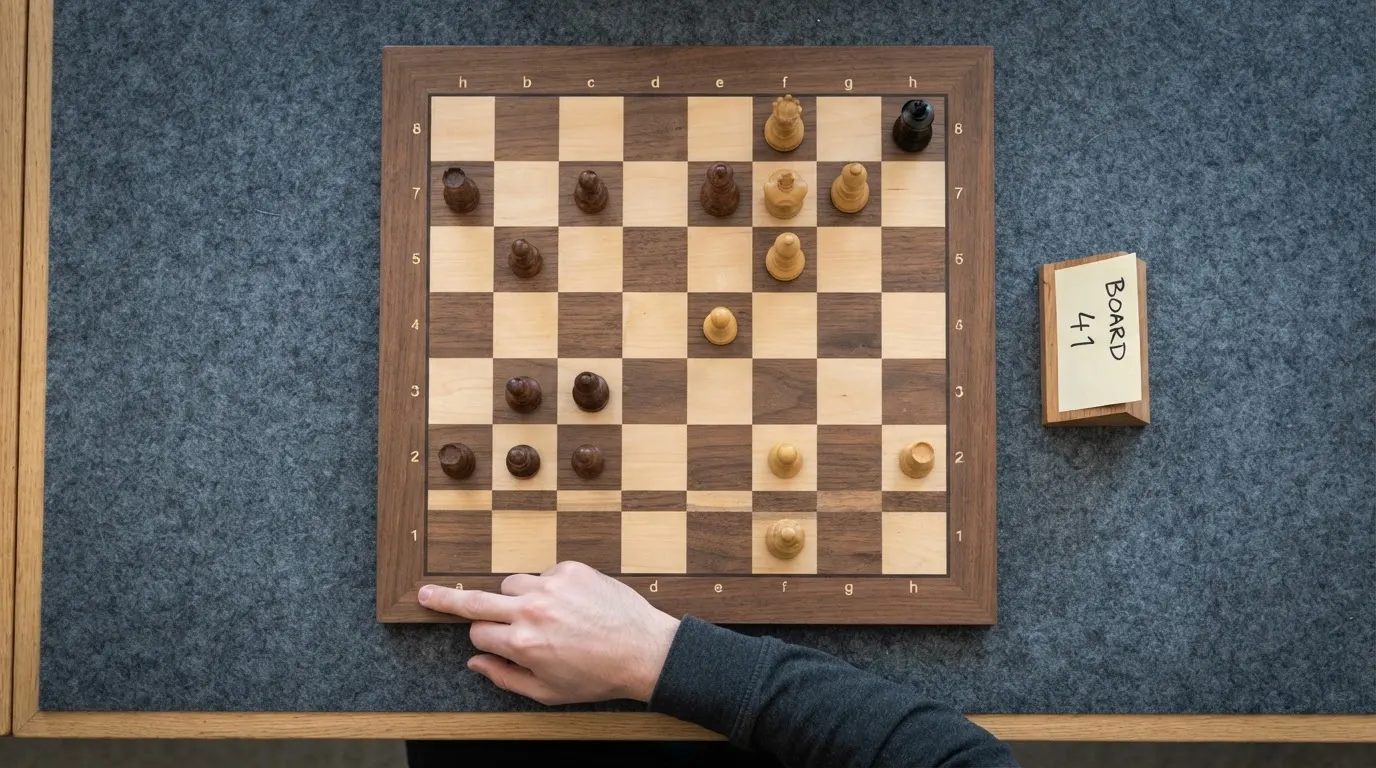
How decimal odds translate into a return
At decimal odds of 2.50, a £10 stake returns £25 if it wins — the stake plus £15 of profit. At 3.75, that same £10 returns £37.50. The conversion from a fractional quote (9/2, say) to decimal (5.50) is mechanical: divide the first number by the second and add one. The stake is included in the decimal figure; it is not in the fractional one. A punter who has only ever read fractional odds (5/1, evens, 11/4) should know that “evens” is 2.00 in decimal, “6/4” is 2.50, and “1/3” is 1.33. Getting that translation wrong costs real money on every bet that follows from it.
What the margin is and why it bites
A bookmaker’s margin is the slice of the market the bookmaker keeps, calculated from the implied probabilities of every outcome. If a perfectly fair three-outcome market had each outcome at exactly 33.33%, the prices would be 3.00 across the board. A bookmaker’s actual prices sum to more than 100% of implied probability; the overround is the excess above 100%, and the margin is the percentage of the total stake that the bookmaker keeps. For a two-outcome market priced at 1.90 and 1.90, the implied probabilities sum to 105.26%; the overround is 5.26%, which corresponds to a margin of 5.0%.
The same two-way market at 1.90 / 1.90 yields a payout share of roughly 95% and a margin of about 5%. Stated as a band rather than a single figure, the margin on a typical two-outcome chess market sits between roughly 3% on a high-liquidity event and 8% or more on a niche fixture where the bookmaker has less information. For a three-outcome chess match market, margins tend to sit at the higher end of that range because the draw is harder to price.
Why a bigger price is not always a better price
Two bookmakers can offer different prices on the same outcome and the “bigger” one can still cost more in expected terms if its margin is heavier on the other side of the market. A punter who chases the largest number without reading what surrounds it is paying a hidden premium that shows up over dozens of bets, not on a single one. The trick is to compare markets on margin, not on headline price — and to compare margins on the same market shape, because a margin on a match-result market is not a margin on a handicap or a totals line.
Where chess appears in a bookmaker’s tournament calendar
Chess is a minority sport in the British sportsbook market. Most major brands cover the marquee events — the World Chess Championship, the Candidates Tournament, sometimes the Grand Chess Tour — and leave the rest of the calendar to specialist bookmakers or to outright markets on rating events. Coverage is calendar-shaped, not league-shaped: chess is not a weekly fixture list, it is a series of tournaments clustered around the international circuit.
The World Chess Championship and the cycle around it
The World Chess Championship is the single biggest betting event in the sport. The current cycle ends with a match between the reigning champion and the challenger who came through the Candidates Tournament. Wilhelm Steinitz claimed the first universally recognised title in 1886, and Gukesh Dommaraju won the title in 2024 at the age of eighteen, the youngest champion in the modern era. Each match is a short, scheduled contest — usually fourteen classical games, with tiebreaks — and bookmakers price every game individually as well as the match outright.
The Candidates Tournament decides who plays the champion. It is an eight-player double round-robin, every game appears in a bookmaker’s feed, and outright markets run throughout. Around the World Championship match itself, some bookmakers offer prices on individual games, on the series score after a given number of games, and on whether the match will go to tiebreaks.
Other FIDE events and the wider circuit
Beyond the world cycle, FIDE sanctions the Grand Chess Tour, the Olympiad, the World Rapid and Blitz Championships, the European Individual Championship and a long tail of opens and round-robins. Coverage at the mainstream British bookmaker is uneven: some brands price the Grand Chess Tour stops, others leave them out. A specialist chess bookmaker, where one exists in the British market, prices more of the calendar but at the cost of smaller liquidity and, usually, a heavier margin.
Online and rapid events
Online rapid and blitz events — the Champions Chess Tour, the Meltwater Champions Chess Tour, Speed Chess and similar — have grown into a betting market in their own right. They are short, frequent and easy to follow live, which makes them attractive for in-play betting. Their results are more volatile than classical chess, and bookmakers tend to price them less aggressively because their own models are still learning the field.
The top ten UK-licensed bookmakers for chess
Every brand below holds a remote licence from the Gambling Commission for real-event betting in Great Britain. None of them is “the only” licensed one — a public register lists far more — and a place in this list is not a recommendation. Each entry is written in the same shape: what the operator is licensed to do, what its own terms say about the things that matter for a punter comparing one to another, and a verdict on what the comparison actually buys.
The comparison uses one table column for the licence reference and one for what the operator’s own terms state on the subject of the page — chess markets, in-play betting, bet builders and the like. The shape of the table is identical across the brands because the question is identical: what does this operator offer, and on what legal footing.
| Brand | Gambling Commission licence | What the operator’s own terms state |
|---|---|---|
| Betfred | Remote licence 039544-R-319290-010 (account 39544), held by Petfre (Gibraltar) Limited | Mobile app published by Done Brothers (Cash Betting) Ltd covers 21 sports and over 2,000 casino-style games; markets and live coverage vary by event |
| BetMGM | Remote licence 039198-R-319450-029 (account 39198), held by LeoVegas Gaming PLC | UK sports welcome for new customers depositing £10+ and placing a sports bet within 7 days: four £10 free bets (two football accas of 4+ legs, two sports multiples of 2+), each valid 7 days, minimum odds apply, opt-in required |
| Bet600 | Remote licence 044731-R-323941-016 (account 44731), held by Tyche Tech Limited | Best Odds Guaranteed on horse racing: bets paid at the starting price if the SP beats the price taken |
| 10bet | Remote licence 043173-R-322899-023 (account 43173), held by Blue Star Planet Limited | Sportsbook covers football, tennis and horse racing with cash out, bet builder and live streaming |
| DragonBet | Remote licence 064908-R-339041-003 (account 64908), held by DragonBet Ltd | App features Welsh football and rugby markets, racing, American football, in-play betting and bet builder markets |
| Fitzwilliam Sports | Remote licence 048760-R-335434-009 (account 48760), held by SBKI Limited | Dublin-based bookmaker with capped membership; “High Stakes Welcome” subject to compliance criteria; instant deposits, fast withdrawals, timeouts, deposit limits, links to GambleAware, GamStop and Gamblers Anonymous |
| Bar One Racing (BAR 1 Betting) | Remote licence 056516-R-332750-007 (account 56516), held by Bar-One Racing Limited | Irish independent bookmaker with shops across Ireland and racing sponsorships at Dundalk, Fairyhouse, Navan, The Curragh, Curraheen Park and Cork |
| Midnite | Remote licence 101839-R-342850-001 (account 101839), held by Midnite Limited | UK sports welcome: new customers betting £5+ on pre-match odds of EVS (2.0) or greater within 14 days of sign-up receive £25 in free bets and 50 free spins, valid 7 days; site shows in-play events, acca builder, popular accas and price boosts with maximum-stake limits |
| Paddy Power | Remote licence 039439-R-319330-013 (account 39439), held by PPB Counterparty Services Limited | App covers football, horse racing, boxing, rugby, tennis, golf, darts, snooker and F1 |
| NetBet | Remote licence 039170-R-319343-032 (account 39170), held by Netbet Enterprises Limited | Daily Boosts, Profit Boosts and free bet offers; bet builder with instant dynamic odds; sports stats for major leagues |
Betfred
Betfred is one of the larger British high-street names to have moved online. Its Commission licence is held by Petfre (Gibraltar) Limited under account 39544, and the Done Brothers app covers 21 sports plus a large casino product. Chess coverage on Betfred tends to follow the marquee events rather than the wider calendar, and a punter comparing it against a specialist will find fewer outright markets on the long tail of opens and round-robins. The breadth of the sportsbook is the reason most customers pick Betfred over a specialist; for chess alone, the case is thinner.
Verdict: a solid generalist whose chess depth tracks the headline events and leaves the wider calendar thin.
BetMGM
BetMGM’s UK arm sits behind LeoVegas Gaming PLC under account 39198. The welcome package is structured rather than a single matched bonus: four £10 free bets split between two football accumulators of four or more legs and two sports multiples of two or more, each valid for seven days from issue, with minimum odds and an opt-in. Chess punters will find that the sportsbook treats chess like other minority sports — present, but not its reason for existing — and the free-bet structure skews towards the bigger accumulator sports.
Verdict: the welcome structure rewards accumulator betting more than single chess selections, and a punter who wants singles-only value will look elsewhere.
Bet600
Bet600 is a smaller British brand licensed under Tyche Tech Limited (account 44731), and its headline feature is Best Odds Guaranteed on horse racing: a bet taken at a price is paid out at the starting price if the SP turns out larger. That is a horse-racing commitment rather than a chess one, and it tells a punter where the operator’s edge of the market is. Chess on Bet600 follows the standard minority-sport pattern: marquee events priced, calendar gaps elsewhere.
Verdict: the horse-racing guarantee is irrelevant for chess, and the operator’s chess offer is mainstream rather than specialist.
10bet
10bet’s licence is held by Blue Star Planet Limited (account 43173), and its sportsbook lists football, tennis and horse racing as headline sports with cash out, bet builder and live streaming available. Chess is not named in the same way as the headline three — coverage tends to be event-driven rather than year-round — but the underlying features (cash out, bet builder) apply to whatever markets the site does carry.
Verdict: a mainstream multi-sport bookmaker where the modern betting features are present and the chess depth is event-dependent.
DragonBet
DragonBet is a Welsh-focused brand operated by DragonBet Ltd itself (account 64908), with a feature set built around Welsh football and rugby, racing, American football, in-play and bet builder markets. Chess is not in that feature list, and a punter who comes to DragonBet for chess will find a thinner market than at a larger generalist.
Verdict: the right pick for a Welsh-racing customer, the wrong one for a dedicated chess punter.
Fitzwilliam Sports
Fitzwilliam Sports sits behind SBKI Limited under account 48760, and describes itself as a Dublin bookmaker with capped membership. The “High Stakes Welcome” is gated by compliance criteria that the site does not publish in full — a punter sees only the headline — and the brand explicitly lists instant deposits, fast withdrawals, timeouts, deposit limits, and links to GambleAware, GamStop and Gamblers Anonymous. Capped membership means the bookmaker decides who it takes on, which is a different relationship from the open-market generalists above.
Verdict: a curated bookmaker where the customer is chosen as much as they choose it; the welcome is gated and the membership is limited.
Bar One Racing (BAR 1 Betting)
Bar One Racing has rebranded as BAR 1 Betting and operates as an Irish independent with shops across Ireland and sponsorships at Dundalk, Fairyhouse, Navan, The Curragh, Curraheen Park and Cork. Its licence is held by Bar-One Racing Limited (account 56516). The Irish-shop heritage means horse racing is the spine of the offer; chess is a satellite rather than a core market.
Verdict: an Irish racing brand with a chess market that is present but not central.
Midnite
Midnite sits behind Midnite Limited under account 101839, and its UK welcome is a £5+ pre-match bet at EVS or greater within 14 days unlocking £25 in free bets plus 50 free spins, each valid for seven days. The site shows in-play events, an acca builder, popular accas and price boosts with maximum-stake limits. The minimum odds threshold (EVS, 2.00) is the practical price floor for a qualifying chess bet — short-priced favourites do not qualify — and a punter who backs only heavy favourites will not trigger the welcome.
Verdict: the welcome rewards longer prices, and the in-play and acca features are present at the cost of stricter qualifying conditions.
Paddy Power
Paddy Power’s UK sports app is run by PPB Counterparty Services Limited under account 39439, and the sportsbook lists football, horse racing, boxing, rugby, tennis, golf, darts, snooker and F1 as named sports. Chess is not in that headline list; coverage tends to appear at the marquee events rather than as a year-round offering. The brand’s strength is its breadth and its Irish heritage of promotion-led pricing, which for chess means the calendar gets attention when there is a market to be made.
Verdict: a heavyweight whose chess offer tracks the marquee events rather than the wider calendar.
NetBet
NetBet’s licence is held by Netbet Enterprises Limited (account 39170), and its features list Daily Boosts, Profit Boosts and free bet offers, a bet builder with instant dynamic odds, and sports stats for major leagues. Chess is present in the sense that the modern features (boosts, builders, stats) apply to whatever markets the site prices, but the underlying sportsbook is built around the major team sports.
Verdict: a mainstream bookmaker whose modern feature set is useful where it does price chess, with the calendar gaps typical of a non-specialist.
How chess betting is regulated in Great Britain
There is no statutory list of permitted sports or markets for betting in Great Britain. The Gambling Act 2005 covers England, Scotland and Wales — Northern Ireland runs under its own older law, and a GB licence does not reach it. A bookmaker serving customers in Great Britain needs a Gambling Commission licence wherever it is based, and since the Gambling (Licensing and Advertising) Act 2014 that licence is compulsory at the point of consumption: a Curaçao, Maltese or Gibraltar licence is not a substitute.
The Commission’s public register can be searched by business name, trading name, domain or account number, and it is the whole test of who holds a licence. Every detail in this page — the account numbers, the licence holders, the registered domains — comes from that register or from each operator’s own terms page. Counting how many brands hold a remote licence without an access date is meaningless; the register changes.
What the licence categories mean
A GB-licensed operator holds one or more licence categories from a set that includes remote general betting standard (real events), remote general betting standard (virtual events), remote general betting limited, remote pool betting and remote betting intermediary (the licence for betting exchanges). The “real events” category is the one a chess bookmaker needs; “virtual events” is a separate category covering computer-simulated fixtures. Pool betting on horse or dog racing is its own licence and duty. Spread betting on financial instruments sits with the Financial Conduct Authority, not the Commission.
What the rules require of a licensed bookmaker
The Licence Conditions and Codes of Practice (LCCP) set the conduct standards. The customer-facing consequences that matter for a punter are these: identity verification before the first deposit (name, address and date of birth, in force since 7 May 2019, and this applies even when the first stake is a free bet); a national multi-operator self-exclusion scheme (GAMSTOP, mandatory for online operators since 31 March 2020); a credit card ban on gambling (since 14 April 2020, including credit-card-funded e-wallet top-ups); a financial vulnerability check that fires once a customer’s net deposits exceed £150 in a rolling 30 days (in force since 28 February 2025); a bonus wagering cap of 10x (in force since 19 January 2026); and a ban on mixed-product promotions (an offer that requires gambling across two or more product types).
A financial risk assessment — what the press has called “affordability checks” — sits in an announced, staged plan, with no start date. A deposit ceiling is the customer’s choice; operators must offer the tool, not set the number.
What an unlicensed site does not give the punter
An unlicensed site does not bind itself to any of the rules above. That means no GAMSTOP coverage for a self-excluded customer, no Commission complaints route, no approved dispute-resolution body, and no British consumer redress if funds are withheld. It also means the 10x bonus cap and the £150 vulnerability check do not apply, and identity checks before the first deposit may be absent or lighter. Enforcement against unlicensed operators is disruption — cease-and-desist notices, search-engine referrals, registrar and host work, payment-provider pressure — and the Commission has been given, or is about to receive, court-order DNS blocking powers. The framing that matters for a punter is the loss of protection, not the legal status of the customer who uses one: no published source names an offence aimed at a customer who merely bets on an unlicensed site, but the funds are at risk and the protections are gone.
Protecting yourself while you bet
Every licensed operator listed above is a GAMSTOP member, and every brand in the comparison offers the safer-gambling tools the LCCP requires. The following section is about what those tools do and where the gaps are.
Self-exclusion and the multi-operator register
GAMSTOP covers online sites and apps; betting shops use a separate service. A self-exclusion period can be six months, one year, five years, or five years with auto-renewal, and after the minimum period the exclusion stays in place for a further seven years unless the customer asks GAMSTOP to remove it. A punter who wants to stop betting across every licensed brand at once goes through GAMSTOP once.
Limits, timeouts and the deposit ceiling
Operators must offer a gross deposit limit on a fixed time frame; the first changes applied on 31 October 2025, and a second phase was postponed to 30 September 2026. The first-deposit identity check means there is no anonymous play at a licensed site. A punter who wants a single rule across every brand sets a GAMSTOP self-exclusion; a punter who wants a tunable per-brand ceiling sets a deposit limit at each operator.
Where help is available
GamCare runs the National Gambling Helpline. GambleAware funds treatment and education. The NHS runs gambling clinics in several regions. Gamblers Anonymous runs peer-support meetings. A licensed operator’s safer-gambling page links to all of these; an unlicensed site may not link to any.
Betting on chess from a phone or tablet
Chess betting apps have to deliver three things: a working betting slip for the events the operator does price, a live feed where in-play markets exist, and an account interface that handles deposits, withdrawals and safer-gambling tools inside the same login. The licensed brands above all have GB-facing apps on the Apple App Store; the question is not whether an app exists but whether it carries chess at the time the punter opens it.
What a chess betting app actually does
A chess betting app is a thin layer over the same account and odds engine a desktop browser would show. The app’s job is to make the betting slip, the in-play screen and the cashier reachable from a handset without losing the ability to set a deposit limit or trigger a timeout. For the major British bookmakers, the app carries football, racing and tennis as headline sports and lists chess as one of many — the punter navigates to the sport, picks the tournament and sees the games the operator is pricing that day. Coverage on a given day depends on the calendar.
Why the chess feed is thinner than football’s
Football fixtures run every day; chess tournaments cluster. On a Tuesday in November with no major event running, a mainstream bookmaker’s chess feed may show nothing at all; on the week of a Candidates Tournament or a Champions Chess Tour final, it will show several games a day. The punter who bets chess regularly learns to plan around the calendar rather than expecting a constant feed.
Live streaming and in-play betting on chess
Live streaming of chess events is rarer than live streaming of football. Some operators stream the marquee events through their in-play pages; most do not stream at all. In-play betting on chess is offered by mainstream brands where the feed exists: a price on the next game, an updated outright market as a tournament progresses, a market on the next decisive result. The punter who wants live streaming of every round of every tournament will be disappointed; the punter who wants it for the headline events will find it on the bigger brands.
Live betting and cash out on chess
Live betting means placing a bet after a game or tournament has started, with odds that update as the position develops. Cash out means settling a bet before the event has finished, at a price the bookmaker offers at that moment. Both are common on football and tennis; both are patchier on chess.
What in-play chess looks like
A chess game unfolds over hours, and the in-play screen for a single game reflects that: odds on the result move slowly at first, accelerate as the position sharpens, and freeze on a move that ends the game. A live outright market on a tournament — who wins, who reaches the final — updates after every decisive result. The punter who wants frequent in-play action on chess needs the calendar to be active; the punter who wants to sit with one game for three hours and watch a position develop can do that too.
Cash-out availability
Cash out is a bookmaker feature, and whether it appears on a chess market depends on the operator and the event. The licensed brands in the section on top-ten bookmakers list cash out as a feature on their sportsbooks; whether the cash-out button actually appears on a given chess market is a question the punter answers at the betting slip. Some markets settle only at the end, and on those cash out is not available.
Where in-play chess makes sense
The Markets where in-play chess adds value are the ones where the position is visible and the live feed updates: a game with a small advantage that may or may not convert. The markets where in-play chess costs the punter money are the ones where the bookmaker’s price moves faster than the punter’s read of the position. As with every in-play market, the punter is betting against a model that updates faster than a human can read.
Reading predictions, form and chess betting tips
Searches for “chess betting tips” and “chess betting strategies” return a long tail of tipsters, model-based forecasts and pre-game write-ups. None of them can tell a punter who will win the next game. What they can do is tell a punter what the model thinks, and a punter who reads several of them against each other gets a sense of where the market might be mispriced.
What “form” means in chess
Form in chess is rating, recent results, head-to-head record, and the colour of the pieces in the next game. A player’s classical rating is the single most predictive number; recent results show whether the rating is current or stale; the head-to-head record shows whether one player has a personal edge. In a tournament, the running score matters more than any single game.
What a chess betting tip actually is
A tip is a price the tipster thinks the market has wrong. It may be a single-game price (White at 1.80 is too big, the tipster says) or an outright price (player X to win the tournament at 6.00 is value). The tipster’s edge, if any, comes from information the market has missed or from a model that prices the draw better than the bookmaker’s. A tip that comes with a guaranteed-win claim is a tip that should be ignored: nobody can know the result of a chess game in advance.
Why a model-driven strategy is not a winning strategy
A punter can build a model that prices White wins, Black wins and draws across a population of games and looks for prices the bookmaker has mispriced. The model can be right on average and still lose on a single bet. A strategy that promises a positive return over many bets is a statistical claim about an average; a strategy that promises a positive return on the next bet is a claim nobody can stand behind.
Bankroll and staking
The practical answer to “how do I bet on chess” is the same as the practical answer to “how do I bet on anything”: set a bankroll, stake a fixed fraction of it per bet, and stop when the bankroll is gone. A punter who chases losses with bigger stakes is a punter who will lose the bankroll faster. A punter who varies the stake by “confidence” is conflated stake with prediction, and a model that knew when to vary the stake would know who would win, which nobody does.
How to check a bookmaker’s licence in thirty seconds
The Commission’s public register is the only test of who holds a licence, and it is searchable by business name, trading name, domain or account number. A punter who has never used the register can find a brand’s licence in three steps:
- Open the register’s search page on the Commission’s website.
- Type the trading name or the domain the punter is about to sign up with. Licensed operators use
.comas well as.co.uk, so the domain by itself proves nothing; the register does. - Read the account number, the licence holder, and the licence categories. A real-event betting brand shows “remote general betting standard (real events)” in the categories. A brand that holds only a virtual-events licence is not licensed to take bets on chess.
A licence line that does not appear on the register is not a licence; it is a claim. The audit of a claim is the register itself.
Frequently asked questions
Which bookmakers take bets on chess?
Several Gambling Commission-licensed brands carry chess at the marquee events, including the World Chess Championship and the Candidates Tournament. Coverage at the wider calendar is uneven and tends to be calendar-shaped rather than year-round. The licensed brands listed earlier in this article are the starting set a punter compares; a register search confirms any other brand’s status.
Can you bet on chess in Great Britain?
Yes. Chess is not on a statutory list of permitted or prohibited events because no such list exists. A bookmaker licensed by the Gambling Commission for real-event betting may offer chess markets under its own rules, and the brands above do. A punter who wants the protection of the LCCP, GAMSTOP and the Commission’s complaints route uses a licensed brand; a punter who uses an unlicensed site gives those protections up.
How do you place a bet on a chess game?
Open an account with a licensed bookmaker, complete the identity check (name, address, date of birth, verified before the first deposit), pick the event from the sportsbook, select the market and the price, enter the stake on the betting slip and confirm. The stake is deducted from the balance; the bet settles when the event resolves or when the punter cashes out if cash out is available.
How can it be checked that a bookmaker holds a Gambling Commission licence?
Use the Commission’s public register. Search by the trading name or the domain. The register shows the account number, the licence holder and the licence categories. A brand that holds “remote general betting standard (real events)” is licensed to take bets on chess. A licence line printed on the operator’s own site is not the audit; the register is.
How is the return on a bet worked out from the stake and the odds?
At decimal odds, the return is the stake multiplied by the odds. A £10 stake at 2.50 returns £25, of which £10 is the stake and £15 is the profit. At 3.75, the same £10 returns £37.50. Fractional odds convert to decimal by dividing the first number by the second and adding one; 5/1 becomes 6.00, evens becomes 2.00, and 6/4 becomes 2.50. The decimal figure already includes the stake.
What is the bookmaker’s margin and how can it be seen in the odds?
The margin is what is left when the implied probabilities of every outcome are summed and the gap above 100% is read. For a two-outcome market priced at 1.90 / 1.90, the implied probabilities are roughly 52.63% on each side, summing to 105.26% — a margin of about 5%. For a three-outcome chess market the same arithmetic runs across all three prices. A heavier margin means the bookmaker keeps more of every pound staked, and comparing margins on the same market shape is the right way to compare one bookmaker’s price to another’s.
Tennis, darts & cue sports – Bookies Trust
Content created by the «Bookies Trust» team
