
How Gaelic football betting odds work, and where they leave the punter
 Available in US
Current as of 27 October 2026, verified against the Gambling Commission’s public register.

Gaelic football sits in an unusual spot among British betting markets. The sport is amateur at its highest level, played to a points system most UK punters have never encountered, and ruled by a body — the GAA — that does not publish fixtures in the form a sportsbook expects. Yet the odds are real, set by the same licensed bookmakers who price the Premier League, and priced with the same machinery: a margin baked into every line, an in-play book that opens and closes around score moves, and a promotional layer that turns a £10 stake into four free bets with a seven-day clock attached. The angle of this page is consequence — what the price, the margin and the offer turn out to be for the punter when the whistle goes, when the free bet expires, when the deposit limit kicks in.
Bonuses and free bets at a sport few bookmakers centre a welcome on
The welcome offers pitched at Gaelic football are almost always football-shaped: a bundle of free bets triggered by a first deposit and a first qualifying wager, with an accumulator skeleton inside. BetUK’s example is representative — four £10 free bets, two four-plus-selection football accumulators and two two-plus-selection multiples, valid for seven days from the moment they land in the account, with an opt-in step the punter has to remember to take. BoyleSports runs a simpler shape, £20 in free bets for a £10 first bet. Betboro’s matched free bet, up to £25, requires a debit-card deposit of at least £10 and a first bet between £5 and £25 carrying at least three selections, each priced at 3/5 (1.60) or higher. Octobet splits the welcome 50/50 — fifty percent back as a free bet up to £50, plus a £10 casino bonus.
What follows from each of those structures is not what the marketing page leads with. The seven-day clock on BetUK’s free bets means a punter who treats them as a future top-up loses them — four £10 bets must be placed, settled or not, within a week. The opt-in is the kind of detail that voids an offer when forgotten, and the four-plus-selection accumulator minimum rules out singles. The acca insurance products several operators run — money back as a free bet if one leg lets you down — only pay back in free-bet form, not cash, so the stake isn’t returned and the next round of clearing starts with someone else’s money. Enhanced odds and price boosts on Gaelic football are thinner than on Premier League football because the liquidity is thinner: a boosted price is a marketing spend the operator may not bother to make for a championship match outside the August run-in.
The wagering cap that arrived in January 2026 is the regulatory ceiling every one of these offers now sits beneath. No bonus at a GB-licensed operator carries a wagering requirement higher than ten times its value, and mixed-product promotions — the kind that ask a punter to bet on football to unlock free spins, for instance — are no longer permitted. That rule does two things. It caps how much clearing the welcome offer actually takes. And it stops operators from stitching a sportsbook and a casino bonus into one bundle that drags the punter sideways into a product they did not come for. The cap sits above most welcome offers on this market, so the practical effect is closer to a ceiling than a binding limit — but it is the ceiling, and any offer pitched above it is unlicensed.
A qualifying-bet minimum price is the figure that quietly disqualifies most of a welcome offer’s headline value. A free bet paid out only on wagers at, say, 4/5 or 1.80 cuts out the heavy favourites — and a heavy favourite is exactly what most of a Gaelic football coupon looks like at the group stage, where the markets are tight and prices cluster around 1/3 to 1/5 on the favourites. The practical consequence: a punter looking to clear a free-bet bundle on a Saturday of championship matches in July has to find legs long enough to qualify, which often means adding outsiders into the accumulator, which raises variance, which is the marketing word “free” quietly earning its keep.
Live betting and cash out at a sport the in-play book does not always follow
Live betting on Gaelic football exists where the bookmaker has priced the match in advance. Ladbrokes, Paddy Power, bet365 and the longer-established brands open an in-play book for the bigger fixtures — All-Ireland quarter-finals onwards, the Tailteann Cup final, marquee provincial ties — and the smaller matches either stay pre-match only or carry a thin in-play selection limited to match result and next goalscorer. DAZN Bet, Sporting Index and Midnite all surface live events through their apps, and Sporting Index’s spread-betting product lets a punter switch between fixed-odds and spread during a match — a feature that has no real analogue for a casual reader but matters for anyone who already trades sports spreads.

The scoring system reshapes the in-play book in a way the Premier League never has to. A goal in Gaelic football is worth three points, a point over the bar is worth one, and since 2025 a shot from outside the new 40-metre arc is worth two. A trailing team that lands a goal cuts a six-point deficit in half — and the bookmaker’s algorithm has to react mid-play to a scoreboard that can move by three points in a single passage of play. That is the mechanism behind the bigger swings in Gaelic football in-play prices than a Premier League reader is used to. It is also why cash out is a more useful tool here than in most sports. A two-score lead is not a two-goal lead; a two-goal lead is a six-point lead; the cash-out value on a £10 bet at 3/1 can move several pounds over the course of a single goal.
Cash out, where it is offered, is the operator’s mid-match offer to buy a bet back at a price the operator itself sets. Auto cash-out, available on the same apps, lets a punter set a stop in advance. The bookmaker’s edge on the cash-out price is wider than the pre-match margin — a settled price is one the operator does not have to honour if the late goal goes the wrong way — and that wider edge is the price a punter pays for taking a profit before the whistle. The trade is real: a cash out at 80 p in the pound on a winning bet pays less than holding the bet to the final whistle, but it pays now. Whether it matters depends on the match, the scoreboard, and what the punter came for.
Live streaming is the third leg of the in-play stool, and it is uneven on this sport. GAA clubs do not sell their broadcast rights to UK bookmakers the way the Premier League does, so a punter who wants to watch the All-Ireland final through a betting app is most often getting a stream from a third-party feed rather than an in-house production. bet365 and a handful of others carry it for the bigger fixtures; the rest carry text commentary, animated pitch visualisations, or simply score updates. None of that stops the in-play book working, but it changes how much information the punter is betting on in real time.
Predictions and strategy at a market that punishes the lazy forecast
The search for Gaelic football betting tips is mostly a search for fixtures the punter cannot name — who is playing Roscommon next Saturday, whether Mayo’s bench is thin this week, how Kerry’s championship form has held since the league. None of that is a tip in the betting sense. It is fixture intelligence, and the punter who treats it as a tip is treating a forecast as an edge, which is the first mistake the page should name.
What follows from the scoring system and the fixture calendar is a small set of structural edges a strategy can lean on. Provincial championships compress the better teams into a four-week window where the favourites meet early, and the favourites lose — Galway, Mayo, Kerry and Dublin have all been eliminated in the provincial round in recent seasons. The All-Ireland series that follows is a longer, more predictable book, and the bookmaker’s prices on the eventual finalists reflect that. Ante-post prices on the All-Ireland winner are released months before the championship starts and tighten as the draw becomes known; a punter who backs Mayo in November at 16/1 and waits through the league has locked in a price that may be 7/1 by May. The cost is that the bet loses the day Mayo lose in the Connacht championship.
Each-way betting has a different shape on Gaelic football because the sport does not run as a series of head-to-head finals the way the Cheltenham Festival does. There is no place market in the same form, and the each-way terms on the All-Ireland winner are typically one-quarter the odds for places that depend on the operator and the stage of the tournament. The strategy that actually works — bankroll discipline, fixture awareness, and the discipline to leave a bet alone when the price has moved against it — is dull, and it is the strategy. The market pays no premium for cleverness, and the punter who thinks it does is the punter the margin eats first.
The handicap and totals markets on the bigger matches are where the bookmaker’s margin shows its face. A two-way match-result market at 10/11 (1.91) on each side is a margin the punter can see; a handicap line at +3 for the outsider, priced 10/11, carries the same margin and the same shape, but the underlying probability is harder to read because it depends on how the model treats a six-point goal swing. The punter who prices these markets without a model is pricing them off the bookmaker’s own numbers, and the bookmaker’s numbers were priced to keep the margin. The strategy is to back the side the model says is mispriced, not the side the form says is the favourite.
Bet types and odds at a sport with its own scoring language
The odds on Gaelic football come in two forms — fractional, the British default, and decimal, the form most calculators and most comparison sites publish. A fractional price of 5/1 means a £1 stake returns £5 in profit plus the £1 stake back, for a £6 return; the decimal equivalent is 6.00. The conversion is mechanical: divide the numerator by the denominator and add one — 5 ÷ 1 + 1 = 6. A price of 11/4 is 11 ÷ 4 + 1 = 3.75. A price of evens is 1/1, which is 2.00 in decimal. The arithmetic is simple enough to do on the back of a betting slip, and it is the conversion a punter should be able to run without a calculator before laying down a stake.
The return on a winning single bet is the stake multiplied by the decimal odds. A £10 stake at 6.00 returns £60 — £50 profit, £10 stake back. The return on an accumulator is the stake multiplied by the product of the decimal odds on each leg. A £5 accumulator across three legs at 2.50, 3.00 and 4.00 returns £5 × 2.50 × 3.00 × 4.00 = £150 — £145 profit, £5 stake back. The product of the legs is also where the bookmaker’s margin compounds: each leg carries its own overround, and the combined overround on a four-fold is the sum of the legs in margin terms, not a flat figure. A four-fold of 1.80 legs may carry a margin closer to 10 percent than the 5 percent a single at 1.90 would. The punter pays for the extra legs in margin before the bet is even placed.
The bet builder products several operators now offer — same-game multiples, acca builders — let a punter stitch markets from one match into a single price. A bet builder on a Galway–Mayo match that combines match result, total points over 28.5, and James Carr to score a goal is one bet, priced as one bet, settled on all three legs together. The product of the implied probabilities across the legs is what the bookmaker quotes, and the margin is wider than on any single market because the correlations between legs are priced in. A goal for Carr makes the total-points over more likely and the match-result more likely in the same direction; the bookmaker’s price accounts for that, and the wider margin is the cost of the convenience.
Spread betting on Gaelic football exists at a much smaller scale. Spreadex carries it, regulated by the FCA rather than the Gambling Commission for the financial product; Sporting Index runs it as an alternative to its fixed-odds book. A spread bet on total points is a bet per point that wins or loses by the size of the spread to the actual total — a £5 per-point spread on a total of 28–30, settled at 33 points, pays £15. The mechanism is the same as spread betting on any sport; the difference is that Gaelic football’s higher scores per match (twenty-plus points is routine) make the spread bets more volatile, and the FCA’s separate regime carries its own warning: spread betting losses can exceed the deposit.
The settlement of bets on Gaelic football follows the GAA’s own rules. A match abandoned before completion is settled under the operator’s rules, most often by voiding all bets unless a specified number of minutes have been played (commonly 60 of the 70); a player who does not start is a non-runner and the bet is void. The rules that govern Rule 4 deductions in horse racing do not transfer, and there is no starting-price discipline in the same form. Each operator publishes them, and the punter who bets on Gaelic football should read the operator’s settlement rules once before the first stake.
Gaelic games and the tournaments the book actually follows
Gaelic football is one of two main Gaelic games, the other being hurling, and the two share a fixture calendar that runs from January to September. The All-Ireland Senior Football Championship is the headline tournament, contested by 31 of the 32 counties of Ireland and culminating in a final at Croke Park, Dublin, normally in July. The 2026 final was played on 26 July 2026 at Croke Park, with Mayo beating Kerry 1–20 to 1–17 for their fourth title. Kerry hold the record for most All-Ireland Senior Football Championship titles, with 39. The Tailteann Cup runs alongside the All-Ireland series for the teams that miss out at the provincial stage, and the Joe McDonagh, Christy Ring and other hurling cups run the equivalent of a second tier.
The National League runs from February to April and acts as a warm-up, played on a points basis across four divisions. Its odds are softer because the teams rotate heavily and the league position does not predict the championship, but its fixtures fill the calendar when the championship has not yet started and keep the in-play book moving. The club championship runs alongside, but UK bookmakers rarely price it beyond a handful of marquee fixtures.
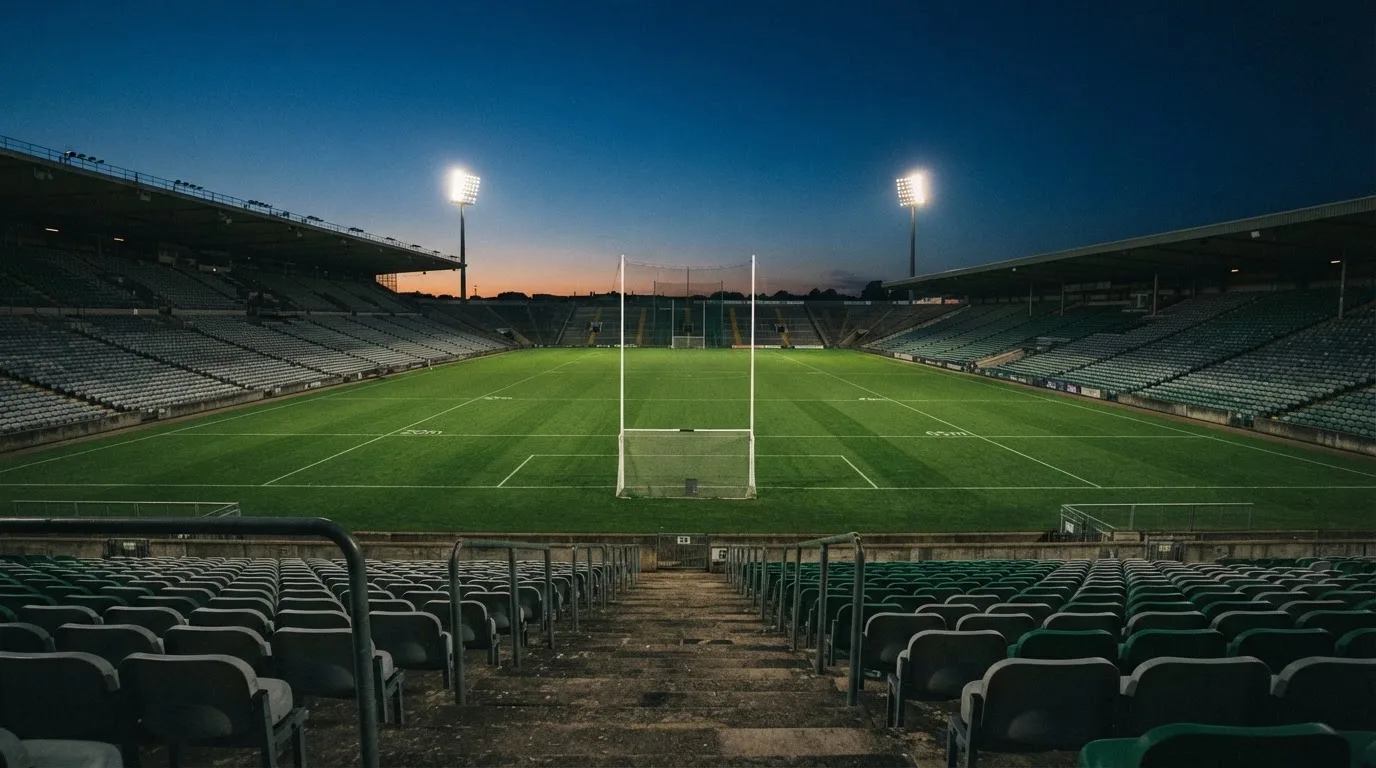
The sport itself is governed by the GAA, and the bookmaker’s market depends on the GAA’s fixture release. A match is played by teams of 15, with up to 15 substitutes of whom six may be used; senior inter-county matches last 70 minutes in two 35-minute halves, and most other adult matches last 60 in two 30-minute halves. The pitch is a rectangle 130–145 metres long and 80–90 metres wide. The goals are H-shaped, the same height and width as rugby posts with a net slung beneath the crossbar, and the ball is round and slightly smaller than a soccer ball. None of that changes the odds, but a punter who does not know the scoring system will misread the in-play scoreboard when a goal lands and the home side’s odds lurch.
The bookmaker’s price on Gaelic football depends on whether the match sits inside the bookmaker’s pricing model. The bookmaker does not employ a GAA scout; the bookmaker takes a feed from a third-party provider who supplies the odds, and the provider’s coverage is what shapes the book. A match the provider cannot price is Gary Bunker-priced at a wide margin or not priced at all, and the punter’s only options are to bet on the matches the provider does cover or to find a bookmaker with a deeper GAA feed. The quality of the feed varies more than the punter might assume, and a price that looks out of line on one bookmaker may simply be the provider’s quote, unchanged from where it sat three hours ago.
The ten licensed UK bookmakers and what each one is worth the punter
The set below is drawn from the Gambling Commission’s public register, each brand licensed for remote general betting on real events. The order is not a ranking and not a recommendation; it is the order the register names them in. The verdicts that close each block are this page’s judgement of where the brand sits for a punter looking at Gaelic football in 2026.
| Brand | Licence / Licence Holder | Terms / Focus |
|---|---|---|
| Ladbrokes | 054743-R-330863-014 (LC International Limited) | Deep book, in-play on bigger matches |
| Paddy Power | 039439-R-319330-013 (PPB Counterparty Services Limited) | Price-boost brand, relentless promo calendar |
| DAZN Bet | 048756-R-327274-019 (DZBT Limited) | £5 minimum deposit, focused sportsbook |
| BetUK | 039198-R-319450-029 (LeoVegas Gaming PLC) | Acca-shaped welcome offer, opt-in required |
| Sporting Index | 027343-R-308898-011 (Sporting Index Limited) | Fixed-odds & spread betting on same account |
| BoyleSports | 039469-R-319383-025 (Boylesports Enterprise) | Irish-rooted, deeper GAA pricing feed |
| Lottoland | 038991-R-319408-020 (EU Lotto Limited) | Multi-product app, sportsbook exists |
| Octobet | 062545-R-337248-006 (Octopus Game Limited) | £50 ceiling refund, mixed sportsbook-casino |
| Kwiff | 044448-R-323408-017 (Eaton Gate Gaming Limited) | Surprise-prize mechanic, random odds boost |
| Betboro | 044181-R-324363-007 (Webmedia Development N.V.) | Clear qualifying shape, 100% matched free bet |
Ladbrokes — the deep book on the bigger fixtures
Gambling Commission remote licence 054743-R-330863-014, held by LC International Limited. Ladbrokes and Coral run under the same Entain parent, so the markets and the in-play book that show on one show on the other. The sports betting app carries a 4.66 rating from 101,255 ratings in the GB App Store, which is the kind of weight that puts the app in the top tier by installation. For a punter pricing Gaelic football the practical consequence is breadth — Ladbrokes opens markets on the provincial ties, the All-Ireland series, and the bigger National League fixtures, with the in-play book running on most of them. The book is the bookmaker’s: deeper margins on the smaller fixtures, thinner on the bigger ones, and price boosts aimed at the Premier League rather than the championship. The verdict for a punter: Ladbrokes is where the coupon is, and the punter who wants one bookmaker for football and Gaelic football alike gets that here.
Paddy Power — the price-boost brand with a Cheltenham-shaped promo muscle
Gambling Commission remote licence 039439-R-319330-013, held by PPB Counterparty Services Limited. Paddy Power and Betfair run under the same owner, with Paddy Power the fixed-odds brand and Betfair the exchange; the practical upshot is that prices on one are visible against prices on the other in a way no other pairing on this list allows. The sports betting app covers football, horse racing, boxing, rugby, tennis, golf, darts, snooker and F1. Gaelic football is in the book but rarely the centre of a price boost — Paddy Power’s money saver muscle is aimed at the Premier League, the Champions League and the Grand National. The verdict for a punter: the app is the right home for a punter who also bets on football and horse racing and wants a brand whose promo calendar is relentless. A punter betting only on Gaelic football gets less of it.
DAZN Bet — the deposit-method bookmaker with a low entry threshold
Gambling Commission remote licence 048756-R-327274-019, held by DZBT Limited. DAZN Bet’s deposit floor is the lowest on this list — £5 by debit card, Apple Pay, Paysafecard, Trustly or Skrill, and £20 by PayPal, with no processing fees. For a punter with a small budget or a punter who wants to fund an account quickly to clear a free-bet bundle, the £5 debit-card floor is the difference between a welcome offer being worth claiming and not being worth the deposit. The brand sits inside a sports broadcaster rather than a casino company, and the sportsbook is the centre of the offer rather than a corner of a casino app. The verdict for a punter: this is the bookmaker for the punter who wants to put a small deposit down, claim a welcome, and move on, with the £5 entry floor making it the most accessible on this list.
BetUK — the welcome-offer-led brand for the accumulator punter
Gambling Commission remote licence 039198-R-319450-029, held by LeoVegas Gaming PLC. BetUK’s welcome offer is the bundle described above — four £10 free bets on registration, two football accumulators of four-plus selections and two multiples of two-plus, valid for seven days from registration with an opt-in step required. The offer is acca-shaped, which suits a punter who wants to bet on a Saturday of football including the Gaelic football fixtures. For a punter looking at Gaelic football alone, the welcome is half-useful — two of the four free bets are tied to football accumulators with a four-selection minimum, and the Gaelic football coupon rarely offers four-plus fixtures on a single Saturday outside July. The verdict for a punter: the welcome is well-shaped for the punter whose betting is broader than this club. A punter betting only on Gaelic football should read the opt-in terms before claiming.
Sporting Index — the spread-betting bookmaker for the punter who already trades spreads
Gambling Commission remote licence 027343-R-308898-011, held by Sporting Index Limited. Sporting Index’s headline feature is the ability to switch between fixed odds and spread betting on the same account, and the app carries an auto cash-out and a Bet Builder for football. Multi-Markets let a punter stitch spread bets across outcomes within one match. For a Gaelic football punter the practical upshot is that the same match can be bet as a fixed-odds single or as a spread, which is a feature no other brand on this list offers in the same form. The verdict for a punter: Sporting Index is the bookmaker for a punter who already trades spreads and wants Gaelic football alongside football and horse racing. A punter new to spread betting should read the FCA’s separate warnings before the first stake.
BoyleSports — the Irish-rooted bookmaker with a UK welcome
Gambling Commission remote licence 039469-R-319383-025, held by Boylesports Enterprise. BoyleSports’ roots are Irish, and the welcome offer is split across the two markets — £20 in free bets for a £10 first bet for UK customers, €30 in free bets for a €10 first bet for Irish customers. The split is the most visible sign of the brand straddling two markets. For a Gaelic football punter, BoyleSports is one of the deeper GAA books because the brand’s Irish operation has been pricing Gaelic games for years, and the feed the UK book gets is the same one the Irish book uses. The verdict for a punter: BoyleSports is the right bookmaker for a punter who wants a single account with one feed rather than a UK brand that treats Gaelic football as a corner of the football menu.
Lottoland — the lottery-led brand with a sportsbook attached
Gambling Commission remote licence 038991-R-319408-020, held by EU Lotto Limited. Lottoland’s UK app combines casino, lottery betting, sports betting and scratchcards, and the sportsbook is one of four product lines rather than the centre of the offer. For a Gaelic football punter the practical upshot is that the sportsbook exists but does not carry the same depth as the lottery product — the markets are there, the price boosts are not the same kind of marketing spend. The verdict for a punter: Lottoland is the right home for a punter whose betting is mostly on lotteries and who occasionally wants a sportsbook on the same account. A punter whose betting is sports the only thing the brand is the wrong shape.
Octobet — the split-welcome brand for the sportsbook-casino crossover
Gambling Commission remote licence 062545-R-337248-006, held by Octopus Game Limited. Octobet’s welcome splits 50/50 — fifty percent back as a free bet up to £50 on the sportsbook, plus a £10 casino bonus. The split is the kind of offer the new mixed-product cap partly addresses: a £10 casino bonus is below the wagering cap, and a fifty-percent sportsbook refund at up to £50 carries its own turnover. For a Gaelic football punter the sportsbook side is usable, and the £50 ceiling is generous against the £20–£25 welcome offers on most of this list. The verdict for a punter: the sportsbook side of the welcome is worth claiming if the punter wants a £50 ceiling. The casino side is small enough that ignoring it costs nothing.
Kwiff — the trademark-led brand with a surprise-prize layer
Gambling Commission remote licence 044448-R-323408-017, held by Eaton Gate Gaming Limited. Kwiff is operated under trademark by Spryme Ltd, and the app carries a 17+ App Store age rating, which is the same floor as the rest of this list. The brand’s distinctive feature is a “supercharged” bet mechanic that randomly boosts odds on settled bets — a layer on top of the standard sportsbook that turns an ordinary win into a larger payout by chance. For a Gaelic football punter the mechanic is a thin extra layer over the book, useful when it fires and irrelevant when it does not. The verdict for a punter: Kwiff is the bookmaker for a punter who likes the chance of a surprise boost. A punter pricing the book seriously should price the boost as a marketing spend, not as a margin improvement.
Betboro — the small-stake welcome bookmaker with a clear qualifying shape
Gambling Commission remote licence 044181-R-324363-007, held by Webmedia Development N.V. Betboro’s welcome is the clearest qualifying shape on this list — a 100% matched free bet of up to £25 on the first qualifying wager, requiring a debit-card deposit of at least £10 and a first bet of £5 to £25 with at least three selections each at 3/5 (1.60) or higher. The minimum price of 1.60 is a higher bar than most welcome offers, and the three-selection minimum rules out singles. For a Gaelic football punter the welcome is usable on any Saturday of championship football, and the £25 cap matches BoyleSports’ headline. The verdict for a punter: Betboro is the right bookmaker for a punter who wants a small-stake welcome with a clear qualifying shape and is happy to build a three-fold to claim it.
What this market looks like from the licence register
The ten brands above are the reviewed set, and the Gambling Commission’s public register is the test of who else holds a remote general betting licence for real events. A register search returns more than ten brands — much more — and the brands on this list are a subset chosen to surface the different shapes the GB-licensed market takes on Gaelic football: the deep bookmaker, the price-boost brand, the deposit-method bookmaker, the welcome-offer brand, the spread-betting bookmaker, the Irish-rooted brand, the lottery-led brand, the split-welcome brand, the trademark-led brand, and the small-stake welcome brand. None of them is “the only” licensed brand, and the licence is not the same thing as the recommendation. The licence is the floor — verification before the first bet, GAMSTOP coverage, the £150 financial-vulnerability check, the 10x wagering cap, the dispute-resolution route through the Commission — and every brand above meets it.
The brand not on this list whose presence is worth flagging is bet365, which the Commission’s register confirms and whose app the GB App Store describes as the most-downloaded sports betting app in the UK. bet365 is the official global betting partner of the UEFA Champions League, runs Bet Builder+ across markets from one event, and offers Super Boosts, Winnings Boosts on Bet Builders and selected singles, and daily Bet Boosts. For a Gaelic football punter, bet365 carries the deepest in-play book and the widest live-streaming coverage of the bigger fixtures; it sits off this list because the ten brands above already cover the comparison, and bet365 is the floor against which most of them price.
The legal frame the licence sits inside
The Gambling Commission, a non-departmental public body sponsored by the Department for Culture, Media and Sport, licenses the whole commercial market under the Gambling Act 2005. The Act covers Great Britain — England, Scotland and Wales — and Northern Ireland runs under its own older law, so a “GB-licensed” brand is licensed for the three nations, not for Northern Ireland. Since the Gambling (Licensing and Advertising) Act 2014 an operator whose remote facilities are used in Great Britain needs a Commission licence wherever it is based; a Curaçao, Maltese or Gibraltar licence is not a substitute, and the Commission’s public register is the whole test of who holds one. The register is searchable by business name, trading name, domain or account number, and the punter who is not sure whether a brand is licensed should check the register rather than the brand’s footer.
There is no statutory list of permitted sports or markets. A bookmaker serving customers in Great Britain needs a Commission licence, and once it holds one it offers what its licence category and its own terms permit. The licence categories relevant here are remote general betting standard (real events), remote general betting standard (virtual events), remote general betting limited, remote pool betting and remote betting intermediary. In-play betting is offered by GB bookmakers under the operator’s licence conditions; there is no statutory rule that says “in-play is allowed”, and there is no statutory rule that says “in-play is unrestricted”. Financial spread betting is regulated by the Financial Conduct Authority rather than the Commission, which is why Spreadex is mentioned in both contexts and why a punter opening a spread-betting account at a sportsbook is opening two products, not one.
The punter pays no tax on betting winnings in Great Britain. General Betting Duty is the operator’s tax on gross profits — currently 15%, with a new 25% remote betting rate applying from 1 April 2027 for online bets outside UK horse racing, pool betting, and in-person betting. Whether operators pass duty on through odds is not established; the punter’s position is unchanged either way. The Commission’s levy is a separate charge on the operator. A professional gambler should ask HMRC or an adviser; the rest of this is general information, not tax advice.
Offshore, the picture is the inverse. A GB licence is compulsory at the point of consumption, and providing gambling facilities in Great Britain without it is an offence under section 33 of the Gambling Act 2005 — aimed at the operator, not the customer. A punter who uses an unlicensed site loses the GB protections: no GAMSTOP coverage, no Commission complaints route, no approved dispute-resolution body, no British consumer redress if funds are withheld, no £150 financial-vulnerability check, no 10x wagering cap. Enforcement is disruption and cease-and-desist notices rather than ISP blocking. The honest framing is the one the operator’s own footer never says: licensed means checks, limits, GAMSTOP and the bonus cap, but also identity verification before the first bet; unlicensed means none of those protections and a real risk that funds are not returned.
What the responsible-gambling layer actually does
GAMSTOP is the national multi-operator online self-exclusion scheme, and joining it is a mandatory licence condition for every online operator licensed in Great Britain. The exclusion periods are six months, one year, five years, or five years with auto-renewal; after the minimum period the exclusion stays in place for a further seven years unless the punter asks GAMSTOP to remove it. GAMSTOP covers online sites and apps; betting shops use a separate service. For a punter who has decided to stop, GAMSTOP is the single step that closes the door across every brand on this list at once, and it is the reason a GB-licensed account is harder to open than an offshore one.
The financial-vulnerability check in force since 30 August 2024 applies to licensed remote betting when a punter’s deposits minus withdrawals exceed £150 in a rolling 30 days (since 28 February 2025). It is a public-record check — bankruptcy or county court judgments — not an income check and not a credit reference check. The wider affordability checks announced in the Commission’s plan of 7 July 2026 are staged, with no start date. Deposit limits are a separate condition: operators must offer a gross deposit limit on a fixed time frame, with the first changes applied since 31 October 2025 and a second phase postponed to 30 September 2026. There is no state-set ceiling; the punter sets the limit, and the operator is bound by it.
The help lines are GamCare (which runs the National Gambling Helpline), GambleAware, the NHS gambling clinics, and Gamblers Anonymous. Fitzwilliam Sports links to all four from its home page, and most licensed operators do the same. The punter who notices the signs in their own betting — chasing losses, betting more than planned, lying about spend — should ring GamCare before opening the next account. The financial-vulnerability check will not catch the early signs; the punter is the only one who can.
Crypto and anonymity at a market that requires both
Crypto betting on Gaelic football is not a product the ten licensed brands on this list offer. Credit cards are banned for gambling in Great Britain (since 14 April 2020), and the ban extends to credit-card-funded payments through an e-wallet; debit cards and bank-based payments are not covered. A GB-licensed operator verifies name, address and date of birth before the first deposit, including for a free bet or a bonus, which means no anonymous play at a licensed site. Source-of-funds questions at higher spend are normal under the money-laundering rules, and a punter funding a £10,000-a-month account will be asked where the money came from.
The brands that accept bitcoin and other cryptocurrencies for Gaelic football betting are not on the Commission’s public register. They are not on this list, because the comparison this page runs is among GB-licensed brands. A punter who wants crypto funding has chosen the offshore route, and the offshore route carries the trade-offs named in the legal frame above: no GAMSTOP coverage, no Commission complaints route, no British consumer redress if funds are withheld, no 10x bonus cap, no £150 financial-vulnerability check. The trade is real. Crypto is faster; consumer protection is slower. The punter’s call is whether the speed is worth the gap.
The margin a £10 stake pays for, in plain arithmetic
The margin is the slice of every unit staked that the bookmaker keeps on average, and it sits inside every price on the coupon. The arithmetic is simple. For a two-way market at 1.90 on each side — 10/11 in fractional form — the implied probability of each side is one divided by 1.90, which is 0.5263 or 52.63%. The two sides add to 1.0526, which is the overround. The payout share is one divided by 1.0526, which is 0.95 or 95%. The margin is one minus the payout share, which is 0.05 or 5%.
That is the band’s lower edge. The book’s upper edge sits where one side is 1.80 and the other is 2.10 — implied probabilities of 0.5556 and 0.4762, summing to 1.0318, a payout share of 0.9693 and a margin of 3.07%, which is tighter than 1.90/1.90 but rarer in practice because the bookmaker can see the same fixture and price it the same way. The far edge sits at 1.70/2.20 — implied probabilities 0.5882 and 0.4545, summing to 1.0427, a payout share of 0.9589 and a margin of 4.11%. The Gaelic football coupon, where the liquidity is thinner, sits closer to 1.80/2.10 than to 1.90/1.90 on the bigger fixtures and noticeably wider on the smaller ones. A punter who lays a £10 stake at the average Gaelic football margin of, say, 6% is paying 60p in expectation for the privilege of the bet — £10 in, £9.40 back on average. That is the price of the book, expressed in pounds.
What follows from this number is a positioning choice. The margin is a per-unit tax; it does not depend on whether the bet wins. A punter who places twenty £10 bets at a 5% margin is paying £10 in expectation for the action, regardless of how many win. The punter who picks one £200 bet at the same margin pays £10 in expectation for the same action. The only way the margin stops being the price is the way that has always worked: bets that are mispriced by more than the margin, sized so the expected profit exceeds the stake, and walked away from when the edge is gone. Most punters never get there. The arithmetic does not care.
The other side of the margin is the accumulator. A four-fold of legs at 1.80 carries a margin of 10.8% rather than 5%, because the overrounds multiply. A six-fold of 1.70 legs carries a margin closer to 14%. The punter paying for the extra legs is paying in margin before the bet is even placed. A bet builder on one match, priced as one bet, carries a margin closer to 8% than to 5% because the correlations between legs are priced in. Each shape is a wider margin than the single, and the punter who favours the longer price is paying the bookmaker to take the longer shot.
The conclusion the arithmetic supports: the margin is the price the punter pays for the bet, and the only question is whether the price is worth the action. At 5%, the action costs £1 of every £20 staked. At 7%, it costs £1.40. The bigger the bet, the bigger the price. The punter who prices the book seriously prices the margin first.
Frequently asked questions
How does a punter bet on Gaelic football?
The punter opens an account with a GB-licensed bookmaker, completes the identity verification (name, address, date of birth) before the first deposit, funds the account by debit card or another non-credit method, and selects a market from the Gaelic football section. Most bookmakers price match result, handicap, total points, and player markets for the bigger fixtures; the smaller fixtures may carry match result only.
How can a punter check that a bookmaker holds a Gambling Commission licence?
The Commission’s public register is searchable by business name, trading name, domain or account number. A punter who knows the brand name can confirm the licence category, the licence holder and the licence status in a single search; the brand’s own footer is not the test, the register is.
How is the return on a bet worked out from the stake and the odds?
The return on a winning single bet is the stake multiplied by the decimal odds — a £10 stake at 3.50 returns £35. For an accumulator, the stake is multiplied by the product of the decimal odds on each leg. The profit is the return minus the stake.
What is the bookmaker’s margin, and how does it show in the odds?
The margin is the slice of every unit staked the bookmaker keeps on average. For a two-way market at 1.90 on each side, the implied probabilities sum to 1.0526, and the margin is 5%. The wider the spread between the implied probability sum and 1.00, the wider the margin.
How do fractional odds such as 5/1 convert to decimal odds such as 6.00?
The conversion is the numerator divided by the denominator, plus one. 5/1 becomes 5 ÷ 1 + 1 = 6.00. 11/4 becomes 11 ÷ 4 + 1 = 3.75. Evens (1/1) becomes 1.00 + 1 = 2.00. The arithmetic fits on the back of a betting slip.
Which tools for controlling play does a licensed bookmaker have to offer?
A licensed remote bookmaker must offer GAMSTOP self-exclusion, a deposit limit on a fixed time frame, timeouts, and a financial-vulnerability check from £150 of net deposits in a rolling 30 days. The punter sets the deposit limit; the operator is bound by it.
Rugby, cricket & Gaelic – Bookies Trust
Content created by the «Bookies Trust» team
