
Handball betting odds, decoded for the British punter
 Available in US
Handball sits in that middle band of British betting markets — not as deep as football or horse racing, not as niche as table tennis or eSports. The bookmakers on the Gambling Commission’s register serve it, the tournaments run year-round, but the structure of the odds is what decides whether a price is genuinely worth taking or just dressed up to look generous. This page reads the prices the way a sportsbook actually builds them: what a fraction means, where the margin lives, how live markets reset, and which operators carry the sport cleanly through a season of Champions League, EHF competitions, Bundesliga and the World Championships that come round every other year.

The data below reflects the public register as of 27 October 2026, checked against each operator’s own licence line and terms page.
Bonuses and free bets on handball markets
British bookmakers do not run a separate “handball bonus”. They run a general sports welcome package and decide, sometimes quietly, which sports count toward it. That single decision tends to matter more than the headline figure does.

A “free bet” is the standard unit. The brand credits an account with a bet token — frequently £5 or £10 — that the bettor uses on a wager. Two rules govern almost every one of them on the British market. First, the stake is usually not returned with the winnings: win at 4.00 with a £10 free bet and the punter receives £30, not £40. Second, the token has a fixed expiry — seven days is standard — and a minimum price. The minimum cuts out the closest favourites and accumulators stuffed with them, because those wagers settle near certainty and the operator gives nothing back for the risk it took. For a mid-market sport like handball, those minimums are the conditions that decide whether a welcome offer is usable at all: a £10 free bet that requires odds of EVS (2.00) is open across most Champions League matches; one that requires 5/1 (6.00) is fun for an accumulator and nothing else.
Wagering requirements sit on top. The 2026 LCCP cap of 10x on a sports welcome bonus is the upper bound any licensed operator can lawfully apply; “£10 at 50x” no longer reaches the British customer. What the cap does not dictate is the choice of eligible bets — the bonus terms often exclude handball, or allow only singles, or force minimum-odds thresholds that win-easy favourites cannot meet. The qualifying condition (place a £10 bet at minimum odds of EVS within 14 days of registration, receive £25 in free bets and free spins) tends to be the most permissive; the conditions for actually spending the bonus are usually tighter.
The cleanest test for a handball punter is whether the welcome credits can be staked on a handball single at a price above the minimum. If they cannot, the offer has nothing to say to this sport and the punters who follow it. If they can, the next question is what the bonus is worth in real money: that depends on the odds the bettor can find, which is the page’s next subject.
Live betting and cash out on handball
Handball plays out in 60 minutes — two halves of 30 — and that shape carries straight into the in-play product. Most licensed British bookmakers publish a running match market from the moment the fixture goes live: 1X2 after the first half, the next team to score, totals, handicaps. The odds swing quickly. A red card in handball is a two-minute suspension, not a sending-off, so the bookmaker cannot price a fixture as if a side has lost a player for good; momentum shifts through a suspension, and the in-play market has to follow.
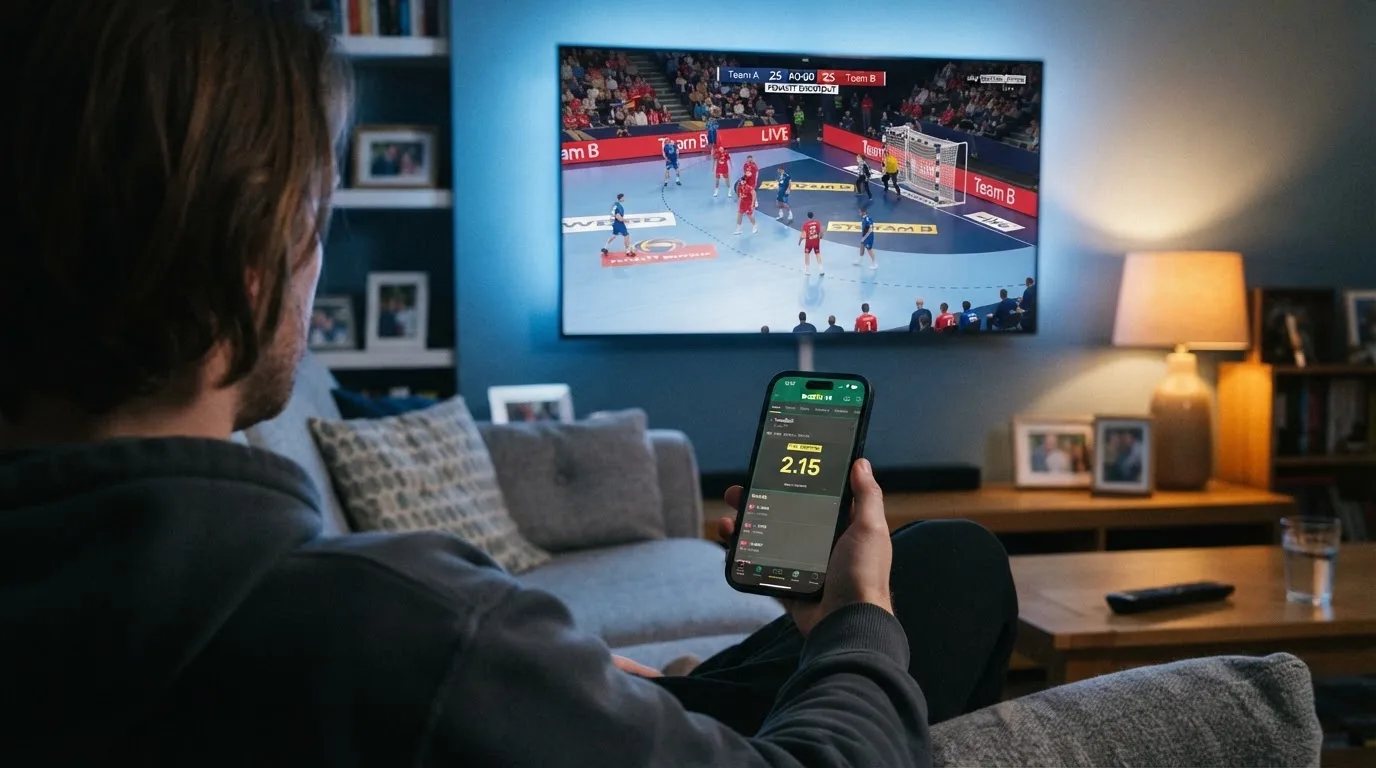
Cash out turns this volatility into a tradable position. The bookmaker offers to close the bet before the event settles at a price derived from the live market and the time left. The price reflects what the bet is worth right now, not what it might be worth: a six-goal lead at 55 minutes is a near-certain win on the 1X2, and cash out flattens the difference. In-play and partial cash out have now been a default feature across most of the top British apps for several years — the operational test is whether the bookmaker streams the match live. Without a live feed the cash out price is built from data only, which means slower updates and a slightly wider book. With a feed, the price tracks the action nearly as fast as a trader can move it.
The reason it matters for handball specifically is tournament density. The EHF Champions League group stage crams six or eight fixtures into midweek evenings, domestic leagues fill Saturday afternoons, and World Championship group matches sit on top of them. A bookmaker that updates in-play prices on a ten-minute lag is one the in-play punters abandon within a season, and a bookmaker that only carries a handful of handball fixtures live is one that has decided where its in-play focus lies — and it is not in this code.
Live streaming on handball is still thin among British operators. The big European bookmakers stream football as default and handball as an add-on; smaller British brands often stream nothing at all. Where a stream exists, it tends to be on a small portfolio of pre-selected fixtures, with the wider catalogue settled from data feeds alone. A punter who plans to back in-play on a Wednesday evening Champions League match should check the operator’s streaming schedule in advance, because the absence of a stream can mean the absence of a market.
Predictions and strategy for handball betting
Handball has its own rhythms, and the model that wins on football loses on it. A football model built on possession and expected goals partly transfers; a handball model that treats the goalkeeper as a percentage-saver rather than a last line is built wrong. The six-outfield formation concentrates attack through a small number of set patterns — seven-on-six attack, a screened shooter, fast breaks off a saved shot — and a single substitution by a settled defence can flip the script in real time. That is not the rhythm of a low-event sport, and it is not the rhythm of a high-event one either; it is something narrower.
A first move for any systematic handball punter is to model the goalkeeper first and the attack second. Save percentages for the top keepers sit between 30 and 40 per cent across a match — a single percentage point on a 30-shot match is the equivalent of 0.5 expected goals conceded. That is the kind of edge a price can absorb. A second move is to read the schedule, because squad rotation in European handball is thin and a Saturday-Wednesday-Saturday pattern is the most punishing the fixture list can produce. A team playing its third match in seven days at altitude is a different price than a fresh side in the comfort of a home venue, and form tables rarely carry the differentiation.
Handicap markets deserve a closer eye than they get. The proportional spread between a strong and weak side in handball is wider than in football — six or eight goals is the standard line in Champions League fixtures — and the price offered on the favourite to cover rarely matches the actual handicap performance of recent seasons. Where the price is fair, a structured handicap betting strategy finds edges that the 1X2 has long priced away.
Bankroll discipline on a niche market cuts against a punters’ instincts. Liquidity is thinner than on football or horse racing, so the bookmaker can offer a wider book and still manage the risk. The punter takes the wider book for granted and adjusts the stake size accordingly: staking more than 1–2 per cent of a bankroll on a single handball bet is over-staking for the market, regardless of how confident the prediction reads.
The single hardest discipline is leaving it on a live in-play market. Handball’s accelerated swings and partial cash out features come together to invite an over-trader to keep adjusting the position; the operator’s edge on the trade is precisely calibrated to encourage that adjustment.
Bet types, odds formats and how a handball price is built
Three odds formats appear on British bookmaker sites: fractional (5/1, 11/4), decimal (6.00, 3.75) and the rarer American line. The fractional form is still printed on UK racing publications and at the betting shop window; the decimal form dominates online, because the same number is also the multiplier on the stake. A £10 bet at 3.75 returns £37.50 — the £27.50 winnings plus the £10 stake — and the arithmetic is the same in both directions. Odds of 3.75 and 11/4 mean exactly the same thing; the fractional form just arrives at it through different notation.
The return on any settled bet is the formula that holds across every market on every British bookmaker. At decimal odds *o* and a stake *s*, the gross return is *s × o*, the net profit is *s × (o − 1)*. For a combination bet — a double, a treble or the longer accumulator packages the bookmakers call “acca” — the prices on the legs multiply into one figure. A double at 3.00 and 2.50 prices the combined bet at 7.50 before the operator’s stake contribution; the punter pays for the single combined stake with the implied margin of two markets, not one. That is why an accumulator’s headline price is always juicier than the per-leg odds and why the margin is also larger.
Totals markets on handball carry an obvious standard line. Championship and Bundesliga matches tend to settle in the 50–60 goal range, and bookmakers set the line at 55.5 or similar; the price on each side aims at balancing the book, not at predicting the total. Handicaps are priced the same way. Where a 1X2 carries an implied margin of around 5 per cent, a handicap may sit closer to 7 per cent and a totals market may push 8 per cent, because handicap and totals markets attract less money and the bookmaker protects itself more aggressively. The wider book on the less-liquid market is not an accident; it is compensation for the thin volume.
The margin of a market is what the bookmaker keeps from every unit staked on it, on average across all outcomes. The arithmetic is simple. For a two-outcome market priced at decimal odds *o₁* and *o₂*, the payout share — the proportion of the total staked across the market that would be returned to bettors if every result won — is *1 / (1/o₁ + 1/o₂)*, and the margin is *1 − payout share*. Take a balanced two-way market priced 1.90 / 1.90 — the kind of price a handball match between evenly ranked sides will settle to before commission. The payout share works out to 1 / (1/1.90 + 1/1.90) = 0.95, and the margin to 0.05, or 5 per cent — in the same band that bookmakers apply to most pre-match football fixtures.
What the band actually represents is the bookmaker’s take of every £1 staked on that market, on average. A market priced exactly at the true probability of each outcome — a 1.95 / 1.95 line for a 50–50 game — would pay out 97.5 per cent of stakes to bettors and keep 2.5 per cent as commission. The 5 per cent margin is the difference between that theoretical price and the one the bookmaker actually quotes, and it is a steady component of the odds no matter which side the punter takes. A market with a smaller margin is more generous; one with a larger margin is more punitive — and a market priced with one side heavily favoured carries the same margin, just skewed toward different outcomes.
That is why margin is the number that matters for a regular handball bettor more than any single price does. A single bet at the wrong price is a single loss; a regular stream of bets at markets with a 7 per cent margin rather than a 5 per cent margin is a guaranteed long-run hit to the bankroll. The lesson: compare margins, not single prices.
Handball competitions and what an operator’s fixture list actually covers
Handball is played year-round across Europe. The IHF Men’s and Women’s World Championships run in odd-numbered years, the men’s event every two years since 1995; the European Championship sits in odd years on the same diagonal between World Championships. Denmark holds the 2025 men’s title; the 2023 women’s title is with France. The Olympic handball tournament debuted at Berlin 1936 as an outdoor sport, returned indoors at Munich 1972 and added the women’s competition in 1976 — the schedule the bookmakers know well.
The club season on a British bookmaker’s site is built around a few key competitions. Men’s EHF Champions League is the headline: 16 group-stage teams in the autumn, then a knockout phase through spring, with the Final Four staged late in the season. The women’s Champions League runs parallel. The men’s EHF European League is the second-tier European competition; the men’s EHF European Cup is the third. Below those sits the men’s and women’s Bundesliga — the strongest domestic league in the world, deep with German and Scandinavian internationals — followed by the Liga Asobal in Spain, the Starligue in France, the Kézilabda NB I in Hungary and the Danish Handball League, with smaller but professional leagues in Croatia, Portugal, Poland, Slovenia, North Macedonia and several others. National team dates sit on top of the club fixture calendar: qualifiers in the European confederation’s calendar windows, friendlies, the EHF Euro, World Championships every second January, the Handball World Cup exhibition events.
A bookmaker’s handball coverage can be checked directly on the site or app. The biggest British brands — the operators whose sites incorporate the European feeds — cover 30 to 80 distinct competitions depending on the season, with Bundesliga, Champions League, the World Championships and several second-tier European leagues default. Smaller brands carry between 6 and 20: Champions League, the top national leagues and a handful of second-tier club competitions, with national-team fixtures window-dependent.
Coverage depth — the number of markets per match — separates the brands too. Top brands list 1X2, both halves, totals, handicaps, score after 30 minutes, winning margins, top goalscorer markets (where the operator names players ahead of a fixture), team totals and several derivative markets. Smaller brands typically settle for 1X2, totals and a single handicap. The pricing on the smaller book lists tends to be wider-margin as a result. The width of the fixture list and the depth of the markets on each match are the two numbers that determine whether a brand is a usable base for handball punting.
Top bookmakers for handball betting
The comparison below lists ten operators that the Gambling Commission’s public register confirms as holding a remote general betting licence for Great Britain. The licence line is the headline number — checked against the Commission’s own register; the column on what each operator’s terms state on the subject covers what it actually delivers on handball.
| Brand | Gambling Commission licence | What the operator states |
|---|---|---|
| 10bet | 043173-R-322899-023 (Blue Star Planet Limited) | Cash out, Bet Builder and Live Streaming over football, tennis and horse racing |
| Midnite | 101839-R-342850-001 (Midnite Limited) | In-play events, acca builder, popular accas and price boosts with maximum-stake limits |
| Smarkets | 039173-R-319366-011 (Smarkets Malta Limited) | Betting exchange; open-bank deposits instant from £10 to £10,000; withdrawals processed within 6 hours up to £100,000 |
| Bet Ahoy | 100094-R-341742-003 (Bet Ahoy Ltd) | Welcome package of four £10 free bets comprising a £5 sports single and a £5 acca |
| Betfred | 039544-R-319290-010 (Petfre Gibraltar Limited) | 21 sports plus more than 2,000 casino-style games |
| BetMGM | 039198-R-319450-029 (LeoVegas Gaming PLC) | Deposit-and-bet welcome with four £10 free bets on football accumulators and sports multiples |
| Spreadex | 008835-R-104580-022 (Spreadex Limited) | Combined fixed-odds and spread betting with one-click, auto and partial cash out |
| Betmaster | 065699-R-339929-002 (BM Solutions GB Ltd) | Coverage across football, cricket, horse racing, NFL and eSports |
| DAZN Bet | 048756-R-327274-019 (DZBT Limited) | Deposits from £5 via debit card, Apple Pay, Paysafecard, Trustly and Skrill; £20 via PayPal |
| Kalooki Sportsbook | 057730-R-333396-005 (Kalooki Sportsbook Limited) | GAMSTOP member, regulated sportsbook |
The rest of this section reads each operator for what it actually delivers on handball — the licence is a ticket to operate, not a guarantee of depth on this code.
10bet
10bet’s site carries football, tennis and horse racing at the top of the sport list, and that is also broadly the order in which its markets deepen. Handball sits on the book — competition lines are present for Champions League and a handful of European leagues during the domestic season — but the depth does not approach the football product. Cash out, Bet Builder and Live Streaming are confirmed for the headline sports; whether they extend to handball is not. 10bet’s licence is held by Blue Star Planet Limited and is current on the Commission’s register; the brand positions itself as a multi-sport bookmaker for a punter whose primary interest is the high-volume codes rather than a niche follower of the Bundesliga or Liga Asobal.
For a handball-first punter, 10bet is a useful account for pre-match single bets on Champions League fixtures and a marginal one for everything else — markets thin quickly outside the headline competitions.
Midnite
Midnite’s sportsbook is built around football with in-play markets prominent at the top of the page, acca builder pre-selected and price boosts featuring maximum-stake limits. The licence is held by Midnite Limited and the Commission’s public register confirms the operator at account 101839. Handball coverage is present, though the depth of markets per fixture sits below what the football product carries; in-play updates appear on the standard cadence and the price boost feature is occasionally extended to Champions League fixtures.
The Midnite welcome structure — qualifying with a £5 sports bet on pre-match odds of EVS or greater, then £25 in free bets and 50 free spins on the casino product — sits within the LCCP bonus cap and is shaped like a hybrid promotion. The maximum-stake limits on price boosts and free bets at low minimum prices can compress the value of the bonus for a handball punter; the welcome credits work, but the per-bet earning has to be checked against the operator’s terms.
Smarkets
Smarkets is a betting exchange, licensed under the betting intermediary category rather than the general betting standard category the rest of this list holds. The difference matters: the exchange layer takes a commission on net winnings rather than building a margin into the price, and the price at each side of the market is offered by other users rather than the operator. For a handball punter that produces a different curve. Where a bookmaker’s handicap is priced at 1.85 and 1.95 — a margin of around 8 per cent — the same handicap on Smarkets may trade at 1.95 / 1.97 with commission on top, and the bettor backs or lays either side at the offered price.
Smarkets’ payment profile is clean: open-bank deposits at £10 minimum settled instantly, withdrawals processed inside six hours on the same minimum, debit card limits at £10 to £15,000. For a handball punt in particular, the exchange is where a confident view on a line finds the tightest price. The drawback is depth — handball markets on Smarkets will sometimes carry only a few hundred pounds of liquidity at match time, and the larger positions become harder to fill at the advertised price.
Bet Ahoy
Bet Ahoy’s welcome package — a £10 sports token and a £5 acca token in free bets on a £10 qualifying bet — is modest by the British market standard. The licence is held by Bet Ahoy Ltd and the Commission’s register is current. The sportsbook covers the headline European competitions and a selection of domestic leagues, with the acca-friendly markets the brand is positioned around. Handball appears on the fixture list across the season but depth per match is thin.
The welcome package is the value proposition here; everything else sits on a more standard multi-sport bookmaker product. For a handball-first punter it is a brand worth registering to claim the welcome credits on a handball single and worth retaining only if the in-season handball markets and prices hold up against better-covered brands.
Betfred
Betfred is one of the bigger names on the British high street and that translates into a deep multi-sport product: 21 sports on the app, with football and horse racing at the front and a long tail of secondary codes behind. Handball features in the long tail with Champions League and a handful of European leagues and tournament fixtures at the front, lower-league coverage select and market depth per match satisfying rather than deep. Betfred’s licence is held by Petfre (Gibraltar) Limited under Gambling Commission account 39544.
The multi-sport breadth is the value here. A Betfred account carries a price on the Champions League outright, league outrights and the high-profile international tournaments, plus a cash out feature on the headline sports. What it does not do is offer a richer set of in-play markets for the less-covered codes than the rest of the high-street brands.
BetMGM
BetMGM’s UK sportsbook is operated by LeoVegas Gaming PLC and the Commission’s register confirms the licence at account 39198. The welcome package combines four £10 free bets — two football accas of four or more selections and two sports multiples of two or more — on a £10 qualifying deposit and a £10 qualifying bet inside seven days, with a seven-day expiry and standard sportsbook minimum prices.
The football orientation of the welcome — two of the four £10 tokens are restricted to accumulator bets — matters for a handball punter. The other two tokens are open across the sportsbook at minimum price, and the £10 free bet on a sports multiple of two or more selections at minimum odds can be applied cleanly to a Champions League handball fixture with a second leg on another sport. The brand’s broader sportsbook product reaches handball with Bundesliga and Champions League fixtures prominently listed, less depth on the second-tier European leagues.
Spreadex
Spreadex sits across two licences: the Financial Conduct Authority regulates the spread betting product and the Gambling Commission regulates the fixed-odds product, and the two halves of the offering sit under different consumer protections. Spread betting losses can exceed deposits — a condition the brand’s own terms state plainly — and a fixed-odds punter should be certain they are betting under the fixed-odds licence before placing a wager. The fixed-odds product combines the sportsbook with the spread book and offers cash out in one-click, auto and partial forms, plus live streaming of UK and Irish horse racing, greyhounds, tennis, NFL and selected football.
The combination matters for a handball punter if spread betting is treated as a separate product rather than a substitute. Spread prices on handball matches exist, but the spread book is one click away and the punter should know which licence the wager sits under before signing up.
Betmaster
Betmaster’s UK product is operated by Bm Solutions Gb Limited under a Gambling Commission licence at account 65699. The sportsbook covers football, cricket, horse racing, NFL and eSports at the top of the list — handball is named on the site but sits among the secondary sports and receives fixture-by-fixture coverage on the European competitions and the Bundesliga rather than throughout the long tail of domestic leagues.
For a handball-first punter, Betmaster is best kept as a backup book for the headline matches in the season. The welcome product and ongoing promotions are oriented around the multi-sport product the brand carries in depth.
DAZN Bet
DAZN Bet carries a wide payments profile, which is the brand’s standout feature: deposits from £5 via debit card, Apple Pay, Paysafecard, Trustly and Skrill, from £20 via PayPal, all without processing fees. The sportsbook sits on top of those rails and the handball coverage extends to Champions League and a portfolio of European leagues. The licence is held by DZBT Limited under Gambling Commission account 48756.
DAZN Bet’s most useful feature for a handball punter is the low minimum deposit — a £5 minimum is half what most UK sportsbooks require and is the kind of entry point that suits a less-regular bettor. The drawback is a sportsbook depth that tracks competitors rather than leading them.
Kalooki Sportsbook
Kalooki Sportsbook is operated by Kalooki Sportsbook Limited under Gambling Commission account 57730, is registered as a GAMSTOP member and is positioned as a responsible-gambling product rather than a high-margin one. The sportsbook carries the headline European handball competitions at fixture-list level with limited depth on the secondary leagues. The brand is best understood as a smaller bookmaker whose centre of gravity sits elsewhere on the page — the GAMSTOP registration and the explicit safer-gambling controls.
For a handball-first punter, Kalooki offers a place to place a small-stake single on a Bundesliga or Champions League fixture; it does not compete with the bigger brands on market depth and would be used by a punter whose primary concern is the licence and the responsible-gambling controls around it.
Where British handball betting stands legally
Handball betting in Great Britain sits inside a single licensing regime. The Gambling Act 2005 — extended by the Gambling (Licensing and Advertising) Act 2014 — requires that any operator offering remote gambling facilities to customers in Great Britain holds a Gambling Commission licence, regardless of where the operator is based. A Curaçao, Maltese or Gibraltar licence is a separate permission that does not replace a Commission licence; a Gibraltar-based operator with an in-perimeter facility serving British customers still needs a UKGC account. The Commission’s public register is the entire check, and a brand that holds a Commission account can be confirmed against it.
Northern Ireland sits outside the Act and is governed by older Northern Ireland legislation. A “GB licence” or “Great Britain licence” is the right phrasing; the Act does not cover Northern Ireland and the licence does not extend there.
There is no state monopoly on sports betting in Britain and no statutory cap on the number of licences issued. Five licence categories matter for a sports punter. Remote general betting standard (real events) covers fixed-odds betting on real sports fixtures — the licence every sportsbook on this list holds except Smarkets. Remote general betting standard (virtual events) covers virtual sports and simulations. Remote general betting limited covers smaller books with limited product. Remote pool betting covers betting pools, primarily British horse racing. Remote betting intermediary covers betting exchanges, where one Smarkets fits and where its Commission account falls.
What may be bet on in Great Britain is not listed in statute. The Commission’s licensing categories define what an operator can offer and the LCCP codifies the marketing, social responsibility and conduct rules the licence conditions are enforced under. There is no Commission rule that excludes handball as a betting subject — it sits inside “real events” and the licence categories the Commission grants to standard sportsbooks. In-play betting is offered across the British bookmaker market and the controls are the operator’s licence conditions and customer-protection rules; it is not unrestricted as a legal conclusion, and a Commission rule on the proportion of bets that must be settled by the closing-whistle outcome or the way the cash out feature is marketed does apply. Esports are treated like any other event under the same regime; novelty markets, including politics and TV shows, are also bookmaker-offered under the same broad category.
Financial spread betting sits under a different regulation. The Financial Conduct Authority regulates financial spread products and the Gambling Commission regulates non-financial spread betting that overlaps with sports fixtures. A bettor placing a wager on a sports spread with a regulated British operator is placing the non-financial product; the loss profile is different and the tax regime is different.
Minimum age 18 across the British market. Identity verification — name, address and date of birth — has applied before a customer can deposit or place a bet since 7 May 2019, including with a free bet or bonus. The credit-card ban in gambling is total: since 14 April 2020 gambling cannot be paid for by credit card in Great Britain, including credit-card-funded e-wallet transactions. Debit cards and bank-based payments are not covered by the ban.
The player pays no tax on betting winnings in Great Britain. General Betting Duty is the operator’s tax on gross profits — 15 per cent currently, moving to a tiered structure with a 25 per cent remote rate from 1 April 2027 on most bets but holding 15 per cent for UK horse racing remote bets, self-service terminal bets, pool bets and in-person bets. Whether the duty passes through to odds is not established and is not something a punter is on the hook for directly.
Player protection is the second regulatory pillar. GAMSTOP is the national multi-operator self-exclusion scheme and has been mandatory at every GB-licensed online operator since 31 March 2020; exclusion periods are six months, one year, five years, or five years with auto-renewal, and a minimum-exclusion customer cannot gamble online with any licensed site for the period chosen plus seven further years. The financial vulnerability check — a public-record bankruptcy or county-court check, not an affordability check — has applied since 30 August 2024 and applies to licensed remote betting when a customer’s deposits minus withdrawals exceed £150 in any rolling 30 days, since 28 February 2025. A separate “financial risk assessment” — the affordability check the British press has talked about at length — was the subject of a Commission announcement in July 2026 and remains announced, staged and with no start date. Help is available through GamCare (the National Gambling Helpline), GambleAware, NHS gambling clinics and Gamblers Anonymous.
The framing for an offshore, unlicensed brand follows from the same logic. Providing gambling facilities in Great Britain without a Commission licence is an offence under section 33 of the Act, on summary conviction carrying up to 51 weeks’ imprisonment, a fine up to level 5, or both. No offence aimed at the customer who bets on an unlicensed site was found. What an unlicensed site means for the bettor is the loss of consumer protection: no GAMSTOP coverage, no Commission complaints route, no approved dispute-resolution body, no British recourse if funds are withheld, no application of the bonus cap, no financial vulnerability check. Enforcement against unlicensed operators is disruption rather than blocking — cease-and-desist notices, search-engine referrals, registrar and payment-provider pressure, court-order DNS blocking powers.
Responsible gambling on handball in Britain
Handball’s pace and its thin betting markets put the bettor in a slightly different exposure profile than football or horse racing. The accumulators the bookmakers love are well-suited to a sport with frequent goals and frequent upsets; the temptation to chase one settled position with the next is exactly the rhythm of a sport with midweek fixtures and weekend matches stacking on top of each other.
The first line of defence is the customer’s own limits. Every operator on the Commission’s register offers a gross deposit limit on a fixed time frame — the rule applies to gross deposits and sits on top of the customer’s choice, with the first changes applying since 31 October 2025 and a second phase postponed to 30 September 2026. Time-out, deposit caps and self-imposed stake limits are all operator-delivered controls. Where deposit limits are optional under an operator’s terms, a bettor who has not set one is choosing to forgo a tool the rest of the regulatory framework was built around.
The second line of defence is GAMSTOP. Self-exclusion for six months or longer removes the bettor from every GB-licensed online site for the exclusion period. The seven-year cool-down period after the minimum exclusion has finished is the structure that prevents a punt-and-resume cycle, and the auto-renewal option for five-year periods is the structure for a bettor who does not want to make the choice again at the end of it. A punt-on-tomorrow punt later set has a long half-life in this regime.
The financial vulnerability check has been in operation since 30 August 2024 and the public-record threshold kicked in at £150 of deposits minus withdrawals over a rolling 30 days on 28 February 2025. It checks public records for bankruptcy orders and county-court judgments rather than the customer’s bank account. The check is a safety net rather than an affordability pressure; it is the background condition for compliance and the customer is entitled to ask the operator what records are pulled and how often.
Help is free and confidential. GamCare runs the National Gambling Helpline; its counsellors take calls for the duration of a problem and through the steps of self-exclusion, family support and recovery. GambleAware funds treatment services and public information. NHS gambling clinics operate in London, Manchester, Bristol, Leeds and a handful of other cities and offer free treatment to anyone referred through their GP or self-referral. Gamblers Anonymous is the peer-support network. The British Betting and Gaming Council’s NetBanx scheme — funded by the industry — supports treatment access. Each of these is a route, not a destination; the step from any of them to a settled course of action is the one the bettor takes.
Cryptocurrency, privacy and handball betting
There is no British-regulated route to bet on handball with cryptocurrency. A licensed British operator cannot take an anonymous deposit: identity verification applies before the first deposit and source-of-funds questions apply at higher spend, with credit cards banned for gambling and bank-based open-payments formats the same as anywhere else. A cryptocurrency betting site falls under one of the non-GB regimes — Curaçao, Anjouan, certain Costa Rica and Panama setups — and offers the currency the licensed operator does not.
What a cryptocurrency site means for handball is narrower than it sounds. The combined liquidity of all the unlicensed cryptocurrency sportsbooks is a fraction of one large British operator’s football turnover, and that fraction is spread thinly across sports. Handball on those sites is typically offered on the Champions League, the World Championships and a handful of European leagues, with handicap and 1X2 markets at competitive prices and limited in-play depth. The bigger handicap is operational: a Curaçao-licensed site sits outside the British regulatory framework, and a customer who deposits Bitcoin or USDT into one has no Commission complaints route, no approved dispute-resolution body and no British recourse if funds are withheld. Some sites run on-chain proof-of-reserves and external auditors; most do not, and the customer is taking the counterparty risk the regulator would otherwise hold.
The British regulatory direction of travel is the more relevant variable for punters reading this page. The Commission’s approach to cryptocurrency has not been settled in statute, and what the public register establishes is which operators hold a Commission account; the register does not yet name a licensed crypto-custody operator that a punter can deposit with. A punt intended for handball through a regulated British bookmaker will arrive through a sterling rail rather than a Bitcoin one.
The cross-over cases are specific. Some exchanges — Bitcoin-only or stablecoin-only — work as rails between a customer’s sterling bank and a betting site, with no operational or regulatory footprint on the gambling side. A few licensed European operators outside the UK regulator’s reach accept cryptocurrency deposits alongside the sterling option; a British-licensed operator is required to operate a fully verified, fiat-funded account, and that is a separate product from the offshore crypto-only book.
The handbook advice that holds across the British market is straightforward. A bettor whose primary interest is handball and the licensed bookmakers who cover it is best served by a sterling-funded, Commission-licensed operator with a clean modern sportsbook. A bettor whose primary interest is in the privacy of the deposit on a bettor side will find that the British regime does not offer one, and any product that markets itself as a private or anonymous alternative sits under a different consumer-protection regime. The two products overlap on a tiny fraction of events and the operator depth on handball in the cryptocurrency space is thinner than the currency choice implies.
Frequently asked questions
Does a handball in football count as a foul in betting?
In betting terminology, the word “handball” describes the indoor team sport that two 30-minute halves decide, not the deliberate use of the hand or arm by a footballer. A bookmaker’s pre-match market named “Handball” refers to the sport itself — Champions League, Bundesliga, the World Championships and so on — and a wager on it settles according to the official score of the match at regulation time or after extra time if specified. The football-sense meaning of “handball” can appear in a market on a football fixture, but it does so as a named outcomes category, not as part of the rule.
Is a handball a foul in football betting?
The English word is the same, and that is why confusion is common. In a football betting market, “handball” can describe either a deliberate or inadvertent handling offence from a player on the pitch, and the bet on whether the referee will award one settles on the referee’s decision within the match. Most bookmakers do not list “handball” as a market on football fixtures in Britain, but a referee-card or foul markets can include handling offences under their broader categories.
How can a bookmaker’s Gambling Commission licence be checked?
Every operator licensed by the Gambling Commission appears on the Commission’s public register. The register is searchable by business name, trading name, domain or licence number and lists the licence categories, the licence holder, the trading names and the registered site against each. A punter who wants to confirm a brand holds a Commission account enters the trading name or domain into the register and checks the licence status is current. The register is the whole test of whether a brand is licensed — there is no separate confirmation.
How is a bet’s return calculated from the stake and the odds?
In decimal odds, the return is the stake multiplied by the odds. A £10 stake at decimal odds of 3.75 returns £37.50, of which £27.50 is profit and the £10 stake is returned. The same bet at fractional odds of 11/4 returns £10 plus £10 × 11/4 = £37.50. The two notations express the same price. For an accumulator, the prices of the legs multiply into a single figure before the stake is applied.
What is the bookmaker’s margin, and how is it visible in the odds?
The margin is the proportion of every unit staked on a market that the bookmaker keeps, on average across every outcome. For a market with decimal odds *o₁* on outcome one and *o₂* on outcome two, the payout share is 1 / (1/o₁ + 1/o₂) and the margin is 1 minus that figure. A two-way market at 1.90 on each side prices to a payout share of 0.95 and a margin of 0.05, or 5 per cent. A market with a higher margin is the bookmaker keeping more of every pound staked, regardless of which side wins.
US & other team sports – Bookies Trust
Content created by the «Bookies Trust» team
