
Tips, value bets and what your stake actually costs on Gaelic football in 2026
 Available in US
This is a guide, not a tip sheet. No picks, no predicted scorelines, no guaranteed winners — what follows is how the price on a Gaelic football match is built, what it costs the bettor who backs one side, and which of the brands under review actually deserves the stake once the marketing words are stripped away. The terrain is narrow on purpose: the All-Ireland Senior Football Championship, the provincial championships and the Allianz National League draw far less betting liquidity than the Premier League or the AFL, which means margins are wider, markets are thinner, and the bettor who walks in without a plan pays more for the same bet than on bigger sports. The plan below is the one that pays it back: form, statistics, the markets on offer, the value hidden inside an inflated price, and the discipline that stops a single big day from becoming a single big loss.

The figures in this article are current as of 27 October 2026 and the bookmaker licences named below are verified against the Gambling Commission’s public register.
Bonuses & free bets
“Free bet” sounds like a gift. It is a marketing word for a token that comes with conditions on how it has to be used, and any number on the front of the offer page has to be read against those conditions before it means anything. On Gaelic football specifically, the relevant offer typically shows up as either a sign-up deal on first deposit, an acca bonus on winning multi-leg bets, an enhanced price on a chosen match, or a no-deposit free bet dropped into the account. Each one has a maths problem of its own, and the maths is the same regardless of the sport.
The fixture on the welcome offer is the wagering requirement — a multiplier on the bonus or the deposit that has to be turned over before any winnings can be withdrawn. Promotions in Great Britain are now subject to a 10x cap on wagering conditions, in force since 19 January 2026, so the worst-case is a £10 bonus that needs £100 of qualifying bets before it unlocks. Read the small print: the cap applies to most bonus cash, but the offer page may still exclude Gaelic football markets from the qualifying list, or carry a minimum-odds rule that pushes the bet onto bigger-priced runners where the bookmaker’s margin eats more of every pound staked. A bonus whose qualifying bets cannot be placed on the sport the bettor wants to bet on is not a £50 bonus in any meaningful sense.
Free bets are a separate case. The stake is usually not returned with the win — stake £10 at 3.00 with a free bet, win net of the original £10, so a winning £10 free bet at 3.00 lands £20, not £30. That changes the calculation of what the offer is worth on average: the value of a free bet equals the free-bet amount multiplied by (odds − 1) divided by the odds, then multiplied by the payout share of the market it lands on. A £10 free bet placed at 2.50 on a market with a 95% payout share is worth £5.70 in expectation, not £25 and not £15. The number is smaller than the marketing wants, and it shrinks further when the free bet expires before it is used (Dabble’s free bets expire after 7 days, per its listed terms).
Accumulators are the offer most associated with Gaelic games because the betting calendar bunches fixtures into a championship weekend. Bet Ahoy runs a 10% acca bonus on winning multiples up to £1,000, which adds value to a winning multi but does nothing for a losing one — the bonus is a kicker on a win, not insurance against a loss. Acca insurance, which refunds a portion of the stake when one leg lets the multi down, is rarer on this sport and usually comes with the same minimum-odds-and-eligible-leagues fine print.
Best Odds Guaranteed (BOG) is the offer most worth knowing about even though Gaelic football is not a horse race. William Hill runs BOG on UK and Irish racing from 8 AM on race days, Fafabet from 9 AM, and Bet Ahoy applies a £100 BOG cap on UK and Irish horse and greyhound racing only. The mechanism — bet at the price on screen, get paid at starting price if SP is bigger — is unique to those sports under those terms. On Gaelic football the equivalent in spirit is a price boost on a chosen match, but a boosted price is locked to the match and the time window named on the offer page, while a BOG upgrade is automatic on every qualifying bet.
Kwiff’s Supercharge feature belongs in the price category, not the bonus one: it can suddenly boost a price for any customer on any sport, which can take a price from 2/1 to 20/1 at random. The catch is identical to BOG and every other price promotion — the boost is on that single bet only, the stake may be capped, and the win is paid at the boosted price regardless of any later drift.
The honest framing of any promotion is what it costs the bettor in expected value. A 100% deposit match sounds like doubling the bank. The first deposit of £50 produces £50 bonus and £100 turnover at the 10x cap if the bonus base is the deposit. Done at 1.90 odds with a 90% payout share on Gaelic football match winner markets, that turnover carries an expected cost of roughly £10 over the clearing period. The bettor who would have bet those £100 anyway comes out roughly even on average; the bettor who deposits only to chase the bonus hands the bookmaker the £10.
The takeaway on every offer: read the wagering multiplier, the minimum odds, the eligible sports, the expiry and the cap on winnings. Five numbers that decide whether the offer is worth £5 or £500 to anyone in particular.
Live betting & cash out
Gaelic football is a fast, momentum-heavy sport. Goals swing scorelines in a single passage of play; a 1–3 lead evaporates in two minutes when one side finds the right forward. That instability is the entire case for live betting on the sport — the live price reflects what has happened in the last five minutes, and the bettor who knows the matchup better than the trader can find edges on a market that settles in real time.

The mechanics of the live market on Gaelic football are the same as on any other event: suspended prices as the ball goes dead for a free or a wide, refreshed prices as play resumes, and a margin that sits on top of the new price because the bookmaker has less time to balance the book. In-play margins are wider than pre-match margins as a rule, sometimes by three or four percentage points, because the bookmaker has to price and re-price faster than the bettor can re-analyse. The bettor who plays live is paying for the privilege of reacting second-by-second, and the price of that privilege is hidden inside the margin.
Cash out is the second tool that defines the in-play product. The bookmaker offers to settle the bet early at a price the bettor sees on screen — lower than the maximum possible payout if the bet wins, higher than the stake lost if it does not. For an accumulator it is more flexible: with one leg left, the cash-out price reflects roughly the implied probability the exchange has assigned to that leg. The bettor takes a known smaller number rather than wait for the last result. On Gaelic football the most common application is on a match-winner market where one team has opened a lead and the live price on them has shortened to 1.20. Cashing out at that point locks in a small profit; holding the bet locks in the maximum return but accepts the variance of a sport where momentum shifts in minutes.
Midnite publishes in-play events, an acca builder, popular accas and price-boosted markets on its UK front page, with maximum-stake limits printed on each. The product shows live play is treated as a first-class citizen rather than a token page. Smarkets’ app adds live charts and an order-book view for an exchange-style product on the same fixtures. Among the ten featured operators, the strongest live offering is from brands that publish a BOG-style boost or a price enhancement on selected fixtures every championship weekend; the thinnest is from brands whose in-play menu on Gaelic football covers match winner only and runs a long layoff between fixtures out of season.
Substitutions are part of live betting on Gaelic football in a way they are not in most football codes. A team may name up to fifteen substitutes on the panel, of whom six may enter the field during a senior inter-county match. A late tactical change is a price-relevant event — Bet Ahoy’s “Sub-Cover” feature, limited to player substitutions, is an example of a product built around this exact mechanic, refunding stakes when a named player does not come off the bench. The bettor who follows team news and not just the headline team sheet extracts more from the live market than the bettor who watches the scoreline.
Three habits make live betting on Gaelic football work. One, watch the bookmaker’s margin before backing in-play, not just the price — the same match at 1.90 / 1.90 pre-match carries a margin that grows once the price suspends and resumes at 1.85 / 1.95. Two, set a ceiling on in-play staking tighter than pre-match staking, because the compounding of margin and emotional reactivity adds up to a higher expected loss rate over an afternoon’s betting. Three, treat cash out as a price rather than a rescue — the cash-out price contains the same margin plus an extra spread to compensate the bookmaker for closing the position early, so a profit locked in below the maximum is not always a good trade.
Predictions & strategy
A value bet is the term of art for a price the bookmaker offers that is higher than the true probability of the outcome justifies. Translate the price into a probability first — a decimal price of 2.00 is a 50% implied chance, 3.00 is 33.3%, 1.50 is 66.7%. Then form a private estimate of the actual probability, using whatever the bettor has: team form, head-to-head record, injury list, weather, home advantage, the rested-and-rotated midweek. If the private estimate says the true chance is 55% and the price implies 50%, that is a value bet of five points. If the estimate says 50% and the price implies 55%, the bet is negative value and should be skipped regardless of how confident the tipster sounds.
The framework’s three building blocks are equally important. Form is the easiest: results from the last five to ten fixtures, weighted toward the most recent, with attention to the calibre of opposition. A team that has beaten three county-second opponents is not the same as one that has faced Divison 1 sides. Statistics are harder because Gaelic football’s underlying data is thinner than rugby league’s, and the public-facing numbers are goals, points and possession metrics that take a season to stabilise into something predictive. Line-ups are the closest thing to an edge in a low-liquidity sport: a team that names an experimental fifteen for a dead-rubber league game should be re-priced against the line-up rather than the table position, and the bettor who spots that 24 hours before the market does has found value that the price already contains once kick-off arrives.
Discipline is what stops a winning strategy from becoming a losing one. A staking plan — flat stakes of 1–2% of the starting bank on each bet, or a proportional variant where the stake tracks the size of the edge — turns a series of value bets into long-run profit on paper. In practice it is bankroll that gets bettors: chasing losses, raising stakes to recover, treating a supposed certainty as a reason to double. The model looks unbreakable on a spreadsheet; it collapses the first time a bad run meets a bettor who has stopped keeping stakes flat. The hard rule is to set a maximum weekly stake before the week starts and refuse to raise it on the day.
Bankroll management is the unglamorous half of the strategy and the half that decides who is still betting in three years. A common framing is the units-of-bankroll model: the bettor’s bank is divided into 100 units, stakes are 1–3 units, and the unit size is reset only when the bank crosses a 25% threshold either way. A 2-unit stake on a match priced at 2.10 risks 2% of the bank to win 2.1% — the bet’s edge, the value the strategy is built to find, comes from running that stake against a string of small edges that compound over hundreds of bets.
The prediction is the last piece and the smallest. The bettor who has form, statistics and the line-up, who has the price and the implied probability, who has a staking plan and a bankroll ceiling, still does not know the outcome. The punt is the moment the bettor accepts the role of the bettor — that the decision is fine and the result is what it is. No tipster in any sport has a record that survives audit; no model is right often enough to override the maths; no “lock of the day” removes the variance the bookmaker is selling.
Staking discipline is the strategy’s spine, the piece that no tip can replace. A 2% stake on a positive-value bet at decimal odds of 2.10 produces a 0.1% bank gain in expectation per bet. Over five hundred bets the bank grows by 50% before margin — and after margin the answer is closer to break-even plus whatever edge the bettor actually had. Tips are a starting point for analysis, not a destination in themselves.
Bet types & odds
The bet types available on Gaelic football are narrower than the bet types on association football, but the ones that exist are the ones that work and the maths on them is straightforward. Match winner — the home side, the draw, or the away side — is the bedrock. Gaelic football is a low-scoring sport where draws occur more often than in football, with a 60-minute (or 70-minute) match punctuated by long spells of attritional play that end in score rather than goal. The 1X2 market prices the home win, the draw and the away win, and any price the bettor chooses is one of three outcomes that sum to over 100% of implied probability because of the margin. Margin is the difference between the three implied probabilities and 100%, expressed as a percentage.
The two-way match winner market ignores the draw; handicap markets absorb it by giving one side a points start that reflects their expected margin of victory. A −3 handicap on a strong favourite means they start three points behind for betting purposes; +3 on the underdog means they start three ahead. The price moves accordingly. Handicap betting on Gaelic football tends to mirror the goal/point split of the sport: a side expected to win by four or five scores is priced around the −3 line, a side expected to win by two scores around the −1 line, and the lines step in two-point increments. The bettor who follows the league knows what a five-point winning margin looks like; the bettor who follows the price discovers it at the same point the bookmaker did.
Totals markets ask whether the combined score goes over or under a line, typically a 0.5-point increment over the 2.5-point spread that bookmakers publish for senior inter-county matches. Goals count three points and points count one, so the goal/point mix affects totals as much as the total itself — a match predicted to be goal-heavy trends higher. Totals on Gaelic football are popular at lower-liquidity bookmakers because the prices the operator quotes are often off the exchange consensus by a point or two, which is exactly the kind of margin the value bettor looks for.
Spread betting is the offer at Spreadex, the one UK-licensed brand in the review set that holds a dual FCA-and-Commission licence for spread and fixed-odds betting. Spread products on Gaelic football let the bettor stake a per-point figure on whether the total score is below, in, or above a quoted spread, and the winnings (or losses) scale with the gap between the spread and the actual outcome. A £5 stake per point on a spread of 28–30 settles a £15 win if the final score is 33, and a £15 loss if it is 25. The product is the only one in the review set where losses can exceed the deposit, and Spreadex’s homepage prints the warning in plain terms because the FCA requires it for the spread side and the Commission’s social-responsibility code requires it for the gambling side.
Each-way betting is built around horse racing, but in principle it can apply to any outright market with a place element. The GAA doesn’t formally recognise an “each-way” frame on a championship match the way the BHA does on a handicap, so each-way is mostly a horse-racing term in this comparison. Where it shows up on Gaelic football is on outright markets — All-Ireland winner, county to reach the final — and each-way terms have to be checked against the bookmaker’s house rules for what counts as a place.
Betting exchanges handle the same markets with a back-and-lay structure rather than a bookmaker margin. Smarkets holds a remote betting intermediary licence (Commission account 39173) and offers a back-and-lay product, an order-book view and a quick-trade-out option. On a thin-liquidity sport like Gaelic football, exchange prices often lead bookmaker prices by several minutes — the consequence of there being fewer professional bettors pricing in real time, leaving the bookmaker’s price momentarily off the consensus.
Combination bets — doubles, trebles, accumulators — multiply the legs together and add the margin the same way. A five-fold acca at average odds of 1.80 per leg produces a 1.80⁵ = 18.9 final price, with a margin that compounds leg-on-leg. The 10% acca bonus at Bet Ahoy is layered on top of that already-margined price, which is why an acca is the highest-margin product on a typical bookmaker menu.
Settling rules matter in a sport where a goal and a point are so different. A bet on “Dublin to win” settles on the 70-minute result regardless of extra-time draws in the championship. A bet on “first goalscorer” requires the named player to start the match — Bench-Cover at Bet Ahoy is one specific mechanism to handle named players who do not appear — and the bettor should know the bookmaker’s default rule on a player who comes on as a substitute before reading the offer.
The bet type table below is a quick reference to the categories and how they settle. The list is the menu a UK-licensed bookmaker typically offers on a senior inter-county fixture; specialised sportsbooks may add or drop lines.
| Market | What settles | Margin note |
|---|---|---|
| Match winner (1X2) | Home / Draw / Away after regulation | Lowest margin on the menu in normal fixtures |
| Handicap | Margin of victory plus the spread | Tighter than match winner on favourites |
| Totals (over/under) | Combined score over or under a line | Margin widens on lower-volume games |
| First goalscorer | Named player who scores first | Check starter status vs substitutes |
| Outright | Championship or league winner | Slower-moving prices, bigger margin |
| Cash out | Settled early at a bookmaker-quoted price | Sits inside the book’s spread on top of margin |
| Combination (acca) | All legs must win | Margin compounds leg-on-leg |
Sports & tournaments
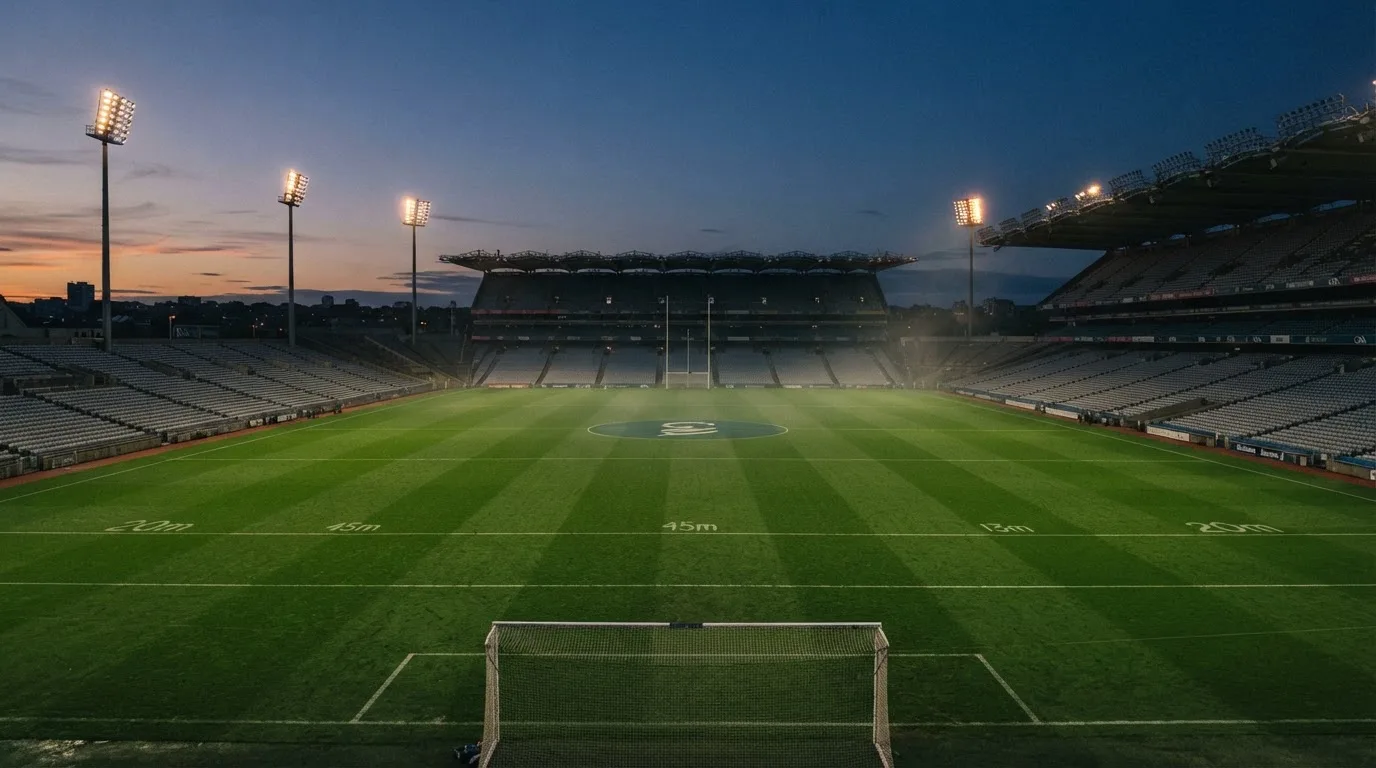
Gaelic games are the umbrella, Gaelic football and hurling the two pillars under it. The Gaelic Athletic Association (GAA) governs both sports from its base at Croke Park, Dublin. All-Ireland finals for both codes are held there every year, and the GAA’s national competition structure is the source of nearly every senior match a bookmaker prices. Junior, intermediate and club fixtures are also offered at most UK-licensed sportsbooks but with thinner markets and bigger margins, reflecting both the lower betting turnover and the lower data quality on those tiers.
The All-Ireland Senior Football Championship is the main event. Five provincial championships — Leinster, Munster, Connacht and Ulster in football — feed into the All-Ireland series through qualifying rounds and a Super 8 group stage (a quarter-final system running in various formats), with the final played in late July at Croke Park. The 2026 final was played on 26 July 2026; Mayo beat Kerry 1–20 to 1–17 for their fourth title. Kerry hold the record for most All-Ireland Senior Football Championship titles at 39, a number that tells its own story about the relative depth of the sport’s elite tier.
The Allianz National Football League runs through the winter and spring. It is the equivalent of a football league season, with the league deciding seeding and the league final scheduled in spring. Markets are thinner than on championship matches but tighter on margin because the volume is concentrated on a small set of fixtures — Divison 1 matches and the league-final day itself. The Tailteann Cup runs alongside the senior championship at a tier below; some operators price it, others do not, and the absence is itself a signal that the bookmaker is not the right home for a bettor who follows the second-tier story.
The provincial championships are the most concentrated betting product — a short, intense period with three or four Saturdays of fixtures where every Divison 1 county plays. The bookmaker’s menu on those weekends becomes the menu on the sport for the year, and the bettor who plans a staking diary around them is making a simple bet on his own attention.
Hurling shares the calendar and the betting product but is the lower-margin sport in many UK books — the All-Ireland Senior Hurling Championship is the headline, Kilkenny’s traditional dominance creates thinner handicap markets than football’s, and the goal-hungry nature of the sport produces more in-play volatility. Any bookmaker that prices hurling heavily tends to price football better; the opposite correlation is not as clean.
Pitch dimensions are a footnote but they shape handicap prices: Gaelic football pitches are 130 to 145 metres long and 80 to 90 metres wide — bigger than association football’s and a different shape — which affects the spread of scores from game to game and the vig on either side of the handicap line. The rule book, since 2025, awards two points for shots from outside a new 40-metre arc added to the scoring area, a change that has shifted expected scores and the lines bookmakers offer for totals markets.
| Competition | Tier | Where it sits in the betting calendar |
|---|---|---|
| All-Ireland Senior Football Championship | Top | Late summer main event; final in late July |
| Provincial championships (Leinster, Munster, Connacht, Ulster) | Top | Early summer; concentrated fixture weekends |
| Allianz National Football League | Top | Winter to spring |
| Tailteann Cup | Second | Runs alongside senior championship |
| Club All-Ireland (Senior) | Club | Late winter / early spring |
| All-Ireland Senior Hurling Championship | Top (hurling) | Late summer; All-Ireland final a flagship event |
| Allianz National Hurling League | Top (hurling) | Winter to spring |
Gaelic games betting is one product among several at every UK-licensed bookmaker, and the operator set is the same set that carries association football, horse racing, tennis and the other sports the bettor is likely to use the account for. The page does not assume the bettor opens an account for Gaelic football alone, which is why the operator reviews below also weigh account-level features — payment methods, withdrawal speed, customer support — that matter beyond the championship.
Bookmaker comparison
Ranking bookmakers for a low-volume sport is a different exercise from ranking them for a Premier League accumulator. The decisive factors are different: licence status matters first, Gaelic football coverage second, in-play depth third, market margin fourth, offers fifth. Across all five, the operators below cover the field with consistent quality but distinctive strengths.
| Bookmaker | Gambling Commission licence | What its own terms state on Gaelic football |
|---|---|---|
| Tote | 54779 · TDCO Limited | Tote-pool betting on selected fixtures; no value figure given by the operator for Gaelic football margin |
| Fafabet | 57385 · Taichi Tech Limited | Standard sportsbook menu; no Gaelic football–specific data point supplied |
| Kwiff | 44448 · Eaton Gate Gaming Limited | Supercharge price boosts can fire on any sport including Gaelic football; stake and cap not specified |
| DAZN Bet | 48756 · DZBT Limited | Standard sportsbook, no Gaelic football–specific data point supplied |
| Smarkets | 39173 · Smarkets (Malta) Limited | Exchange back-and-lay on selected Gaelic games; in-running data flow rate not specified |
| Bet Ahoy | 100094 · Bet Ahoy Ltd | 10% acca bonus up to £1,000, Sub-Cover for substitutions, BOG on UK and Irish racing; no Gaelic football–specific data point supplied |
| BetTom | 64959 · Bet Tom Limited | 50% back-as-free-bet welcome on the sports side; eligible Gaelic football markets not specified |
| Dabble | 65677 · Dabble Sports UK Ltd | Bet £10, Get £10 in free bets on first deposit; eligible sports not specified, minimum odds apply |
| BetUK | 39198 · LeoVegas Gaming PLC | Standard sportsbook; free bets exclude virtuals, esports and non-UK/IE racing |
| Spreadex | 8835 · Spreadex Limited | Dual FCA and Gambling Commission licence; spread products on Gaelic football where listed |
The table above is one piece of the comparison; the rest is in the operator reviews that follow. Two rules the table cannot show: that every brand listed holds a remote licence on the Commission’s public register at the date of writing, and that several licence holders run multiple brands under the same account (LeoVegas Gaming PLC runs BetUK; Spreadex Limited runs both fixed-odds and spread products). None of the brands is “the only” licensed option, and the licence number is the only verification a bettor needs.
Each review closes on a verdict — what the operator is worth, in the context of Gaelic football, to whom. The verdicts differ because the products differ; the comparison is not ten repetitions of the same shape.
Tote
Tote operates under TDCO Limited with a pool-betting focus that has historically set it apart from fixed-odds books. The pool structure pools stakes on each fixture together and pays a dividend based on the distribution of bets, an arrangement that worked well on horse racing and was carried into selected sports. On Gaelic football, the Tote product typically covers the major championship fixtures with win and place pools; the menu is thinner than a fixed-odds bookmaker but the margin treatment is built into the dividend rather than the price. For a bettor who wants the pool product on the All-Ireland final and the league final, the Tote is the home for it. For the bettor who wants 1X2, handicap and totals on every provincial fixture, the menu is short and the value bets are found elsewhere.
The Tote brand is its own feature alongside the licence. Where most UK-licensed sportsbooks are owned by larger groups (Flutter, Entain, bet365, the Kindred Group), Tote’s place in the comparison is the pool product, which is unique on the operator list.
Verdict: pick the Tote on the All-Ireland final if you want the pool dividend; the rest of the year, the brand is not the strongest on the menu.
Fafabet
Fafabet operates under Taichi Tech Limited with a standard sportsbook menu and the racing-side BOG from 9 AM on race days. The BOG is the headline feature on racing; for Gaelic football the relevant product is the standard pre-match menu and the in-play offering on selected championship fixtures. Fafabet’s UK presence is built around breadth — a sportsbook with a full football offering, a casino, the racing BOG and a customer-facing app rated on the App Store at the date of the registration snapshot. On Gaelic football specifically, no margin figure or market-by-market data is published, and the bettor who cares about exact figures has to log in during the championship to read the live menu.
The 9 AM BOG is fixed odds on horse racing, which is the proper context for it. The Gaelic football menu sits inside the same bookmaker but on different terms.
Verdict: pick Fafabet if you want the racing BOG in the same account as your Gaelic football bets; if you bet Gaelic football heavily and racing rarely, the racing feature does not earn its place.
Kwiff
Kwiff operates under Eaton Gate Gaming Limited and the headline feature is Supercharge — a price boost that can fire on any bet on any sport, including Gaelic football, taking a price such as 2/1 to 20/1 at random. The boost is the differentiator; the rest of the menu is a standard sportsbook with an acca builder and a casino section. On Gaelic football, the Kwiff proposition is that any bet placed on a championship fixture is eligible for a Supercharge boost, with no need to opt in to a specific offer page.
The randomness is the catch: a Supercharge that fires at 20/1 on a 1.20 favourite is a different proposition from a Supercharge that fires at 3/1 on a 3.00 price. The bettor’s value from Kwiff is across a sequence of bets rather than on a single event.
Verdict: pick Kwiff for the Supercharge feature if the randomness fits the way you bet; if you want a price you can rely on for each bet, the unpredictability of the boost is not an edge.
DAZN Bet
DAZN Bet operates under DZBT Limited with a deposit minimum of £5 across debit card, Apple Pay, Paysafecard, Trustly and Skrill, and £20 by PayPal, with no processing fees. The deposit menu is the headline feature; the sportsbook itself is a standard layout covering the major sports including Gaelic football during the championship season. The DAZN brand connection brings in customers who already use the DAZN streaming product for combat sports, so the bettor who arrives at DAZN Bet from that side of the business gets a sportsbook with the same deposit flexibility and no fees on any of the methods named.
The £20 PayPal minimum is the detail that hits the small-stake bettor’s actual experience. A pay-by-PayPal punter betting £5 at a time pays a different minimum than the same bettor using a debit card.
Verdict: pick DAZN Bet if the deposit menu matches the way you fund your account, particularly through Apple Pay or Trustly; the sportsbook itself is mid-table for Gaelic football.
Smarkets
Smarkets holds a remote betting intermediary licence under Smarkets (Malta) Limited, which is a different licence type from the standard sportsbook licence. The intermediary licence lets Smarkets run a back-and-lay exchange rather than a fixed-odds book, with prices set by customers against each other and Smarkets taking a commission on net winnings. The app adds two-factor authentication, live charts and an order-book view, a quick-trade-out option and 24/7 live chat support.
On Gaelic football the exchange experience is distinct. Liquidity on a typical provincial championship fixture is lower than on a Premier League match, and the price the exchange shows is often the cleaner signal of where the public money is. The bettor who can stomach lower liquidity in exchange for tighter prices will back on the exchange, lay on the exchange, or place a back bet on the bookmaker side and a lay bet on the exchange to lock in a position. The product is the most flexible one on the operator list, and the bettor who follows Gaelic football closely is best placed to use it.
Verdict: pick Smarkets if you want the exchange model and the price it produces; if you want a familiar fixed-odds menu, the exchange side of the brand is not for you.
Bet Ahoy
Bet Ahoy operates under Bet Ahoy Ltd and the published features are a 10% acca bonus up to £1,000, Sub-Cover for player substitutions, Best Odds Guaranteed on UK and Irish horse and greyhound racing up to £100, and Double Result payout on UK and Irish racing. The acca bonus is the most relevant feature for Gaelic football, where accumulators are the most common betting product during a championship weekend.
Sub-Cover is the Sub-Cover feature for player substitutions — a refund when a named player on the bet does not come off the bench. Six substitutions are allowed in a senior inter-county match, and the bettor who builds a first-goalscorer acca on three championship fixtures has a non-zero chance that the player he named sits on the bench throughout. Sub-Cover removes that risk; the named player needs to play, and a non-appearance triggers a refund.
Verdict: pick Bet Ahoy for the acca bonus during the championship weekends and for the Sub-Cover on a first-goalscorer bet; the racing features are a bonus on a bookmaker you may already use for the Gaelic football product.
BetTom
BetTom operates under Bet Tom Limited with a sports welcome offer that returns 50% as a free bet up to £50 alongside a matching 50% as free slot funds for casino play. The split product — half the bonus on the sportsbook, half on the casino — is the headline shape of the welcome package. Eligible Gaelic football markets and any minimum-odds or eligible-fixture rules are not stated publicly; the bettor who wants the answer has to read the offer page after registration.
The casino slot funds are half the headline figure. A bettor who wants the welcome offer purely for the sportsbook side is buying a package whose headline is 50% but whose sportsbook value is closer to 25%.
Verdict: pick BetTom for the sportsbook welcome offer only if the casino slot funds are also useful to you; if casino play is not part of your account, the headline is half what the offer page suggests.
Dabble
Dabble operates under Dabble Sports UK Ltd with a Bet £10, Get £10 in Free Bets welcome on first deposit, minimum odds applying, a 7-day free bet expiry and the stake not returned with a win. The welcome package is straightforward: deposit £10, place £10 of qualifying bets, receive £10 in free bets. The free bet is a non-stake-returned token (a £10 free bet at 3.00 wins £20, not £30), which is the standard structure on this list.
Minimum odds apply and the eligible-fixture list is not stated publicly. A bettor who wants the welcome offer on a Gaelic football fixture should check the offer page on the day.
Verdict: pick Dabble for a clean welcome offer and a 7-day expiry that is shorter than the longest in the comparison; the offer is good value if you have a bet lined up within the week.
BetUK
BetUK operates under LeoVegas Gaming PLC with a standard sportsbook and the published exclusion list for free bets — virtual sports, esports, and non-UK/IE horse racing excluded, minimum odds applying. The parent company is significant: LeoVegas Gaming PLC runs the LeoVegas brand alongside BetUK, and the licence account covers both.
The exclusion list matters for the small-stake bettor. A Gaelic football bettor who also bets on virtuals and esports is excluded from using the welcome bonus or the recurring free bets on those products. The bettor who bets only on Gaelic football and tournament-grade sports sees no exclusion.
Verdict: pick BetUK for a sportsbook whose free-bet exclusions are spelled out; if you bet virtuals and esports, account for the exclusion before signing up.
Spreadex
Spreadex operates under Spreadex Limited with a dual licence — FCA for spread betting, Gambling Commission for fixed-odds betting — and is unique on the operator list in offering both products. Spread betting on Gaelic football lets the bettor stake a per-point figure on totals, winning margins or other numerical markets, with winnings and losses scaling beyond the original stake. The fixed-odds product is a standard sportsbook.
The new-customer offer on the fixed-odds side is £60 in free bets for a £10 qualifying bet, with the free bets usable on fixed odds and spread betting, and a 28-day window for the qualifying bet. The new-customer offer on the spread side has its own terms and is published separately.
Losses on spread products can exceed the deposit, which is the FCA’s regulatory spine for the warning. The product is not for the bettor who wants his maximum loss capped at his stake.
Verdict: pick Spreadex on the fixed-odds product for a generous welcome offer; choose the spread product only if you understand the gearing, and read the spread betting warning before staking.
Overview
This page is for the bettor who wants Gaelic football as a serious betting product, not as a curiosity added to a Premier League account. The shape of that intention matters because the same lesson applies across every other sport the bettor stakes on: the price on the screen is not the price after margin, and the bonus on the offer page is not the bonus after conditions.
The bookmaker’s margin is the bridge between the price the bettor sees and the value the bet extracts. Margin is built into every market because the bookmaker has to make a profit on every unit staked across all outcomes, and the profit is the gap between what the bettors collectively stake and what the bookmaker collectively returns. On a two-way market priced at 1.90 / 1.90, the implied probabilities are 1/1.90 = 52.63% on each side, which sums to 105.26% — an overround of 5.26% (about 5.3%) of the total stake pool, which is what the bookmaker keeps on average. That number is what the bookmaker offers on a typical Gaelic football match winner; the narrower the market and the bigger the margin, the less value the bettor extracts per unit staked.
A worked example at 1.90 / 1.90 illustrates the cost. The implied probability of each side is 52.63%, the sum of the two is 105.26%, and the margin is 5.26% — the bookmaker’s average take from every unit bet on this market. A £100 stake across the two outcomes in proportion to the odds returns £100 × (1 / 1.0526) = £95 in payouts, with the difference (£5) being the margin. A bettor betting only on one side, the back side, expects to win his stake × (odds − 1) on a hit and to lose his stake on a miss. Over a long series of bets at the same price, the bettor is paying 5.26% of his turnover in expected loss — a £10 stake at 1.90 with no edge produces an expected loss of 53p over many bets at the same price.
A bookmaker margin typically sits in a band: roughly 2–4% on mainstream handicap and totals markets on Premier League football, 4–7% on Gaelic football match winner, and 7–10% or more on less popular markets such as total points in Gaelic football or the marginal leagues that bookmakers cover thinly. The lower-liquidity a sport is at a given bookmaker, the higher the margin tends to be, because the operator has fewer bets to balance the book. The bettor who checks margins across bookmakers on the same fixture — a comparison the operator reviews above do not provide directly, but the bettor can perform it on the betting slip — finds the cheapest price on the match by reading the implied probability.
The product of any comparison is the cheapest price available for a market, and the cheapest price is the one with the lowest margin. A bookmaker offering 1.85 / 1.95 on a Gaelic football match is closer to a 4.5% margin than a competitor offering 1.80 / 2.00 on the same fixture; the bettor who uses both books for a single bet on the cheaper side captures that gap on every bet. Betting with more than one bookmaker is therefore not a choice the bettor makes for variety — it is the operational expression of margin comparison.
A live example shows the band a margin sits inside. Assume an illustrative two-way market at decimal odds of 1.90 / 1.90, which is a common price on Gaelic football match winner markets during a championship weekend. The implied probability of each outcome is 52.63%, summing to 105.26% across the two outcomes, which means a margin of about 5.3% (1 minus 1 divided by 1.0526, the payout share). The bookmaker pays out roughly £95 of every £100 staked across the two outcomes at that price, keeps about £5, and the bettor who places £100 on one side of that market in expectation loses £5.30 over many bets at the same price.
The right mental model is that every bet pays the bookmaker on average, and the bettor profits only when his private probability estimate is better than the implied probability the price carries. A value bet of five points (private 60%, implied 55% on a price of 1.82) returns the bettor 5.3 points a bet after margin, and that 5.3-point edge compounded over hundreds of bets is the profit.
Legality & regulation
The Gambling Commission is the regulator of the commercial market in Great Britain, established under the Gambling Act 2005. Northern Ireland sits outside the 2005 Act and is regulated by separate legislation; “GB-licensed” is the precise term for a Commission licence, and operators licensed by the Commission are licensed to take bets from customers in England, Scotland and Wales. The Commission licences operating companies and licenses them by category: remote general betting standard (real events), remote general betting standard (virtual events), remote general betting limited, remote pool betting, and remote betting intermediary (the licence for betting exchanges). A single operator may hold more than one category.
The Gambling (Licensing and Advertising) Act 2014 closed the consumption loophole — before 2014 an operator based outside Great Britain could take bets from customers in Great Britain on an overseas licence; since 2014, an operator whose remote facilities are used in Great Britain needs a Commission licence wherever it is based. A Curaçao, Maltese, Isle of Man or Gibraltar licence is not a substitute for the GB licence for customers in Great Britain. The point is enforced under sections 33 and 36 of the Gambling Act 2005.
The Commission’s public register lists every licensee and every licence held. The bettor’s check is on the register: business name, trading name, domain or licence account number. The licence account numbers in the operator table above can be entered into the register search and matched against the operator’s name. A brand whose domain is registered on a Commission licence is verified; a brand whose domain is not is not. The Commission’s own search box is the only test.
Three rules shape who can bet. The minimum age is 18. Identity is verified before the first deposit or bet — name, address and date of birth, since 7 May 2019, including with a free bet or bonus. No anonymous play exists at any UK-licensed bookmaker. The account holder’s identity is known to the operator before the first pound moves, and a source-of-funds check at higher spend is normal under money-laundering rules.
Two further checks are newer. A financial vulnerability check (LCCP condition 3.4.4, in force since 30 August 2024) applies to a remote customer whose deposits minus withdrawals exceed £150 in any rolling 30 days (since 28 February 2025); the check is a public-record check against bankruptcy or county court judgments, not an income check. Financial risk assessments, the more extensive affordability checks of the press, were announced on 7 July 2026 in a staged Commission plan with no start date set.
A wagering requirement cap of 10x on bonuses has applied since 19 January 2026 (a £10 bonus at 10x requires no more than £100 of qualifying bets), and mixed-product promotions — offers that tie betting to casino, bingo or lottery play — are banned under the same rule. Credit cards are banned for gambling in Great Britain (since 14 April 2020, LCCP condition 6.1.2), including credit-card-funded e-wallet deposits. Debit cards and bank-based payments are not covered by the ban.
A player who wants to use a Curaçao-licensed operator does so outside the GB framework, with the protections attached to that status and not the GB protections. The losses of that choice are specific: no GAMSTOP coverage, no Commission complaints route, no approved dispute-resolution body, no British consumer redress if funds are withheld, not bound by the 10x bonus cap or the £150 vulnerability check, and the operator may or may not honour its own terms. The Commission has disruption powers (cease-and-desist notices, search-engine referrals, registrar and payment-provider work) and has been given, or is about to receive, court-order DNS blocking powers; consumer-facing ISP blocking is not in operation.
The bettor pays no tax on betting winnings in Great Britain. General Betting Duty is the operator’s tax, currently 15% on gross profits, with a new remote betting rate of 25% to apply from 1 April 2027. From that date, remote bets on UK horse racing, self-service betting terminal bets, pool betting and in-person betting stay at 15%; spread betting has its own rates (3% financial, 10% other). Until 1 April 2027 the remote rate stays at 15%. The duty is levied on the operator; whether operators pass it on through worse odds to customers is not established and is not the subject of any published estimate in this article.
Responsible gambling
Betting is no income, no substitute for budgeting and no route through financial difficulty. The product is sold as entertainment with a price tag attached, and the price tag is a stake the customer may lose. Most customers treat it that way; the protective architecture is for those who don’t.
GAMSTOP is the central self-exclusion tool. A customer registers on the GAMSTOP site, confirms identity, and chooses an exclusion period: six months, one year, five years, or five years with auto-renewal. Every GB-licensed online bookmaker (online only, not betting shops) checks new sign-ups against the GAMSTOP database and refuses to open an account while an exclusion is active. After the minimum period the exclusion stays in place for a further seven years unless the customer asks GAMSTOP to remove it. The exclusion cuts off all GB-licensed online bookmakers in a single registration — it is the most efficient single tool the customer has.
Deposit limits are the customer-side tool most operators publish first. A gross deposit limit can be set on a fixed time frame — daily, weekly or monthly — and the limit applies to deposits only, not to withdrawals. Any operator change to the limit (raising it) has a 24-hour cooling-off period before the new limit takes effect; reductions take effect immediately. Lowering a limit is a one-click operation; raising it is a deliberate cooling-off decision. The Commission rules (RTS 12) tightened the deposit-limit framework in stages: first changes since 31 October 2025, a second phase postponed to 30 September 2026, and whether the second phase is now in force remains unclear.
Self-exclusion is the operator-side tool a customer can ask for at any time. The operator closes the account for a defined period (typically six months minimum) and removes marketing contact during the exclusion. Self-exclusion is one operator; GAMSTOP is the whole market.
Product restrictions are a third layer. A customer can request that specific product categories — casino, slots, fixed-odds betting — be removed from the account while keeping others open. Unibet’s safer-gambling tools list product restrictions alongside deposit limits and a Player Profile test as part of the operator’s published safer-gambling offering.
Reality checks are the in-session reminder. A pop-up or notification appears at intervals a customer has chosen (typically 30, 60 or 90 minutes) and summarises session length and net position. The reminder is the simplest friction point a customer can opt in to, and the easiest one to ignore.
Time-out is the short break. A customer can take the account off for 24 hours, 48 hours, a week or a month without committing to a full self-exclusion. The account reopens automatically at the end of the period; this is the lightest-touch tool.
External help is the route outside the operator. GamCare runs the National Gambling Helpline (0808 8020 133, 24/7), and the GamCare website offers live chat, online forums and access to local counselling. The NHS runs gambling clinics in several regions for treatment of gambling harm. Gamblers Anonymous runs peer-support meetings. The Commission publishes a full directory of help services on its site.
A bank-side tool exists for the customer whose account control is breaking down. Most UK banks now offer a card-blocking feature that can be activated from the banking app to decline gambling transactions. The block stops transactions at the merchant-code level (the gambling MCC) and is reversible; it does not need the customer’s bank to know the customer is in difficulty.
The responsible-gambling tools above are mandatory at every GB-licensed operator since 31 March 2020. An operator licensed by the Commission offers deposit limits, time-out, self-exclusion and product restrictions. An operator not licensed offers none of these protections and is outside the GAMSTOP framework.
The reasonable framing is that betting is entertainment the customer pays for, and the protection architecture is what stops the entertainment from turning into the problem. Gambling harm is a real harm and the services named above are staffed, available and free.
Crypto & anonymity
Gaelic football betting with cryptocurrency is not available at any UK-licensed bookmaker in the comparison. The Commission does not allow anonymous play — identity is verified before the first deposit or bet, a rule in force since 7 May 2019 — and the Commission’s framework requires source-of-funds documentation at higher spend. Cryptocurrency deposit acceptance is the operator’s choice under its own licence conditions, but at a GB-licensed site the deposit is identified to the operator, the operator is identified to the Commission, and the chain of custody is the regulated kind.
A bettor who wants to bet on Gaelic football with bitcoin or another cryptocurrency has two routes. One is via the offshore market — operators licensed in Curaçao, Anjouan or similar jurisdictions that accept crypto deposits, run on the operator’s own house rules, and do not verify identity before the first bet. The product is the same shape as a UK sportsbook on the menu side, with the absence of GAMSTOP, the absence of the Commission’s complaints route, and the absence of any British consumer redress if funds are withheld. The risks attached to that choice are set out in the legality section above and they apply to a Gaelic football crypto bet the same way they apply to any other sport.
The second route is via a peer-to-peer exchange that accepts crypto funding and then places the bet against the exchange’s own account at a UK-licensed bookmaker. That structure is closer to bettor-funded betting than direct crypto staking; the bettor’s funds are deposited with the exchange, the exchange settles positions, and the consumer credit sits with the exchange rather than with the bookmaker. The regulatory status of the exchange is its own; a bettor who uses this route is engaging with whatever KYC and KYT the exchange operates, separate from the bookmaker’s.
The general rule of crypto and gambling in Great Britain: a UK-licensed bookmaker’s first deposit triggers identity verification under the Commission’s rules, regardless of the payment instrument. A debit card, a bank transfer, an e-wallet or a crypto deposit all pass through the same identity gate. The Commission’s framework does not allow the crypto deposit to substitute for the verified-identity gate, and operators running on a GB licence do not offer it.
A bookmaker licensed in Curaçao with bitcoin deposits has the appeal of anonymity in the sense of pseudonymous ledger transactions and no verified identity, and the absence of every protection the Commission mandates at a GB bookmaker. The bettor who values the pseudonymity more than the protection takes that trade knowingly. The bettor who values the protection more than the pseudonymity stays with a GB-licensed brand and pays his way in via debit card or bank transfer, with identity verified and source-of-funds documentation supplied at higher spend.
The narrow ask — “gaelic football betting with bitcoin” — is best answered as: not at a GB-licensed brand; only at an offshore brand licensed elsewhere; with all the protections absent that the Commission’s framework provides. The cost of that absence is not a number; it is a set of possible downsides (no GAMSTOP, no approved dispute resolution, no recourse to a British regulator) that the bettor accepts because he values the other side of the trade.
Calculating the margin on a Gaelic football market
Margin is the price the bettor pays the bookmaker on every unit staked on a market. It sits inside the price the bettor sees on screen, and the calculation that takes the price apart is the one operation every bettor should be able to do before any bet is placed. The two-way match-winner market is the cleanest example because it has only two outcomes, and a price of 1.90 / 1.90 on a typical Gaelic football match is a common one during the championship season.
To find the implied probability of an outcome, divide 1 by the decimal odds. At 1.90, the implied probability of either side is 1 / 1.90 = 0.5263, or 52.63%. The two probabilities add up to 1.0526, or 105.26%, and the gap between that sum and 100% — 5.26% (about 5.3%) — is the margin. Translate the same number the other way: the payout share is 1 / 1.0526 = 0.9503, or 95.03%, and the margin is 100% minus the payout share, which gives the same 5.0% gap once rounding is allowed for.
The calculation generalises to any two-way market and to any three-way or N-way market on the same pattern — the sum of the implied probabilities is greater than 100%, and the gap is the overround. A 1X2 match-winner market at 2.10 / 6.00 / 2.50 produces implied probabilities of 47.62% / 16.67% / 40.00%, summing to 104.29%, and an overround of about 4.3%. The margin on a Gaelic football match winner in a typical fixture tends to sit between 4% and 7%, reflecting the lower liquidity of the sport at most bookmakers.
What the margin means in expected loss is straightforward. Over a long series of bets at the same price, the bettor pays the margin on his turnover in expected loss. Betting £10 at 1.90 on the same match for a hundred bets produces total stake of £1,000 and expected loss of £52.60 (5.26% of turnover), before any edge the bettor has from a private probability estimate better than the price’s implied probability. A bettor whose private probability is 60% on a price that implies 55% (1.82) has an edge of 5% in his favour and an expected loss smaller than the margin — the edge is the difference between the private probability and the implied probability, and the margin is what the bookmaker takes on top of the edge on average.
A worked example illustrates the cost concretely. Take an illustrative two-way Gaelic football match at decimal odds of 1.90 / 1.90. The implied probability of either outcome is 52.63%, and the sum of the two implied probabilities is 105.26%. The payout share (what the bookmaker pays back to bettors on average per unit staked across both outcomes) is 1 / 1.0526 = 95.03%. The margin is the difference, 4.97% — about 5% once rounded. The bookmaker keeps about 5p of every £1 staked on this market in the long run, and a bettor staking across both outcomes at this price loses 5p per pound in expectation.
The same calculation applied to a different price set gives the bettor the spread of margin across bookmakers on the same fixture. A bookmaker offering 1.85 / 1.95 carries a margin of (1/1.85 + 1/1.95) − 1 = (0.5405 + 0.5128) − 1 = 3.33% — a tighter margin than the 1.90 / 1.90 example, and the bettor who uses that bookmaker pays less in expected loss per pound staked. The implication for the bettor isoperates against the bettor who bets only on one bookmaker.
Three cautions sit alongside the calculation. The margin is the average cost across many bets, not the cost of any single bet — a winning bet returns the full odds, a losing bet returns zero, and the average converges on the margin over a long series. The margin is not the same as the bookmaker’s profit, because the bookmaker’s profit depends on the asymmetry of stakes across outcomes (the bookmaker profits more when favourites are over-backed than when the book is balanced). The margin is a price the bettor can compare across bookmakers, and the comparison is the bettor’s edge in shopping for the best price.
The conclusion is mechanical: every bet pays the bookmaker on average, and the bettor’s long-run outcome is the difference between his private probability estimate and the price’s implied probability, less the margin. The argument for betting is the edge; the argument against it is the margin that edge has to beat.
Frequently asked questions
How is a bet placed on Gaelic football?
The first step is opening an account with a UK-licensed bookmaker — one of the ten brands reviewed above, or any other brand whose details appear on the Gambling Commission’s public register. The account requires identity verification (name, address and date of birth) before any deposit or bet is placed, and the minimum age is 18. Once verified, a deposit — debit card or bank transfer in most cases; credit cards are banned for gambling — funds the account and unlocks the betting menu. Gaelic football markets appear under “Gaelic games” or “GAA” in the menu; the All-Ireland Senior Football Championship and the Allianz National Football League are priced across championship weekends. Stakes are placed by selecting the match, picking an outcome, entering the stake and confirming.
What is a value bet and why is no tip ever certain?
A value bet is one where the decimal odds imply a lower probability than the bettor’s private estimate of the true probability — the price is too big for what it offers. Convert the price to a probability (1 divided by decimal odds), compare it to the bettor’s estimate, and the gap is the value. No tip is ever certain because the true probability is unknown, the markets settle on real outcomes, and a tipster’s record can only be assessed after many settled bets that have not yet happened. The bet is a probability bet, not a prediction bet, and the value is the average over many bets, never a single bet.
What is the bookmaker’s margin and how does it show up in the odds?
The margin is what the bookmaker keeps of every unit staked across all outcomes of a market on average. On a two-way market priced at 1.90 / 1.90, the implied probabilities (1 divided by 1.90) sum to 105.26%, and the gap between that sum and 100% (about 5.3%) is the margin. Translate to a payout share by dividing 1 by the sum of the implied probabilities — 95.03% on this example — and the margin is the difference. The margin sits inside every price on the menu, and a bookmaker with a tighter margin gives the bettor a cheaper price per unit staked on the same market.
How is the return on a bet worked out from the stake and the odds?
For a single bet, the return on a win is the stake multiplied by the decimal odds, and the profit is the stake multiplied by (decimal odds minus 1). A £10 stake at 3.00 returns £30 (profit £20); a £10 stake at 1.50 returns £15 (profit £5). For a combination bet — a double, treble, accumulator — the odds of each leg multiply together into a single price, and that combined price times the stake is the win return. A four-fold acca at average odds 2.00 produces a 16.00 combined price, so a £5 stake returns £80 (profit £75) on a win.
How can it be checked that a bookmaker holds a Gambling Commission licence?
Use the Commission’s public register, which is searchable by business name, trading name, domain or licence account number. Enter the bookmaker’s domain or its Commission account number (the licence numbers in the operator table above can be entered directly), match the result against the brand name on the licence, and confirm the categories — “remote general betting standard (real events)” is the typical category for a sportsbook. The register page for each licensee shows the licence status, the operating company and the categories of licence the operator holds. A licence in force at the time of checking is the only verification needed; an expired or lapsed licence is not a current licence.
Which tools for controlling play does a licensed bookmaker have to offer?
Every GB-licensed bookmaker offers GAMSTOP registration (covering all GB-licensed online operators in a single sign-up), deposit limits on a fixed time frame (daily, weekly or monthly), self-exclusion from the operator for six months or more, time-out for short breaks (24 hours, 48 hours, a week, a month), product restrictions (closing specific categories while keeping others open) and reality checks (session-time and net-position reminders). GamCare runs the National Gambling Helpline (24/7), the Commission lists help services on its site, and bank card-blocking at the merchant-code level is available from most UK banks. The presence of these tools is a condition of GB licensing and the bettor’s first check on the operator.
Rugby, cricket & Gaelic – Bookies Trust
Content created by the «Bookies Trust» team
