
How horse racing predictions actually get made — and what the price hides
 Available in US
Punters who type “horse racing betting predictions” into a search bar are usually after a tip. This page is built on the harder truth behind every tip — that a prediction is a probability dressed up as a name, and a price is a probability with a margin carved out of it. The arithmetic below is what decides whether a tip is worth following. The ten bookmakers reviewed here are all on the Gambling Commission’s public register; each gets a verdict in its own block, and the verdict rests on what the terms say, not on the marketing copy that surrounds them.

The data here is current as of 27 October 2026 and was checked against the Gambling Commission’s public register, each operator’s own terms and the Commission’s Licence Conditions and Codes of Practice.
The ten bookmakers reviewed here
A shortlist, not a scoreboard. The place is set by what each operator brings to a British punter who takes racing seriously: pool betting on the Tote, exchange commission on Matchbook, antepost specials from Fitzdares, Best Odds Guaranteed from William Hill’s rules, in-play depth on bet365. None of them is “the best” in any universal sense — the right one depends on the bet being placed.

| Operator | Gambling Commission licence | What their own terms say on the subject |
|---|---|---|
| Tote | 054779-R-331321-008, held by TDCO Limited | Pool betting on British and Irish racing; dividends set by the pool, not by a sportsbook margin |
| Fitzdares | 000400-R-103839-030, held by Fitzdares Limited | Cash out, accumulators, Lucky 15s and specials on racing, football, tennis, rugby, cricket, golf and American football |
| Bar One Racing | 056516-R-332750-007, held by Bar-One Racing Limited | Irish-focused sportsbook; racing sponsorships at Dundalk, Fairyhouse, Navan, The Curragh, Curraheen Park and Cork |
| 10bet | 043173-R-322899-023, held by Blue Star Planet Limited | Cash out, Bet Builder and live streaming on football, tennis and horse racing |
| Fafabet | 057385-R-333191-006, held by Taichi Tech Limited | Best Odds Guaranteed on UK and Irish racing win and each-way bets from 9am on race days |
| DragonBet | 064908-R-339041-003, held by DragonBet Ltd | Cash out in-play and pre-match; live streaming of racing |
| bet365 | 055148-R-331498-002, held by Hillside (UK Sports) ENC | In-play betting and live streaming worldwide; Bet Track, Match Live and a Live Golf Tracker |
| Matchbook | 039504-R-319407-024, held by Triplebet Limited | Betting exchange — back and lay against other users; Bet Builder, multiples, in-play and live racing streams |
| Smarkets | 039173-R-319366-011, held by Smarkets (Malta) Limited | Betting exchange; two-factor authentication, live charts, order book view, 24/7 live chat |
| Betboro | 044181-R-324363-007, held by Webmedia Development N.V. | In-play markets and cash out on football, racing and tennis; boosted odds on selected singles from £10 stakes |
Each row is a starting point. The judgment on which bookmaker fits a particular punter sits in the operator blocks further down.
The fundamentals: what a horse race actually is
Flat racing and jump racing are different sports. Flat racing is run directly between two points around a straight or oval track, while jump racing — steeplechasing and hurdling — is called National Hunt racing in Great Britain and Ireland. Flat distances range from 440 yards (400 m) to more than four miles (6.4 km), with five to twelve furlongs (1.0 to 2.4 km) the most common distances on the British programme. A novice punter glancing at a racecard sees furlongs and assumes they are all the same race in different lengths; they are not — five furlongs and a mile and a half ask entirely different questions of a horse, and the form book treats them as separate contests.
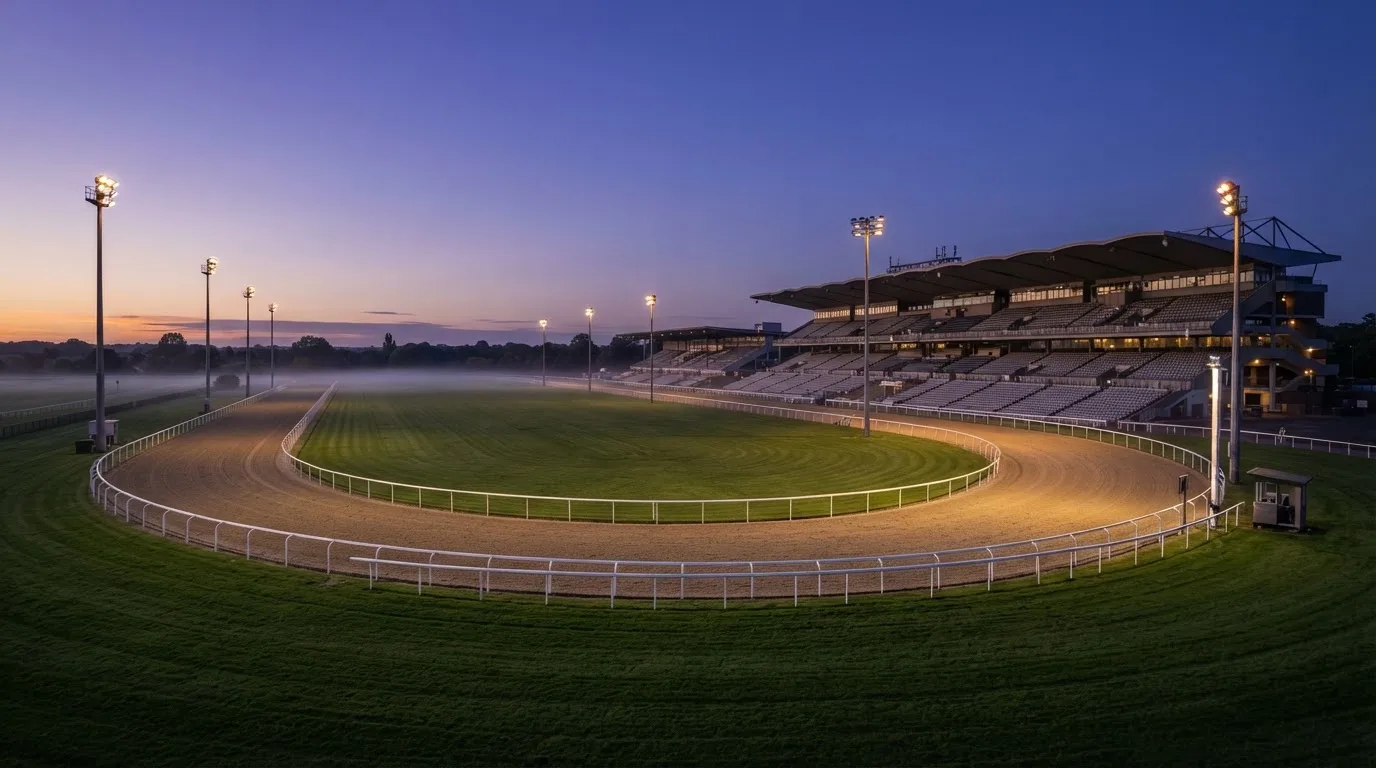
Handicap races and conditions races also differ. In a handicap each horse carries a different weight chosen by the handicapper to reflect its ability, while a conditions race gives horses the same weight with allowances for younger and female horses. A handicap is, by construction, a race the handicapper thinks he has levelled; a conditions race is one the rules have left open. The form angles that work in one do not always transfer.
The British Triple Crown — the 2000 Guineas, the Derby and the St Leger — is three flat races run against different opposition across the season, open to three-year-old colts and fillies. Winning all three is a feat so rare it has happened only a handful of times since the Second World War. Each leg stands on its own; the Triple Crown is a line drawn over a career, not a single event.
Each-way betting — the stake that is two bets
An each-way bet is two bets at equal stake: a win bet and a place bet. A £5 each-way stake therefore costs £10. The place part pays out at a fraction of the win odds, and that fraction is set by the place terms — a bookmaker’s rule, varying by race type and field size. UK each-way place terms at most firms run on a familiar grid: handicaps with more than fifteen runners pay a quarter of the win odds for four places, twelve-to-fifteen-runner handicaps a quarter for three places, other races with more than seven runners a fifth for three places, five-to-seven-runner fields a quarter for two places, and fields of fewer than five runners win only — no place dividend. Each operator’s site states its own grid, and the grid is worth reading before staking on a small field.
Worked at one set of place terms, a £10 each-way bet on a 10/1 horse at 1/4 odds for three places costs £20 in stake; if it wins, the win part returns £110 and the place part returns £35 — £145 in total. If it only places, the place part alone returns £35 against the £20 stake, a small loss on the place half but a useful cushion when the win pick has run below expectations.
Fractional to decimal — the punter’s arithmetic
British odds speak in fractions on the racecourse and in decimals on the betting slip. A 5/1 shot is six decimal (5 ÷ 1 + 1 = 6.00); an 11/4 chance is 3.75; evens is 2.00. Anything shorter than evens — “odds-on” — has the smaller number on top. The conversion is mechanical, and it is the first thing a serious punter learns to do in their head. Return on a winning bet at decimal odds c is stake × c; profit is stake × (c − 1). On a combination bet the prices multiply into one.
The legal landscape: who is allowed to take your bet
Every commercial bookmaker taking bets from customers in Great Britain needs a Gambling Commission licence. The Commission’s register is the whole test of who holds one and what the licence covers. The Gambling Act 2005 covers England, Scotland and Wales; Northern Ireland sits under older legislation and is outside the Act, so a “GB-licensed” or “Great Britain licence” framing is correct and a Northern Ireland framing is not. Since the Gambling (Licensing and Advertising) Act 2014 an operator whose remote facilities are used in Great Britain must hold a Commission licence wherever it is based — sections 33 and 36 of the 2005 Act, as amended. A Curaçao, Maltese or Gibraltar licence is not a substitute, and a .com domain is no proof either way: licensed operators use .com and .co.uk interchangeably.
The Commission issues several licence categories. The relevant ones for racing are remote general betting standard (real events), remote pool betting, and remote betting intermediary — the last is the licence a betting exchange runs under. A licence for one category does not cover another, and a brand running an exchange arm alongside a sportsbook arm holds two licences, not one. The register lists account numbers that are not customer-friendly — long strings starting at zero — and a single licensee can run several brands under them. Ladbrokes and Coral, for instance, share a parent; the same is true of Paddy Power and Betfair. Two brands on a shortlist are not two independent operators, and the price they offer will reflect it.
The customer protections attached to a GB licence are not vague. Since 7 May 2019 the operator has to verify name, address and date of birth before a customer can deposit or gamble, including when the first stake is a free bet or bonus. There is no anonymous play at a licensed site. Credit cards have been banned for gambling in Great Britain since 14 April 2020 — debit cards and bank-based payments are not covered by that ban. The minimum age is 18, and the Commission’s safer-gambling duties are spelled out in the Licence Conditions and Codes of Practice. Spread betting that is not a financial product sits inside General Betting Duty; financial spread betting is regulated by the Financial Conduct Authority, not the Commission. The two are not the same activity and a firm that does one is not licensed for the other.
What may be bet on
There is no statutory list of permitted bets. The Commission’s LCCP and each operator’s own house rules decide what is offered. In-play betting is offered by GB bookmakers under licence conditions and customer-protection duties, not as an unrestricted market by statute — a fine but important distinction that the marketing pages often blur. Esports, virtual events, politics, TV outcomes and novelty markets are all available from GB-licensed bookmakers, and none is statutorily prohibited. There is no statutory cap on stakes in sports betting: operators set their own maximum stakes and may restrict a customer if their model of the account warrants it.
What the operator keeps — the margin
Every price on a racing market carries the operator’s margin, called the overround in the trade. Take a two-way book at 1.90 / 1.90 (decimal; fractional 9/10). The implied probability of either outcome, expressed as a share, is 1 ÷ 1.90 + 1 ÷ 1.90 = 0.526 + 0.526 = 1.053, or 105.3 %. The 5.3 points above 100 % is the overround: what the bookmaker keeps on average from every £1 staked across the two outcomes in that market. Strip it out and the market returns 1 ÷ 1.053 ≈ 95.0 % of stakes to punters as winnings — a payout share of 95 %, a margin of 5 %.
That is what a “value bet” really trades against. A price at 1.90 in a market whose true probability is 50 % (a 1/1 shot, decimal 2.00) is not value — at the true probability the fair price is 2.00, and 1.90 already strips 5 % of expected value out of the bet. A price at 2.10 on the same 50 % runner is value — the extra ten basis points over fair odds is the punter’s edge. The margin is the fog the edge has to clear. Where the line falls on this trade depends on the market: a place-only market with the place terms on a small field carries a heavier overround than a two-runner match bet, and an antepost book on a Classic weeks before the race carries more again.
Help, limits and the duty the law actually imposes
GAMSTOP is the national multi-operator online self-exclusion scheme and a mandatory licence condition for online operators since 31 March 2020. Exclusion periods are six months, one year, five years, or five years with auto-renewal, and after the minimum period the exclusion stays in force for a further seven years unless the customer asks GAMSTOP to remove it. GAMSTOP covers online sites and apps; betting shops use a separate service. GamCare runs the National Gambling Helpline; GambleAware, the NHS gambling clinics and Gamblers Anonymous complete the help network.
Deposit limits are now in the rule book. The Commission’s Remote Technical Standards require operators to offer a gross deposit limit on a fixed time frame — the first changes applied from 31 October 2025, with a second phase postponed to 30 September 2026, and whether the second phase is live is not yet established. Limits are the customer’s choice; the law does not set a deposit or loss ceiling. The financial vulnerability check, in force since 30 August 2024, kicks in once a customer’s deposits minus withdrawals exceed £150 in any rolling 30 days — since 28 February 2025 — and it is a public-record check (bankruptcy, county court judgments), not a credit check and not an income check. Financial risk assessments — the “affordability checks” of the press — are announced in a staged plan of 7 July 2026 with no start date; write “announced, staged, no start date” rather than “in force”, and no punter should plan around them as if they were settled.
Bonuses and the marketing rule that actually bites
Bonuses are not what the headline figure suggests. Since 19 January 2026 wagering requirements on bonuses have been capped at 10x — a £10 bonus that previously demanded £500 of bets now demands no more than £100. Mixed-product promotions — offers that require a punter to gamble on two or more product types such as betting and casino — are banned. Whether the 10x cap applies to free bets that carry no wagering condition is not established. Promo codes are never printed on this page: codes move, codes expire, codes are an affiliate’s lever, and the relevant fact is what the offer costs the punter in turnover.
The bonus cap is not the only protection. A “100 % bonus” of £100 sounds generous until it sits next to a 10x turnover — £1,000 of qualifying bets at minimum odds — and the 5 % margin on the average racing market turns roughly £50 of those bets into expected loss. The headline becomes the price the punter pays to clear it. The arithmetic of an offer is in the next block.
Tax
The punter pays no tax on betting winnings in Great Britain. General Betting Duty is the operator’s tax on gross profits and currently sits at 15 %; from 1 April 2027 a new remote betting rate of 25 % applies within it, while remote bets on UK horse racing, bets on self-self-service betting terminals in licensed premises, pool betting and in-person betting stay at 15 %. Spread betting carries its own rates (3 % financial, 10 % other). Until 1 April 2027 the remote rate is still 15 %, and whether operators pass duty on through their odds is not established — no claim is made here that the punter is charged duty. A professional gambler should ask HMRC or an adviser; this page is not tax advice.
Offshore
A GB licence is compulsory at the point of consumption. Providing gambling facilities in Great Britain without the licence the Act requires is an offence under section 33 of the Gambling Act 2005 (on summary conviction up to 51 weeks’ imprisonment, a fine up to level 5, or both; six months in Scotland) — the offence is aimed at the operator, not the customer. No offence aimed at a customer who merely bets on an unlicensed site was found in the law. What the customer loses is the protection — no GAMSTOP coverage, no Commission complaints route, no approved dispute-resolution body, no British consumer redress if funds are withheld, and none of the bonus cap or vulnerability-check rules apply. Enforcement is disruption rather than blocking: cease-and-desist notices, search-engine referrals, work with registrars, hosts and payment providers; the Commission has been given or is about to receive court-order DNS blocking powers, but ISP-level blocking is not in operation as a matter of policy. Neither licensed nor unlicensed play is the “safe choice” by default; the licensed choice comes with verification before the first bet and the duty to fund the checks, and the unlicensed choice comes with the absence of all the protections the licensed path owes.
Responsible gambling — the controls a licensed bookmaker must offer
The safer-gambling toolkit at a GB-licensed operator is not a courtesy, it is a licence-condition obligation. The LCCP and the Remote Technical Standards spell out what must be in the product, and an operator that falls short is open to regulatory action. The controls a punter can expect to see, regardless of the brand on the front of the site, are these.
Deposit limits — gross limits on a fixed time frame, set by the customer and respected by the operator. Reality checks — pop-ups at intervals the customer chooses, surfacing session length and net position. Time-outs — short exclusions of twenty-four hours to several weeks, sitting between a deposit limit and a GAMSTOP exclusion. Product restrictions — the customer can block specific products, casino or sportsbook or one sport inside the sportsbook, when their own play warrants it. Self-exclusion — the GAMSTOP route, six months to five years, plus the operator’s own single-brand exclusion. Affordability and vulnerability signals — the operator’s own monitoring, escalating to source-of-funds questions at higher spend, and the public-record financial vulnerability check described above. The combination is layered: the customer’s own controls at one end, the operator’s monitoring in the middle, the Commission’s vulnerability rules at the back. None of it makes gambling safe; what it does is give the punter a way to step back without closing the account and a way to escalate the step back when one limit is not enough.
The signposts a licensed operator publishes are also part of the licence. GamCare and the National Gambling Helpline; GambleAware; the NHS gambling clinics; Gamblers Anonymous; GAMSTOP. These sit on every licensed site in roughly the same place at the foot of the safer-gambling page, and a site that hides them is itself a signal about the operator.
When the controls are not enough
If gambling stops being a choice and starts being a pressure, the routes out are these. GAMSTOP blocks every GB-licensed online operator at once. GamCare’s National Gambling Helpline is twenty-four hours a day. The NHS gambling clinics offer treatment, not just advice. Gamblers Anonymous runs peer-support groups. None of these requires the punter to keep betting to use them; none of them depends on the operator’s permission.
How predictions are built — and why no tip is ever certain
A horse racing prediction is a probability dressed up as a name. Strip it back and the work is the same: form, statistics, the line-up and the market’s own price, in that order of weight.
Form is what the horse did last time out, and the times before that. A course-and-distance winner returning to the same track is one signal; a horse beaten by a slow pace and dropped in class is another. Form reading is not a science — the same form line tells different stories to different readers — and the best readers do not claim certainty. They claim a view of the probability.
Statistics are the public data behind form. Sectional times, going reports (the going description: heavy, soft, good to soft, good, good to firm, firm), draw bias at the course, trainer-jockey combinations, and the horse’s record on the surface. Racing’s statistical literature is rich, and a serious punter uses it the way a football modeller uses expected goals.
The line-up is the field the horse actually faces. A Group horse dropped into a handicap is the headline story; the less-publicised angle is the pace map — who goes forward, who sits, who finishes. The pace shape of the race decides which style of horse wins, and the form book alone does not.
The market’s own price is the final input. A horse at 5/1 in a seven-runner field, with all the form above stacking up, is one bet; the same horse at 2/1 after a market move on the morning of the race is a different one. A prediction that ignores the market price is a prediction that ignores the aggregated view of everyone else doing the same work.
Value, and why it is the only thing worth following
Value is the gap between the punter’s estimated probability for a horse and the market’s implied probability at the price offered. If the punter thinks a horse has a 25 % chance (a 3/1 shot, fair decimal 4.00) and the market offers 5.00, the gap is the value. Bet the gap. If the punter thinks 25 % and the market offers 3.50, there is no gap, and the bet is the market’s, not the punter’s. Value is the only criterion that survives contact with the betting account over thousands of bets; form, statistics and the line-up are inputs to estimating the probability, and the probability is the engine, and the price is the test.
No tip is ever certain. The 5/1 winner wins one race in six on its true probability; the 2/1 favourite wins one in three; the 10/1 longshot wins one in eleven. A punter who treats any tip as a certainty loses to the variance they ignored. Variance is what makes a tip a probability rather than a result, and the variance is the same whether the tip came from a friend, a newspaper column, a paid service or the punter’s own work.
Bankroll discipline — the staking plan that survives losing runs
Bankroll is the float set aside for betting, kept separate from the household budget. Discipline is what happens to it. A staking plan — flat stakes as a percentage of bank, or a more elaborate Kelly-style fraction — turns a sequence of bets into a sequence with a known shape. A 2 % bankroll stake per bet means a fifty-bet losing run costs the bankroll roughly 63 %, and the punter is still in business. A 10 % stake means the same run wipes the bankroll, and the punter is not.
The shape of losing runs is what destroys punters who rely on form alone. Even at a true edge of 5 %, a sequence of bets at the wrong end of the variance curve produces twenty losers in a row. The staking plan is the bit that absorbs the variance; the form work is the bit that builds the edge. Neither works without the other.
Why a tipster service is not an income
A tipster service is a stream of selections with a published staking plan and a published yield. The headline number is the yield — the profit over the period, expressed as a percentage of stakes — and the right question is not the headline but the sample size, the staking plan and the market the service played in. A 20 % yield over fifty bets is noise; a 5 % yield over two thousand bets is a signal. A service that does not publish the staking plan, the sample size and the independent audit cannot be checked against its own claims. Even a checked service is no income: variance swings across both directions, and the punter who follows it without a bankroll plan is the punter who breaks first.
The bookmaker’s margin in plain numbers
A worked two-way market at 1.90 / 1.90 (fractional 9/10, decimal 1.90) is the clearest case. The implied probabilities, expressed as shares, are 1 ÷ 1.90 and 1 ÷ 1.90 — roughly 0.526 each, summing to about 1.053, or 105.3 %. The 5.3 percentage points above 100 % is the overround: the slice the bookmaker keeps on average across both outcomes. The market returns 1 ÷ 1.053, around 95.0 % of stakes to punters as winnings — a payout share of about 95 %, a margin of about 5 %.
That 5 % is the fog any edge has to clear. A punter with a true 50 % read on a coin-flip needs odds of 2.00 to break even; the same punter at 1.90 is paying the 5 % margin to take the bet, and the bet is the bookmaker’s, not the punter’s. The right move at 1.90 is to take the bet only when the punter’s edge over 50 % is greater than the 5 % margin — in the roughest framing, a 53 % read at 1.90 is a value bet, and a 51 % read is not.
The same arithmetic on a place market, with each-way place terms on a five-runner field paying a quarter of the win odds for two places, returns a heavier margin: the place half of an each-way bet at 4/1 win and 1/1 place is roughly 1.33 decimal, the win half is 5.00, and the place half compounded into the each-way book carries a margin closer to the 7-8 % band. Place markets on small fields are where the bookmaker’s edge runs deepest, and a punter who bets place-only on short fields is paying for the privilege.
What “Best Odds Guaranteed” actually pays
Best Odds Guaranteed is a British bookmaker concession on UK and Irish racing: if the starting price (SP) returned at the end of the race is bigger than the price the punter took, the punter is paid at SP. The rule applies from a morning cut-off on race day — William Hill’s terms put it at 8 AM, Fafabet’s at 9 AM — and it does not apply to ante-post bets, tote bets or pari-mutuel pools. The economics for the punter: the bookmaker is paying the gap between early-morning price and starting price when the market drifts out, and absorbing the gap when it drifts in. On a typical race day the drift out is the more common move, and the BOG concession is worth a small but real percentage on top of the price. The economics for the bookmaker: BOG pulls early-morning money onto the book, and a bookmaker with a heavily populated early book gets a more accurate liability picture before the off. Both sides get something, and the punter’s “something” is paid in cash, not free bets.
Ten bookmakers, ten verdicts
A place in a comparison is not a licence and not a recommendation. What follows is each operator on the terms it states and the licence it holds, with a verdict that answers the question the block above it actually established.
Tote — pool betting on British and Irish racing
The Tote sits on the Commission’s register under account 054779-R-331321-008, held by TDCO Limited, and trades under the pool-betting model rather than the fixed-odds sportsbook model. A pool bet’s dividend is set by the pool — the total staked minus the operator’s take, divided among winning tickets — and the price is not set by a sportsbook margin in the way a fixed-odds book is. The Tote is the natural home of a punter who likes the structure of a pool and is happy to read dividends rather than prices.
The verdict: the Tote suits a punter who treats racing as a pool-and-goes product. The sportsbook standard features — Bet Builder, acca insurance, enhanced odds — do not apply; the value is in the pool, not the promo.
Fitzdares — antepost specials and an upmarket betting app
Fitzdares runs under account 000400-R-103839-030, held by Fitzdares Limited, and the Commission’s public register confirms the licence categories. The app offers cash out, accumulators, Lucky 15s and specials on horse racing, football, tennis, rugby, cricket, golf and American football, with in-play live odds across the sports. The shape of the offer is a sportsbook with antepost weight: specials, multiples, in-play — the British combination.
The verdict: Fitzdares suits a punter who wants antepost and specials in one product, and is happy with the sportsbook-margin economics that come with the format.
Bar One Racing — an Irish-focused sportsbook with racing sponsorship depth
Bar One Racing trades as BAR 1 Betting and runs under account 056516-R-332750-007, held by Bar-One Racing Limited. The brand has shops across Ireland and sponsors race meetings at Dundalk, Fairyhouse, Navan, The Curragh, Curraheen Park and Cork — depth on the Irish programme that an Irish-focused sportsbook brings and a UK-only one does not.
The verdict: Bar One Racing suits a punter who follows Irish racing closely. The shop-and-sponsorship depth on the Irish track is the differentiator; for British-only form the offering is more ordinary.
10bet — sportsbook staples on football, tennis and racing
10bet runs under account 043173-R-322899-023, held by Blue Star Planet Limited. The app carries football, tennis and horse racing with Cash out, Bet Builder and Live Streaming. The product is the British sportsbook standard.
The verdict: 10bet is a mainstream British sportsbook, and the verdict is the form of the product itself — Cash out, Bet Builder, Live Streaming on the three sports, no feature missing, no feature distinct.
Fafabet — Best Odds Guaranteed from 9 AM on UK and Irish racing
Fafabet runs under account 057385-R-333191-006, held by Taichi Tech Limited. The terms state Best Odds Guaranteed on UK and Irish racing win and each-way bets from 9am on race days: where the starting price is bigger than the price taken, the bigger price is paid. The rule does not apply to ante-post bets or pool bets.
The verdict: Fafabet is the BOG book for a punter who likes to take a price after 9 AM rather than first thing in the morning. The 9 AM cut-off is later than some rivals, and the BOG rule on each-way bets is the working detail to read before staking.
DragonBet — in-play cash out and live racing streams
DragonBet runs under account 064908-R-339041-003, held by DragonBet Ltd. The app carries cash out both in-play and pre-match, and live streaming of racing — the combination a punter wants from a sportsbook for in-running racing.
The verdict: DragonBet suits a punter whose racing is in-play and whose stakes are settled during the race. The cash-out rule in-play is the working detail; pre-match in-play depth on racing is the question to ask before staking.
bet365 — global in-play and racing depth
bet365 runs under account 055148-R-331498-002, held by Hillside (UK Sports) ENC. The app carries in-play betting and live streaming of events worldwide, plus Bet Track, Match Live and a Live Golf Tracker. The product is the deepest in-play sportsbook in the British market by a clear margin.
The verdict: bet365 is the in-play default. Where the depth of in-running markets and live streams on racing matters more than a single-feature special, bet365 is the reference. The scale of the product is the differentiator; the licence is one of many on the same register.
Matchbook — exchange commission on back and lay
Matchbook runs under account 039504-R-319407-024, held by Triplebet Limited, under both remote general betting standard and remote betting intermediary. The product is an exchange: customers back and lay against each other, and Matchbook’s cut is commission on net winnings rather than a margin baked into every price. The app offers Bet Builder, multiples, in-play betting and live streaming of horse racing and greyhounds.
The verdict: Matchbook suits a punter who wants exchange economics — back and lay, commission on the win, the ability to trade out — and is willing to leave the fixed-odds sportsbook format behind. The exchange licence is the differentiator.
Smarkets — exchange with the order book front and centre
Smarkets runs under account 039173-R-319366-011, held by Smarkets (Malta) Limited, under the remote betting intermediary category. The app offers two-factor authentication, live charts and an order book view, a quick trade-out option and 24/7 live chat support. The product is built around the order book — the live queue of unmatched bets — and the experience is closer to a trading screen than a sportsbook.
The verdict: Smarkets suits a punter who reads the order book as the price moves. Two-factor authentication and the live order book are the operating details; the licence is the exchange licence.
Betboro — in-play cash out with a boosted-odds angle on ranking strikes
Betboro runs under account 044181-R-324363-007, held by Webmedia Development N.V. The terms state in-play markets and cash-out on football, racing and tennis, boosted odds on selected singles from £10 stakes, and responsible gambling tools — deposit limits, reality checks, self-exclusion.
The verdict: Betboro suits a punter who wants boosted odds on selected singles and is willing to take the £10 minimum stake to claim them. The boosted-odds format is the differentiator; the in-play cash-out is the standard.
The arithmetic of a bonus — and what it really costs
A 100 % deposit bonus of £100 sounds like free money. It is not. The bonus carries a wagering requirement of 10x under the Commission’s 19 January 2026 cap, and the qualifying turnover is the bonus amount times the multiplier: £100 × 10 = £1,000 of bets at minimum odds. The minimum-odds rule is set by the operator; a typical racing minimum is 1.50 (decimal) or 1/2 (fractional). Bets below the minimum do not count.
The cost of clearing the bonus is the expected loss on the £1,000 of qualifying bets. With an average racing-market margin of 5 %, the expected cost is £1,000 × 0.05 = £50. The bonus pays £100 in cash (or in free bets whose stake is not returned with the win); the expected loss on clearing is £50; the net expected gain is roughly £50 — before any restriction on what the bonus can be staked on, before any deadline, before any cap on withdrawals from the bonus balance. Free-bet rules carry their own arithmetic: a free bet whose stake is not returned with the win has a value of free-bet-amount × (odds − 1) ÷ odds × payout share of the market staked on. At decimal odds of 4.00 (3/1 fractional) on a market with a 95 % payout share, a £10 free bet is worth £10 × (4 − 1) ÷ 4 × 0.95 ≈ £7.13 in expected value — never the headline £40 the win would pay if it landed.
A deadline tightens the arithmetic. A seven-day wagering window on the £1,000 turnover means roughly £143 of bets per day at flat stakes, and the punter is taking on liquidity rather than edge. A thirty-day window is the same £1,000 over thirty days, much closer to a normal staking pattern. The shorter the window, the more the bonus punts the punter’s bankroll into high-frequency bets; the longer the window, the more the punter’s own staking plan can absorb it.
The headline number on the bonus is the marketing. The cost of clearing it is the page.
Frequently asked questions
What is a value bet and why is no tip ever certain?
A value bet is a price that is bigger than the true probability of the outcome justifies once the bookmaker’s margin is taken out. If a horse has a 25 % chance of winning, fair odds are 4.00 (decimal); a price of 5.00 carries value, the bet pays off over many repetitions. No tip is certain because every race is a sample of one and variance swings both ways — even a 5/1 shot wins one race in six on its true probability, and a tipster’s edge plays out over hundreds of bets, not a single selection.
What is the bookmaker’s margin and how can it be seen in the odds?
The margin is the slice of every pound staked the bookmaker keeps on average. On a two-way market priced at 1.90 / 1.90 (decimal), the implied probabilities sum to 1.053 — 105.3 % — and the 5.3 percentage points above 100 % is the overround. Stripped out, the market returns about 95 % of stakes to punters, a 5 % margin. A market at 1.80 / 1.80 carries a higher margin; a market at 1.95 / 1.95 carries a lower one.
How is the return on a bet worked out from the stake and the odds?
At decimal odds c, a winning single returns stake × c; profit is stake × (c − 1). A £10 single at 4.00 returns £40 and profits £30. On a combination bet the prices of the legs multiply into one price; a double at 2.00 and 3.00 is a 6.00 line, and a £10 double returns £60 if both legs win.
How can it be checked that a bookmaker holds a Gambling Commission licence?
The Commission’s public register can be searched by business name, trading name, domain or account number, and the register is the whole test of whether a brand holds a licence. Search by domain to check a brand, and search by trading name to confirm the company behind the trading name. A long licence number beginning with a zero (such as 000400-R-103839-030) is the account record. The register lists every licensed operator in Great Britain; there is no other authority on the back of a GB licence.
Which tools for controlling play does a licensed bookmaker have to offer?
The safer-gambling toolkit is set out in the LCCP and the Remote Technical Standards and includes deposit limits on a fixed time frame, reality checks, time-outs, product restrictions, GAMSTOP self-exclusion and the financial vulnerability check that applies when deposits minus withdrawals exceed £150 in a rolling 30 days. The operator’s site publishes links to GamCare, GambleAware, the NHS gambling clinics and Gamblers Anonymous. A licensed bookmaker that does not offer these is open to regulatory action.
How do fractional odds such as 5/1 convert to decimal odds such as 6.00?
Fractional odds a/b convert to decimal by a ÷ b + 1. A 5/1 shot is 5 ÷ 1 + 1 = 6.00; an 11/4 chance is 11 ÷ 4 + 1 = 3.75; evens is 2.00. Anything shorter than evens — odds-on — has the smaller number on top, and 4/6 is 4 ÷ 6 + 1 = 1.67. The decimal form is the price on the betting slip; the fractional form is the price on the racecourse.
Horse racing & greyhounds – Bookies Trust
Content created by the «Bookies Trust» team
