
Rugby League Betting Online in Great Britain
 Available in US
Current as of 27 October 2026 against the Gambling Commission’s public register and the bookmakers’ own published terms.

A rugby league team has 13 players on the field, a match lasts 80 minutes in two 40-minute halves, and the side in possession gets six tackles before the ball must change hands. The numbers look small; the markets that have grown up around them are not. From August through to the Super League Grand Final in October, and across the southern winter when the NRL runs to its own decider, the sport offers a calendar of fixtures long enough that a serious bettor can keep a betting slip busy for most of the year. This page is about the betting side of that calendar — what markets licensed bookmakers carry, how the prices are built, which rules govern a settled bet, and which of the ten operators on the Gambling Commission’s remote register make the most of the schedule.
How rugby league prices are built: odds, handicap and the margin
A bet on rugby league looks like a bet on anything else. The bookmaker offers a price — 1.80 in decimal form, 4/5 in fractional — and a stake, and a winning ticket returns stake multiplied by that price. What sits inside the price is the bookmaker’s margin, and that is the figure that decides whether a price is generous or thin.
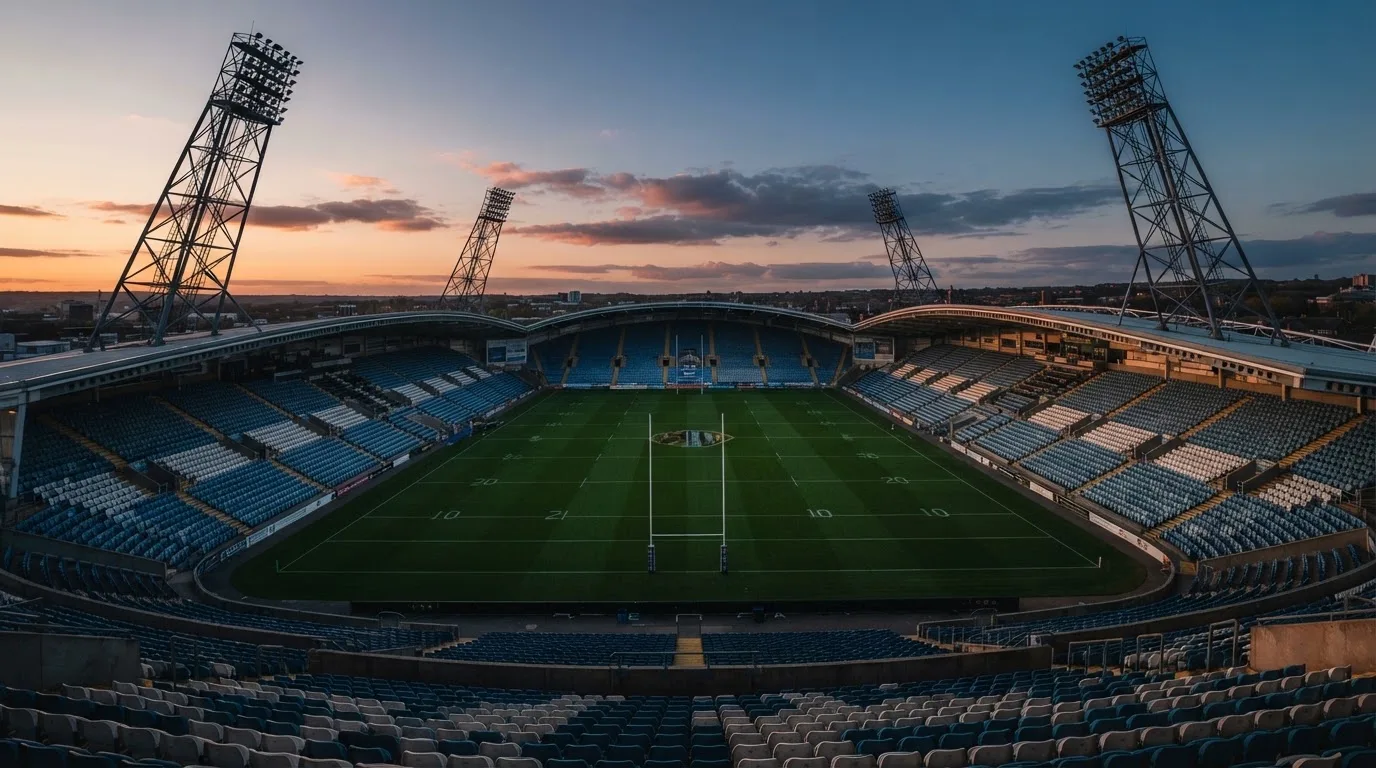
The most basic rugby league market is Match Betting: who wins, with a draw an option in some competitions. Beyond that, the standard bookmaker menu is built from a small toolkit of market types. Match Result and Match Betting are the headline; Handicap Betting attaches a head start in points to one side, the way a handicap works in any sport; Total Points sets a line, and the bettor chooses over or under; First Try Scorer and Anytime Try Scorer settle on the player who crosses the try line; Half-Time/Full-Time pairs the leader at the break with the winner at full-time; Margin betting offers bands of winning points. Each of those markets has its own margin, and one market’s margin is not another market’s margin.
Handicap deserves a paragraph of its own because it is the market the bookmaker leans on most for a sport with so few tries. A whole-number handicap of, say, +8 on Wigan means Wigan start the bet eight points ahead. A whole-number line has a quirk: if the handicap is hit exactly — Wigan win by eight — all wagers on that line are refunded. That is the standard GB bookmaker rule. The same rule gives a postponed match 48 hours from the original kick-off, after which the bet becomes void. These are the small print clauses that turn a winning bet into a refunded one, and they are worth reading before a stake is placed.
The margin, finally, is what sits inside every price on a market. A worked example with a two-way market at 1.90 / 1.90 — both outcomes priced identically — illustrates the shape. Payout share is 1 divided by the sum of 1/odds for every outcome, so 1 ÷ (1/1.90 + 1/1.90) = 0.95. The margin is 1 minus that, or 5% — the bookmaker keeps 5 pence of every pound staked across all outcomes of that market, on average. Most real rugby league markets run tighter than 1.90 / 1.90, often 1.85 / 1.85 on a heavy favourite, sometimes 1.95 / 1.95 on a balanced contest. In these real-world market conditions, the margin typically fluctuates within a 3–6% band. That is the tax the bettor pays to play, expressed in arithmetic, and it is the figure that tells two prices apart more reliably than the prices themselves.
Rugby league tournaments and where the schedule comes from
Rugby league’s competitive calendar is split between hemispheres. Super League is the main European club competition; the NRL is the Australian and New Zealand club competition; international rugby league sits under the International Rugby League governing body and runs the World Cup every few years. The English Championship and League 1 sit below Super League, the Queensland Cup and NSW Cup sit below the NRL, and the State of Origin series pits New South Wales against Queensland mid-season.

The betting calendar follows the playing one. Super League runs from February through to the Grand Final in October. The NRL runs from March to October on its own southern schedule, with Magic Round in May and a State of Origin window in June–July. The World Cup takes the sport international every four years and brings together Australia, New Zealand, England, Tonga, Samoa, Fiji, Papua New Guinea and the Pacific Island nations in a tournament that bookmakers price months in advance. Between the hemispheres, the running calendar rarely has a quiet month: the southern off-season is the European season, and vice versa.
For the bettor, that calendar matters more than the sport’s history does. A licensed GB bookmaker will carry outright markets for Super League and the NRL months before either competition starts, and the ante-post market on the Grand Final is open from the previous November. The World Cup produces its own outright market on the trophy, on group qualification, on the top try-scorer, and on the player of the tournament. Each is priced as a separate market, with its own margin, and the bettor who shops across more than one bookmaker finds a real difference between them.
Settlement rules vary by competition and by market. In the standard GB bookmaker rule, Super League and NRL Match Betting and Handicap Betting settle on 80 minutes’ play, while most other markets settle on the official result including extra time. That distinction matters when a Grand Final or a knockout tie goes to extra time: a bet on the handicap settles at 80 minutes and ignores the extra twenty; a bet on the outright winner settles on the trophy. The bettor who reads the rules before the final whistle is the one who avoids a surprise at settlement.
The ten licensed bookmakers compared
The comparison below draws on the Gambling Commission’s public register, verified against the operator’s own published terms. Every brand named here is a current holder of a remote general betting standard (real events) licence, except Smarkets, which holds a remote betting intermediary licence for its exchange. The Commission account number is the figure to quote if a check is needed; the licence holder is the corporate entity the licence is issued to; the “what the operator’s own terms state” column takes the headline terms from the operator’s own site or app.
| Brand | Gambling Commission licence | What the operator’s own terms state on the key’s subject |
|---|---|---|
| Swifty Sports | Account 58957, held by Swifty Global (UK) Ltd — remote general betting standard (real events) | Best Odds Guaranteed on racing, Cash Out, daily price boosts, in-play markets, live streaming; Bet Builder listed as coming soon |
| Ladbrokes | Account 54743, held by LC International Limited — remote general betting standard (real events) and remote betting intermediary | Long-established UK high-street brand, with a GB App Store rating of 4.66 across more than 100,000 reviews |
| Smarkets | Account 39173, held by Smarkets (Malta) Limited — remote betting intermediary | Open bank transfer deposits from £10 to £10,000 land instantly; withdrawals from £10 to £100,000 processed within 6 hours |
| Midnite | Account 101839, held by Midnite Limited — remote general betting standard (real events) | In-play markets, acca builder, popular accas and price boosts, with maximum-stake limits stated per market |
| Copybet | Account 53774, held by Copybet UK Limited — remote general betting standard (real events) | Best Odds Guaranteed all day every day on UK and Irish racing, with first past the post paid even on later disqualification |
| Betfred | Account 39544, held by Petfre (Gibraltar) Limited — remote general betting standard (real events) | 21 sports covered alongside 2,000+ casino-style games under one app |
| Fafabet | Account 57385, held by Taichi Tech Limited — remote general betting standard (real events) | Best Odds Guaranteed on UK and Irish racing from 9am on race days, paying the bigger of SP and the original price |
| Fitzwilliam Sports | Account 48760, held by SBKI Limited — remote general betting standard (real events) | Dublin bookmaker with capped membership, instant deposits, timeouts and deposit limits; “High Stakes Welcome” by compliance criteria |
| Bar One Racing | Account 56516, held by Bar-One Racing Limited — remote general betting standard (real events) | Irish independent bookmaker with shop coverage and racing sponsorships at Dundalk, Fairyhouse, Navan, The Curragh, Curraheen Park and Cork |
| BetTom | Account 64959, held by Bet Tom Limited — remote general betting standard (real events) | Sports welcome offer of 50% back as a free bet up to £50, with a matching 50% back up to £50 as free slot funds |
The licensing pattern is the headline of the table: every brand is current, every licence is a remote licence covering customers in Great Britain, and the licence holders sit in the UK, Gibraltar, or Malta while the brands themselves trade under familiar British names. The variety in the third column is the reason a bettor shops across more than one. Some lean on racing; some lean on exchanges; some carry casino alongside sport. The list is a starting position, not a ranking.
What rugby league betting is, and what it is not
For a bettor new to the sport, the working vocabulary is short. A bet on the match result is a single. A bet that combines two or more selections into one ticket is an accumulator — “acca” for short — and the odds of the legs multiply into one price. A bet on one match that combines several markets from that match is a bet builder, or same-game multi, and a typical rugby league bet builder might pair the match result with the total points line and a first try scorer.
The opposite of a bet builder is a handicap line that asks the bettor to take a points head start or deficit. A bet on a 6/4 Wigan handicap takes Wigan at a fictional head start; a bet on the opposition at the other end of the same line takes them giving those points away. The price on either side of the line tells the bettor the bookmaker’s read on the spread: a balanced handicap at 1.90 / 1.90 is a close match, a one-sided 1.45 / 2.75 is a heavy favourite. The whole-number rule — a handicap hit exactly, all bets refunded — is the small print that turns the result into a refund rather than a push, and is worth a second look.
Total points, also called over/under, is the second market the bookmaker leans on. A line of 38.5 means 39 points or more for the over to win; a line of 41.5 means 42 points or more. The half-point kills the push. The line is set by the bookmaker’s traders and shifts with team news, weather and weight of money. A bettor watching the line move in the hours before kick-off is watching the bookmaker adjust the price, and the move is a piece of information in its own right.
What rugby league betting is not, finally, is a guaranteed income. The margin sits in every price; the bettor pays it on every bet. The disciplined approach is to treat the margin as a cost of doing business, to specialise in the markets where the bettor’s knowledge is real, and to recognise that even a sharp-eyed model loses to the close-out on most weeks. The bookmaker’s edge is small but it compounds; over a year of bets, the difference between a 3% margin market and a 6% margin market is the difference between a flat bankroll and a quietly leaking one.
Regulation and legality: who may take a bet, and on what terms
The regulator is the Gambling Commission, a non-departmental public body sponsored by the Department for Culture, Media and Sport, and the law it administers is the Gambling Act 2005. The Act covers Great Britain — England, Scotland and Wales. Northern Ireland sits outside the Act and runs under its own older framework, which is why the right phrasing for a GB-licensed brand is “licensed in Great Britain” or “GB-licensed”, never that the licence covers Northern Ireland. Since the Gambling (Licensing and Advertising) Act 2014 the point of consumption rule has been the rule: an operator whose remote facilities are used in Great Britain needs a Commission licence wherever it is based. A Curaçao, Maltese or Gibraltar licence is not a substitute for the British one, even if it is held by a familiar brand.
The Commission’s public register is searchable by business name, trading name, domain or account number, and it is the whole test of who holds a licence. The licence categories relevant to sports betting are remote general betting standard (real events), remote general betting standard (virtual events), remote general betting limited, remote pool betting, and remote betting intermediary. The betting intermediary category is the licence a betting exchange runs on. Every brand in the comparison table above holds one of those categories, and the account number is the figure to quote from the register.
The minimum age is 18. Identity is verified before a customer may deposit or place a bet — name, address and date of birth — and that check has been required at every GB-licensed remote operator since 7 May 2019, including when the first bet is a free bet. There is no anonymous play at a licensed site. There is no statutory list of permitted sports or markets: the operator offers what its licence covers and what its traders are willing to price. In-play betting is offered by GB bookmakers and is governed by the operator’s licence conditions and customer-protection duties; the legal status is “allowed under licence conditions”, not “unrestricted”.
Financial spread betting is regulated by the Financial Conduct Authority rather than the Commission, which is why Spreadex, for instance, is dual-regulated. The market is its own kind of bet — one where losses can exceed the deposit — and that warning sits on the spread-betting site itself. A bettor moving from a fixed-odds sportsbook to a financial spread betting account should read that warning twice.
Offshore, the picture is the reverse. There is no GB-licensed offshore route. Providing gambling facilities in Great Britain without the Commission licence the Act requires is an offence under section 33 of the Gambling Act 2005 — aimed at the operator, not the customer. The bettor who uses an unlicensed site does not commit a criminal offence under the Act, but loses the protections the licence brings: no GAMSTOP coverage, no Commission complaints route, no approved dispute-resolution body, no British consumer redress if funds are withheld, no benefit from the bonus cap or the financial vulnerability check. The right framing is to say what the licence buys, not to say the offshore site is “illegal” in the colloquial sense.
Player protection: what the licence requires of the operator
GAMSTOP is the national multi-operator online self-exclusion scheme. It has been a mandatory licence condition for online operators since 31 March 2020, which means every GB-licensed remote bookmaker — including all ten in the comparison above — takes part. Self-exclusion periods are six months, one year, five years, or five years with auto-renewal, and after the minimum period the exclusion stays in place for a further seven years unless the customer asks GAMSTOP to remove it. GAMSTOP covers online sites and apps; the betting shops run a separate service.
The financial vulnerability check is a different instrument. Under LCCP condition 3.4.4, in force since 30 August 2024, a licensed remote betting operator must run a public-record check — for example, for bankruptcy or county court judgments — on a customer whose deposits minus withdrawals exceed £150 in a rolling 30 days. The £150 threshold has applied since 28 February 2025. The check is a public-record check, not an income check and not a credit reference check, and it is meant to catch markers of financial distress rather than to assess affordability. The Commission’s wider “financial risk assessment” regime — what the press calls affordability checks — is announced in a staged plan (Commission article of 7 July 2026) with no start date. The right phrasing is “announced, staged, no start date”; the wrong phrasing is “in force”.
Deposit limits sit in a separate policy stream. Remote Technical Standard 12 requires operators to offer a gross deposit limit on a fixed time frame. The first phase has applied since 31 October 2025 and a second phase was postponed to 30 September 2026; whether the second phase is live is not established from the regulator’s published position. The state does not set a deposit or loss ceiling for betting: limits are the customer’s choice within the operator’s product. The help services — GamCare and the National Gambling Helpline, GambleAware, the NHS gambling clinics, Gamblers Anonymous — are signposted from every licensed operator’s safer-gambling page.
A final word on the bonus terms the regulator polices. Since 19 January 2026, wagering requirements on bonuses have been capped at 10x — a £10 bonus at 50x would have required £500 of qualifying bets; under the cap, no more than £100. The same policy banned mixed-product promotions, the “bet on football to get free spins” offer that ties a sportsbook incentive to a casino product. Whether the cap applies to free bets that carry no wagering condition, and whether there is any cap on the money value of a bonus, are not established from the regulator’s published position. Operators are responsible for marketing by their affiliates, which is why the marketing rules in the CAP Code matter even when the advert sits on a third-party site.
Bonuses, free bets and what the offer actually costs
A free bet is a stake paid for by the bookmaker, with one quirk that turns the marketing word into a smaller real number than the bettor expects: the stake is usually not paid back with the win. A £10 free bet at odds of 3.00 returns £30, not £40, and the £10 stake vanishes. The expected value of a free bet depends on the odds the bettor chooses and the margin of the market the bettor chooses it on. As a worked shape, the expected value of a free bet whose stake is not returned equals the free-bet amount multiplied by (odds minus 1) divided by the odds, then multiplied by the payout share of the market. On a market with a 95% payout share and odds of 3.00, a £10 free bet has an expected value of roughly £9.50 — close to face value on a relatively even line, smaller on a market where the favourite is short. The point of the worked shape is that a free bet’s worth is the price the bettor selects, not the headline figure on the promotional email.
A matched deposit is a different kind of offer. The bookmaker matches the customer’s first deposit up to a cap, with a wagering requirement that says how many times the bonus must be turned over before it may be withdrawn. A £50 bonus with a 5x wagering requirement means £250 of qualifying bets, at the operator’s stated minimum price, before the bonus money is withdrawable. The cost of clearing the bonus is the turnover multiplied by the margin of the market the customer wagers on: at a 5% margin, £250 of qualifying bets costs the customer on average £12.50 of stake value. That is the real cost of the offer, and it is the figure the marketing page never prints.
Best Odds Guaranteed, the racing concession, is on a different footing. The bookmaker promises to pay the bigger of the original price or the starting price, on win and each-way bets on UK and Irish racing from a stated time on race day. For the rugby league bettor, the relevant point is that BOG is a racing promotion rather than a rugby league one; the same bookmaker may offer a Super League price boost on a Friday night, but the two are different products, and the cost of clearing a free bet against a BOG race is the same as the cost against any other race.
In-play and cash out: the live side of the bet
In-play betting is a separate market from the pre-match one. The bookmaker offers a price on a market at the same time the game is being played, and the price moves with the score, the time left, the field position, and the weight of money on each side. The bettor watching the price move has a different kind of information to work with: the score, the momentum, the substitution the coach has just made. The margin on an in-play market is usually wider than the margin on the pre-match equivalent — the bookmaker prices more uncertainty in — and the bettor who shops around will find one bookmaker’s in-play price on the next try scorer narrower than another’s.
Cash out is a separate product that turns an in-flight bet into a closed position. The bookmaker offers a price on the bettor’s open ticket at the moment of cash out, and the bettor takes that price in place of letting the bet run. The cash-out price is the bookmaker’s own, not the market’s, and the spread between the cash-out price and the fair price is the bookmaker’s edge on the cash-out itself. The bettor who cashes out on a winning bet before the final whistle is trading the uncertainty of the next ten minutes for a smaller guaranteed return; the bettor who cashes out on a losing bet to recover a stake is paying the bookmaker’s edge to close a position. Both are legitimate uses; neither is free.
Live streaming is the third leg of the in-play package. The bookmaker streams the event to a logged-in customer, often with a stake requirement or an active bet on the event as a condition. The stream is the channel the bettor watches; the in-play market is the channel the bettor bets through; the cash-out button is the channel the bettor closes through. The three together form a single product, and a bookmaker with a thin in-play product is one where the bettor sees the match on a separate screen and the betting slip on a phone, with the two out of sync.
Bet Builder and same-game multi are a more recent product. The bookmaker offers to combine markets from one event — match result, total points, first try scorer, half-time result — into a single bet. The price is the multiplied price of the legs with the bookmaker’s own margin layered on top; the legs are correlated, which is why the price of a same-game multi is not simply the product of the leg prices. The bettor comparing a bet builder to placing the legs as separate singles should check that comparison; the convenience of the single ticket carries a margin on top of the legs, and the difference can be 5–10% of the return.
Predictions, strategy and the limits of both
Rugby league is a low-scoring sport with a small number of tries per match, and the data behind the sport is thinner than the data behind football or horse racing. The publicly available team-level statistics — metres gained, tackle efficiency, completion rate, line-breaks — are useful inputs, but the historical samples for any one match are small and the team-level variance between rounds is high. A model built on the last five rounds of a Super League season is, in practical terms, a model built on a small sample; the bettor who trusts it implicitly is trusting a small sample.
Strategy, in the practical sense, is the discipline of where the bettor places the bet. The first discipline is to specialise. A bettor who follows Super League week to week, who watches the matches, who knows the teams and the form lines, has a real edge in the match result and handicap markets of that one competition; the edge does not transfer automatically to the NRL, the World Cup or the Championship. The second discipline is to shop. Two bookmakers with the same selection will often have different prices, and the bettor who has accounts at three or four licensed operators can find a 0.05 difference on a 1.85 price — meaningful on a single bet, more meaningful across a season. The third discipline is to record. A spreadsheet of placed bets, with stake, price, market, result and reason, is the only way to know whether the strategy is paying for the time the bettor puts in.
The honest framing of predictions is that nobody can know the outcome of a rugby league match in advance. The bookmaker’s margin sits inside every price; the bettor pays that margin on every bet; the disciplined approach is to keep the cost of the margin as small as possible by shopping for the tightest line and by specialising in markets where the bettor’s knowledge is real. The bookmaker’s job is to keep the margin; the bettor’s job is to keep the discipline. Neither job is a route to a guaranteed income, and a reader who treats either as one is the kind of reader the safer-gambling pages are written for.
The bookmakers, reviewed
Swifty Sports — racing-heavy newcomer with the Super League calendar in tow
Swifty Global (UK) Ltd holds the Commission’s remote general betting standard (real events) licence under account 58957, and the Swifty Sports app is the consumer-facing product. The brand leans on racing: Best Odds Guaranteed is in the headline offer, Cash Out is available on horse racing and football, and the price boosts run daily. Live streaming and in-play markets are part of the package; Bet Builder is listed as coming soon rather than available today. For the rugby league bettor, the relevant point is that the brand is a working bookmaker app rather than a racing-only shop, and the Super League and NRL fixtures will sit alongside the racing in the in-play tab. The Bet Builder gap is the gap a same-game-multi bettor will notice.
Ladbrokes — the long-established GB high-street name, in app form
LC International Limited holds account 54743, covering remote general betting standard (real events) and remote betting intermediary. The Ladbrokes Sports Betting App is published by Entain Operations Limited and carries a GB App Store rating of 4.66 across more than 100,000 reviews, which is a real measure of how often the app is used rather than a measure of how generous the prices are. The brand is part of the Entain group, which also runs Coral; the two are not independent operators and the price they offer on the same Super League match will typically be the same. For a bettor with a long memory of the British high street, Ladbrokes is the brand on the corner; for a bettor comparing prices, it is one bookmaker among many.
Smarkets — the betting exchange, with banking that takes the friction out
Smarkets (Malta) Limited holds account 39173 under the remote betting intermediary category, the licence category a betting exchange runs on. The exchange model is different from a fixed-odds bookmaker: customers back and lay against each other, and Smarkets takes a commission on net winnings rather than a margin baked into every price. The banking side is the headline for many users: open bank transfer deposits from £10 to £10,000 land instantly, and withdrawals from £10 to £100,000 are processed within 6 hours. UK debit card deposits are instant from £10 to £15,000. The exchange is the channel for a bettor who wants to back a result and lay the same result in a single account; for a bettor who only wants a fixed-odds price, the exchange is a different kind of bet.
Midnite — in-play and acca builder as the headline
Midnite Limited holds account 101839 under remote general betting standard (real events). The site carries in-play events, an acca builder, popular accas and price boosts with stated maximum-stake limits. The acca builder is the product a Super League bettor will use most often — combining the match result with the total points and a first try scorer from the same match — and the price boost menu runs daily. The bettor comparing Midnite to the rest of the licensed field will see the in-play product as the differentiator and the maximum-stake limit as the constraint to read before placing a bet.
Copybet — racing-led, with a “copy” angle for the more social bettor
Copybet UK Limited holds account 53774 under remote general betting standard (real events). The brand extends the racing concession: Best Odds Guaranteed all day every day on all UK and Irish racing, with first past the post paid even on a horse later disqualified. The “copy” angle is a social product that lets one bettor follow another’s tips; for a bettor who wants to pick their own bets, the headline offer is the racing concession and the rest of the book is a standard sportsbook. Super League and NRL fixtures are part of the menu; the price on a Super League match result should be compared to the price on the same match at Ladbrokes, Betfred or any of the rest.
Betfred — 21 sports and 2,000+ casino games under one app
Petfre (Gibraltar) Limited holds account 39544 under remote general betting standard (real events). The Betfred Sports, Casino & Games app is published by Done Brothers (Cash Betting) Ltd and covers 21 sports alongside more than 2,000 casino-style games. The breadth of the product is the point: a bettor who wants a Super League bet, a few hands of blackjack and a few slot spins under one login gets all three. The breadth is also a constraint: a specialist sportsbook can price tighter on a Super League match than a generalist can. The bettor comparing prices on a single match will find Betfred among the candidates rather than the cheapest.
Fafabet — Best Odds Guaranteed from 9am on race days
Taichi Tech Limited holds account 57385 under remote general betting standard (real events). The brand’s racing concession is the headline: Best Odds Guaranteed on UK and Irish horse racing win and each-way bets from 9am on race days, paying the bigger of the starting price and the original price. For the rugby league bettor, Fafabet is one of the smaller licensed brands and the price on a Super League match should be compared to the price on the same match at any of the others. The size of the brand is a constraint on the breadth of the in-play product; the licence and the racing concession are the headline.
Fitzwilliam Sports — a Dublin bookmaker with a capped membership
SBKI Limited holds account 48760 under remote general betting standard (real events). Fitzwilliam Sports describes itself as a Dublin bookmaker with capped membership, and the welcome offer is a “High Stakes Welcome” subject to compliance criteria. The “capped” framing means the operator runs a closed book; an account is not automatic, and the larger stakes are by invitation. For the rugby league bettor, the bettor who wants a high-stake Super League bet at a GB-licensed bookmaker is the customer Fitzwilliam is built for; the bettor who wants a £5 acca is the customer the bookmaker is not built for. Instant deposits, timeouts, deposit limits and the safer-gambling links — GambleAware, GamStop, Gamblers Anonymous — sit alongside the high-stakes framing.
Bar One Racing — Irish independent with shop coverage
Bar-One Racing Limited holds account 56516 under remote general betting standard (real events). The brand has rebranded to BAR 1 Betting, an Irish independent bookmaker with shops across Ireland and racing sponsorships at Dundalk, Fairyhouse, Navan, The Curragh, Curraheen Park and Cork. The racing sponsorship list is the picture: this is a bookmaker built on Irish racing, with an online product that runs alongside the shops. For the rugby league bettor, BAR 1 is a candidate on the Super League and NRL menus, and the price on any given match should be compared to the rest. The brand’s racing roots are the differentiator rather than the rugby league product.
BetTom — sports welcome with a casino tie-in
Bet Tom Limited holds account 64959 under remote general betting standard (real events). The sports welcome offer is 50% back as a free bet of up to £50, with a matching 50% back up to £50 as free slot funds for casino play. That second leg is the point: the operator’s offer is a mixed-product promotion, an offer that requires gambling on two or more product types (sports and casino) for the full headline. Under the Commission’s rules in force since 19 January 2026, mixed-product promotions are banned, which means the offer as quoted sits in a policy grey zone. The bettor reading the headline should treat the sports-only leg as the real headline: 50% back as a free bet up to £50, with the casino leg a separate decision.
Frequently asked questions
How do I bet on rugby league?
A bet on rugby league is a stake against a price offered by a licensed bookmaker. The price in decimal form is the number that multiplies the stake to give the return on a win; in fractional form, the fraction is the profit per unit stake. The standard menu is Match Result, Handicap, Total Points, First Try Scorer and Anytime Try Scorer, with Half-Time/Full-Time and Margin betting available on the bigger fixtures. Settling rules are 80 minutes’ play for Match Betting and Handicap on Super League and NRL under one GB bookmaker’s rules, with most other markets settling on the official result including extra time.
How can I check that a bookmaker holds a Gambling Commission licence?
The Gambling Commission’s public register is searchable by business name, trading name, domain or account number, and is the whole test of who holds a licence. The register lists the licence holder (the corporate entity the licence is issued to), the licence categories (remote general betting standard, remote betting intermediary, remote pool betting, and the rest), and the account number. A bettor who has a brand name should search by that name; a bettor who has a domain should search by the domain; a bettor who has the account number should search by the account number. A match in the register is the licence; a mismatch is the warning.
How is the return on a bet worked out from the stake and the odds?
Return equals stake multiplied by the decimal odds. At decimal odds of 3.00, a £10 stake returns £30. Profit is the return minus the stake — £20 in that example. For a combination bet, the odds of the legs multiply into a single price, so a double at 2.00 and 3.00 has combined odds of 6.00, and a £10 stake returns £60. The arithmetic is the same on every bet; the only variable is the price the bookmaker offers on the leg or combination the bettor selects.
What is the bookmaker’s margin and how can it be seen in the odds?
The margin is the share of every pound staked on a market that the bookmaker keeps, on average across all outcomes. For a two-way market at 1.90 / 1.90, payout share is 1 divided by (1/1.90 + 1/1.90), which works out to 0.95, so the margin is 0.05, or 5%. Tighter prices (1.95 / 1.95) give a 2.6% margin; wider prices (1.80 / 1.80) give an 11.1% margin. The margin sits inside every price on a market; the bettor’s job is to keep the margin as small as possible by specialising in markets where the bettor’s knowledge is real and by shopping across more than one bookmaker.
How do fractional odds such as 5/1 convert to decimal odds such as 6.00?
Decimal odds equal the fractional odds expressed as a decimal, plus one. So 5/1 becomes 5.0 plus 1, or 6.00; 11/4 becomes 2.75 plus 1, or 3.75; evens (1/1) becomes 1.0 plus 1, or 2.00. The decimal form is the number that multiplies the stake to give the return; the fractional form is the profit per unit stake. Both forms express the same price, and the conversion is mechanical. “Odds-on” prices — shorter than evens, like 4/5 or 1/2 — sit under 2.00 in decimal; “odds-against” prices — longer than evens, like 5/1 or 11/4 — sit over 2.00.
Rugby, cricket & Gaelic – Bookies Trust
Content created by the «Bookies Trust» team
